At MISSION, an insurance program incubator, the pricing spreadsheet was ready. The launch still had to wait. Developers needed to translate that workbook into a policy administration system, test the translation, and do it again for another platform. Rating consumed one or two months. The business wanted an entire launch in three.
That awkward interval is Coherent’s territory. The company sells a way to turn Excel calculations into services other software can call. Its wager is pleasingly unfashionable: the expert with the workbook may already have built something worth keeping.
- Keep models in Excel; publish approved logic as APIs.
- Discover spreadsheets, govern changes, and test calculations.
- Sell to enterprises where repeated implementation costs real time and money.
01 / Keep the expert. Change the handoff.
Coherent dates its founding in Hong Kong to 2018. CEO and co-founder John Brisco had worked inside large financial-services businesses, watching employees build rules and financial models in Excel. His realization concerned what happened afterward: turning that logic into operational software took too long and cost too much.
CTO Peter Roschke designed and wrote Spark’s first iteration. The practical idea was to give business teams a route from their existing models to enterprise applications, without asking developers to reproduce every formula by hand. Excel could remain the workshop. A compiled service would carry the approved calculations into the world.

The financing followed. Cathay Innovation led a $14 million Series A in November 2020, with Franklin Templeton participating. In April 2022, Coherent announced a $75 million Series B led by Maverick Capital, bringing total announced funding to $89 million. Expansion beyond insurance included banking, capital markets, and asset management.
02 / Three jobs for one workbook
Today the platform has three connected parts. Insights scans spreadsheet estates and maps their structure, dependencies, complexity, and version sprawl. Its current positioning emphasizes structural extraction before AI-assisted interpretation. Before anyone modernizes a model, somebody must know which model actually matters.
Control handles ownership and permission: version history, approval workflows, and audit records. Submit, review, and approve actions can live inside Excel. A pricing change gets a documented route to release, rather than a chain of emails whose final attachment has a suspiciously optimistic filename.
- 01InsightsFind the logic
- 02ControlApprove the version
- 03SparkPublish the service
Spark turns the approved logic into APIs. Teams identify inputs and outputs, upload the model, and configure the service. Applications then send inputs and receive calculated results. Testing, simulation, version comparison, and rollback provide the surrounding controls. A conversion demonstration is quick; connecting a service to a company’s actual systems is a separate piece of work.
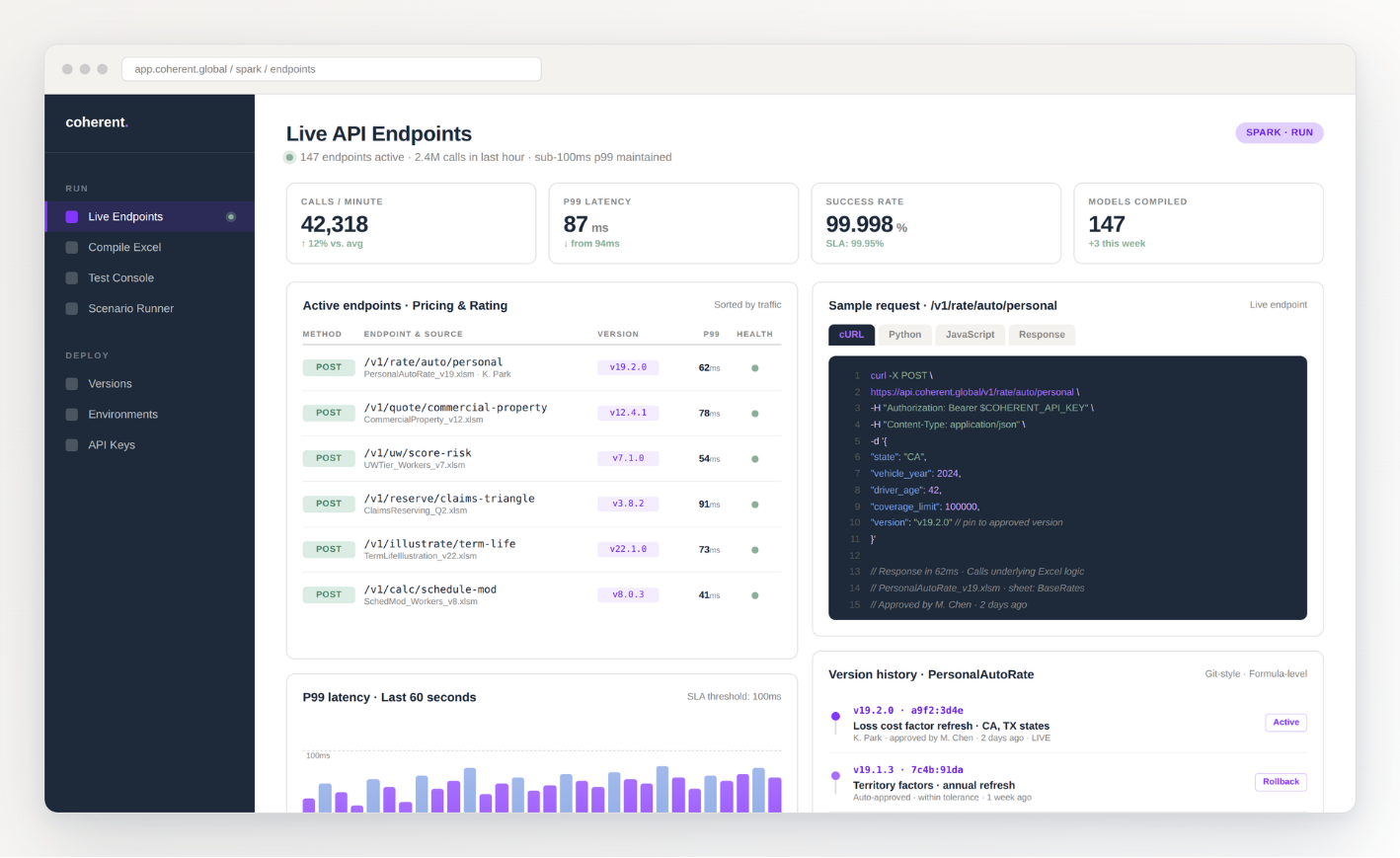
This puts Coherent between spreadsheet governance and enterprise decision software. Its distinction is preserving the workbook’s logic through deployment. A manual rewrite moves calculations into another language. A governance-only tool can inventory the risk while leaving execution elsewhere. Coherent brings both concerns into the same product family.
03 / When rating stopped holding up the launch
MISSION offers a concrete test. Its policy platforms were already API-enabled. The obstacle was repeated translation. With Coherent, program teams named the fields, uploaded their models, and exposed pricing through one governed service. According to the published case study, rating builds fell to one week.
“Now we don’t even really think about it.”Michael Waller · VP Technology Business Operations, MISSION
On rating builds, in Coherent’s customer case study
Each connected platform could call the same calculation. Updating rates became an Excel model release rather than another core-system rebuild. The case describes staff redirecting attention toward forms, workflows, and user experience. Removing one delay made the next job visible.
At East Africa’s ICEA LION, the earlier workaround included static rate tables and macro-coded spreadsheets. Simplifying models to fit system constraints introduced awkward rate bands and repeated recalculation. Quotation spreadsheets distributed to partners were difficult to update or recall.
Publishing the existing actuarial logic as services changed that arrangement. Coherent’s case study reports deployment shrinking from roughly a year to two months, with broader testing and retained evidence. Those are customer-specific accounts, rather than a timetable every buyer should assume.

04 / The price of keeping Excel
Coherent sells enterprise SaaS through negotiated contracts and partnerships. Its AWS Marketplace Spark for Insurance listing gives one unusually concrete reference: $125,000 for twelve months of non-production use. Production requires separate terms; additional infrastructure costs may apply. The number describes that listing’s scope, not a universal price card.
The buying question therefore concerns avoided work. How many models are repeatedly implemented? How often do rates change? How costly is a disagreement between channels? For a small, rarely changed spreadsheet, the commercial case looks different from an insurer maintaining dozens of products across several systems.
Customers also need functioning models and a practical integration path. Automating an unsound assumption makes it travel faster. Version control records a decision; it does not make that decision wise. Coherent’s tests help compare results, while responsibility for the model stays with the people approving it.
05 / An AI strategy still needs arithmetic
The current website says more than 150 insurers and financial institutions trust Coherent. Partnerships extend its reach: Microsoft brings marketplace and co-selling routes; INSTANDA connects rating services to policy administration. In March 2026, Indico Data announced a partnership around underwriting intake and orchestration.
Regional appointments underline the expansion. Harsil Patel became Chief Growth Officer and EMEA general manager in August 2026. Dhileep Paski, formerly Deloitte’s Hong Kong Head of AI Engineering, became Asia Pacific general manager in September. The AI proposition follows the same logic: agents need access to approved business calculations.
The useful lesson to copy is modest. Pick one important workbook, identify its owner, mark its inputs and outputs, and establish expected results before deployment. Measure the whole release cycle. MISSION’s experience suggests the revealing question: how much of that cycle is spent rebuilding something the business already understands?
Open the workbook
Explore the platform, watch the calculations travel, or follow the company’s next moves.