There is a lovely bit of mischief in Cliff Dinwiddie’s advice to executives: do not take his advice. He delivered the line during a 2022 conversation about technology and customer experience. Then he supplied the useful part. Talk to the people you serve. They will tell you where to go. It was part joke, part operating doctrine, and a neat summary of a career spent translating machinery into motives.
Dinwiddie is the Denver-based chief marketing officer of Uniti Group and Kinetic. His résumé moves through MCI, NorthPoint, Qwest, Level 3, CenturyLink, Spectrum Business and Windstream. Read chronologically, it is also a pocket history of American telecommunications: long-distance competition, mobile backhaul, Ethernet, managed services, fiber broadband, Wi-Fi 7 and now AI-assisted customer intelligence.
The equipment changes. The commercial problem is stubborn. A company knows a great deal about its product. A customer is thinking about the meeting that must not freeze, the shop that cannot lose its connection or the family member conscripted as unpaid domestic help desk. Dinwiddie’s work begins in that gap.
The useful enemy of jargon
In 2010, as a business development director at Qwest Wholesale, Dinwiddie was explaining the migration of wireless backhaul from TDM to Ethernet. Smartphone data was climbing, and carriers needed bandwidth in places where demand could surge around stadiums, hotels and other gathering points. It was a technical sale with an intensely practical plot: put capacity where people are about to need it, without rebuilding everything at once.
More than a decade later, while leading strategic marketing at Windstream Enterprise, he described the same translation from a different altitude. Connectivity was the underlying infrastructure; software above it allowed teams to see and change the network in real time. The customer did not need a lecture on the architecture. The customer needed stability, visibility and confidence.
“People are not buying your product. They’re not buying your technology. They’re buying a solution to their problem.”Cliff Dinwiddie, The Modern Revenue Executive
That sentence could be printed above most product-marketing desks, though it would ruin a profitable trade in feature grids. Dinwiddie calls the alternative “outside-in.” Start with the frustration, obstacle or desire. Research it continuously. Let sales bring back the language it hears in live conversations. Then make the positioning answer to reality.
One dashboard, fewer alibis
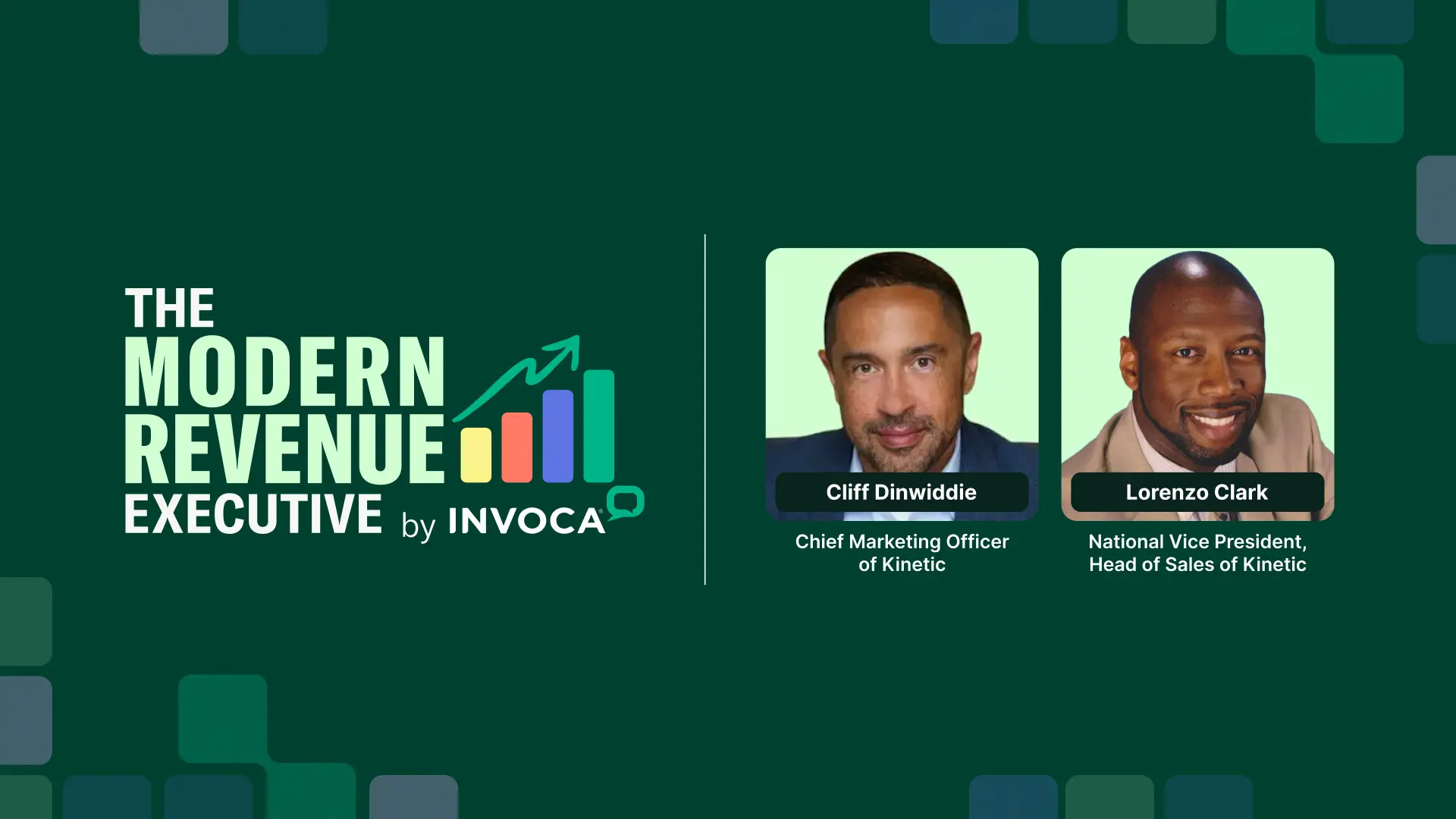
Sales and marketing have perfected a familiar office sport. Marketing sends leads. Sales questions the leads. Marketing questions the follow-up. Everyone owns a dashboard that proves someone else has disappointed them. At Kinetic, Dinwiddie and national sales leader Lorenzo Clark changed the rules by making the scoreboard common property.
The teams use daily standups to inspect sales occupancy, agent performance by tenure and channel results in one view. Marketing metrics such as click-through rate and share of voice remain interesting, Dinwiddie says, but they cannot distract from selling the service. A common dashboard does more than settle an argument. It changes what sort of argument is worth having.
Clark recalled an early meeting in which Dinwiddie interrupted the cadence of reports and updates with a sharper question: what problems were they actually trying to solve? The answer pulled the teams toward joint workshops, shared KPIs and messages built from both market research and sales conversations. Conversation intelligence then fed useful phrases and failed phrases back into the loop.
The practical loop: listen to customer language, test it in the field, inspect the shared result, and return the learning to both teams. No department gets to hoard either credit or evidence.
A leader leaves the door unlocked
Shared numbers do not create candor by themselves. They can just as easily produce a better-lit blame game. Dinwiddie’s cultural answer is to separate agreement from alignment. Colleagues can see different colors in the same decision. Once the choice is made for understood reasons, the group walks the road together.
He also makes a point of announcing when he thinks he is wrong, especially in front of people who report to him. The gesture is not ornamental humility. It lowers the cost of contribution. An idea can be evaluated without first bowing to the title attached to it.
“My agreement isn't always required for my alignment.”Cliff Dinwiddie
In a 2026 essay about vulnerability, Dinwiddie began with the certainty of his 25-year-old self and the wider uncertainty he recognizes now. That distance is the biography inside the business lesson. Thirty years of expertise have not made certainty more precious to him. They have made it easier to see where certainty gets in the way.
Public recommendations from former colleagues repeatedly describe coaching, energy and personal investment. One credits him with helping people enter unfamiliar territory with confidence. Another says his positivity is infectious. Recommendations are an imperfect literary form, usually written in the dialect of appreciation, but the pattern fits Dinwiddie’s own stated method: leaders create a safer room by making status less frightening.
The campaign was a handoff
In 2025, Kinetic accelerated an effort to move eligible households from legacy copper service to fiber. The campaign used email, text messages, direct mail, digital outreach, outbound calls and door-to-door contact. Its cleverness was not the number of channels. It was the removal of reasons to hesitate.
The offer included no-cost upgrades, guided scheduling, technician-supported installation, whole-home Wi-Fi setup and speed recommendations connected to actual household use. Marketing, operations and customer experience had to behave like one continuous promise. Customers, notoriously, do not arrange their lives by corporate org chart.
The reported outcome was 61 percent of eligible households migrated from the March starting base, including a 37 percent rate in December. The program also coincided with improved retention and fewer repeat dispatches and support calls. When the Broadband Multimedia Marketing Association recognized the playbook in 2026, Dinwiddie divided the credit across marketing, operations and customer experience. The attribution is revealing. A campaign can generate attention. Only a coordinated company can complete the handoff.
AI as an honesty test
Dinwiddie’s current preoccupation is what AI changes and, more interestingly, what it exposes. AI can produce content, personalize interactions and analyze customer conversations at enormous speed. It also makes an inside-out brand easier to detect. Customers have more information, more options and less patience for a message that begins with the vendor’s enthusiasm.
His June 2026 essay argues that the durable premium belongs to brands that feel human. At Kinetic, the local element is literal. Employees and customers encounter one another around town, at schools and in grocery stores. That closeness makes the marketing promise harder to hide from, which is healthy. The brand must survive contact with the neighbor.
One Kinetic advertisement he described avoids a recitation of network specifications. A mother is preparing for a work call while a father races around the house checking that nobody will overload the Wi-Fi. The scene is funny because it is recognizable. Fiber appears as the end of an irritation, not the beginning of a lecture.
Inside the company, his AI argument is equally human. Employees need to understand that judgment, creativity and relationships remain essential. AI supplies speed, scale and precision. People decide whether the work feels accountable and useful. The machine can expand the reach of a promise, but it cannot decide which promise deserves to exist.
The signal beneath the machinery
Dinwiddie’s story resists the tidy mythology of sudden reinvention. It is a long operator’s education conducted through changing networks and recurring customer problems. In 2010, bandwidth demand was surging around gathering places. In 2022, a customer needed real-time control and confidence in a digital platform. In 2025, sales and marketing needed one version of the truth. In 2026, AI made human discernment more valuable.
The connecting fiber is attention. Listen before advising. Put the shared outcome where everyone can see it. Allow disagreement without letting it become drift. Admit error loudly enough that a junior colleague can risk a better idea. Give the customer a solution rather than a museum tour of the product.
It also explains the aspiration visible in his recent work. Better connectivity reaches beyond faster downloads. It means moving more communities onto fiber, helping local businesses participate in the digital economy, and building a marketing organization that can use new tools without surrendering its judgment to them.
Telecom is an industry of astonishing equipment built to carry signals across distance. Dinwiddie has spent three decades attending to the less obedient signal: what people actually mean when they say they need to be connected. His operating system is not glamorous. It is useful. In business, the two are rarely acquainted for long.