A hotel room has an awkward property: tonight’s unsold inventory disappears tomorrow. You cannot put Tuesday back on the shelf. For an independent hotelier, that makes the ordinary work of reservations, prices and availability unusually consequential. Clerk Hotel Management was built around this small, relentless problem. Its own story reveals another: software can help a business keep track of its rooms without giving the software company a reliable way to grow.
- Cloud tools for independent hotels, hostels, cabins and campgrounds.
- A PMS handles the property; a channel manager coordinates online sales.
- The founder’s next experiment adds commercial analysis through AI.
A hotelier on both sides of the desk
Jorge Barahona dates his hospitality education to 1997, when he and his wife opened a boutique hotel in Viña del Mar, Chile. He also worked in digital product design. Clerk brought those experiences together: a small property’s operational frustrations, approached by someone accustomed to designing interfaces.
The historical team profile makes that combination more interesting. Barahona appears as founder and CEO, Pedro Arellano as co-founder responsible for UX, and Herbert Spencer as co-founder and design director. The same profile connects Barahona with the AyerViernes UX consultancy and Hotel Monterilla. Industry experience and interface design were present at the beginning.
That background explains the audience. Clerk speaks to independent accommodation businesses, including properties that rent cabins or camping spaces rather than conventional hotel rooms. Its public pitch emphasizes simple implementation and an approachable reception system. For an owner with a small team, the cost of complexity includes every interruption needed to explain the software.

One property, too many places to update
The product has two main jobs. Clerk PMS, its property management system, handles reservations, arrivals, departures and stays. It also records guest purchase histories and preferences, offers sales reporting, and supports seasonal rates. Staff can work with different permissions. These are modest-sounding capabilities until the person who remembers everything takes a day off.
Consider the difference between knowing that a guest stayed before and knowing what that guest preferred. A stored record gives the next receptionist something useful to act on. Seasonal pricing does a similar job for the owner’s memory: an agreed rate structure becomes something the team can use consistently. This is the practical appeal of putting information in a shared system.
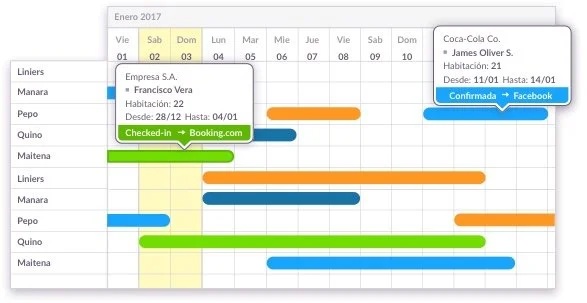
The channel manager addresses the work outside reception. A hotel may advertise through several online travel agencies, or OTAs. Clerk’s homepage names Booking.com, Expedia and Airbnb. Its channel product centralizes rates, offers and availability, advertising real-time updates intended to prevent overbooking. The attraction is fewer repeated changes across separate booking systems.
Conceptual workflow. Connection details depend on the property’s channels.
A useful way to assess that promise is to imagine the last available room. Every sales outlet needs an accurate view of it. More exposure creates more opportunities to sell, but also more places for an outdated number to survive. Clerk sells coordination alongside distribution. That is a concrete problem an owner can demonstrate during a product trial.
The price of keeping things together
Clerk’s named tariffs page advertises Steel at US$50 a month and Silver at US$80. Steel contains the PMS; Silver adds the channel manager. The published list includes housekeeping reports, customer histories, user privileges and tariffs in up to three currencies. Properties with fewer than ten rooms are invited to request a discount.
Manage the property
Add channel management
There is a wrinkle worth a buyer’s attention. A separate Clerk storefront displays US$119 for the PMS and US$149 for the channel manager. Those listings do not make a clean comparison with the named monthly plans. A purchasing decision should start with confirmed billing terms, included connections and the package offered to the particular property.
Within the wider market, Capterra lists Cloudbeds as an alternative, alongside options such as Hostaway and rezStream. Clerk’s positioning rests on the independent operator and straightforward daily use. That positioning is useful; it is not proof of superior results. A sensible comparison starts with the property’s actual work: the reservation change, the seasonal price, the returning guest.
For a property whose required booking channel cannot connect, the convenience would shrink quickly. The same applies if staff keep a second, conflicting availability record outside the system. Centralization pays off when the shared record becomes the one people actually maintain. That makes adoption a question about working habits as much as a list of features.
The product worked. The business needed work.
Barahona’s retrospective says a 2011 MVP led to a freemium offering tried by more than 100 hotels. Revenue supported infrastructure, he writes, but he did not develop the commercial capacity needed for growth. His diagnosis is unusually direct: he had designed the solution before fully designing the business.
“El producto funcionó, pero el negocio no alcanzó el desarrollo esperado.”
Jorge Barahona, reflecting on ClerkThe product worked, but the business did not develop as expected. Translation
There is a transferable lesson here for anyone building industry software. A founder’s firsthand knowledge can make the product credible. Finding buyers, converting interest into paid use and supporting those accounts remain separate jobs. A growing list of trials cannot, by itself, settle whether that commercial machinery works.
A second act, tested at reception
In 2026, Barahona says, he returned to Clerk. His proposed redesign includes an AI agent analyzing occupancy, ROI, average daily rate and revenue per available room, alongside competitive information. He describes testing with hoteliers before commercial relaunch. It is a product hypothesis under examination, rather than an established performance result.
The distinction matters. A record of what happened and advice about what to do next require different kinds of trust. Commercial recommendations depend on useful inputs and the circumstances of a property; an operator still has to judge the advice. The next test for Clerk is whether those recommendations deserve a place in the owner’s working day.
The reader can borrow that testing discipline now. Bring a real reservation workflow to the demo. Check the channels that matter. Ask how a staff member corrects a mistake. For Clerk itself, the question reaches beyond the next feature: can an improved product be matched by a business that knows how to sell it?