The customer wanted more space on her laptop. Clara Shih had come to Boston to sell software; she found herself looking at a desktop crowded with screenshots. It was 2011, and a financial firm was preserving images of its advisers’ LinkedIn profiles, over and over, to satisfy advertising rules. The computers were filling up. Somewhere between a sales meeting and a storage complaint, Hearsay found a reason to exist that its founders could scarcely have improved by brainstorming.
Shih and her colleagues went back to California and made the case to LinkedIn for a compliance API. A chore that had swallowed employees’ days became a software problem. For a young company, that was an encouraging discovery. Years later, after helping lead AI work at Salesforce and Meta, Shih would find herself considering the other end of that bargain: what happens to people when software becomes very good at their work?
By October 2026, she was running New Work Foundation, a nonprofit helping young Americans navigate an economy being changed by AI. The Hearsay co-founder had spent years helping businesses get closer to customers. Now she was thinking about the graduate who could not get close enough to an employer to begin.
The cold call, and the crowded laptop
Hearsay’s original provocation was less exotic than artificial intelligence. Shih received a cold call in 2009. The interruption suggested a question: why were salespeople still trying to manufacture trust through repeated calls when social networks were making relationships and life changes visible?
She and Steve Garrity, a fellow Stanford alumnus, founded Hearsay that year. A new job, a move, or retirement might create a sensible reason to contact someone. Shared expertise could give a potential customer a reason to listen. A salesperson could arrive with context. Anyone who has answered an unsolicited pitch while cooking dinner can appreciate the distinction.
The name contained the product idea. “Hear” meant listening for useful signals in a seller’s network. “Say” meant suggesting a timely message. Their first office was a conference room in Sequoia Capital’s basement. The address was distinguished; the arrangement was modest.
The Boston visit gave that broad ambition a particular customer. Financial firms needed to communicate online while satisfying rules about what their advisers said. Hearsay developed around that combination of engagement and supervision. The unglamorous work of keeping records helped make social selling usable in a regulated business.
Who gets access to the next opportunity?
Before the business cards
Shih was born in Hong Kong in 1982 and came to the United States at four. Her family lived in Ohio before moving to the Chicago area. She attended the Illinois Mathematics and Science Academy, then Stanford, where she studied computer science. A Marshall Scholarship took her to Oxford for a master’s in Internet studies.
Her early ambitions wandered pleasantly. At different points she pictured herself as a teacher, a grocery checkout clerk, a lawyer, and a physicist. Technology entrepreneurship entered the picture at Stanford. Looking backward through an executive biography can conceal how many other futures were once plausible.
There was already a public-service thread. As an undergraduate, she founded Camp Amelia, a nonprofit devoted to technology education. In 2004, a team prepared a pilot program in Accra, Ghana, with lessons ranging from physics demonstrations to word processing and basic programming. Before she was advising companies about the internet, she was trying to make it more accessible.
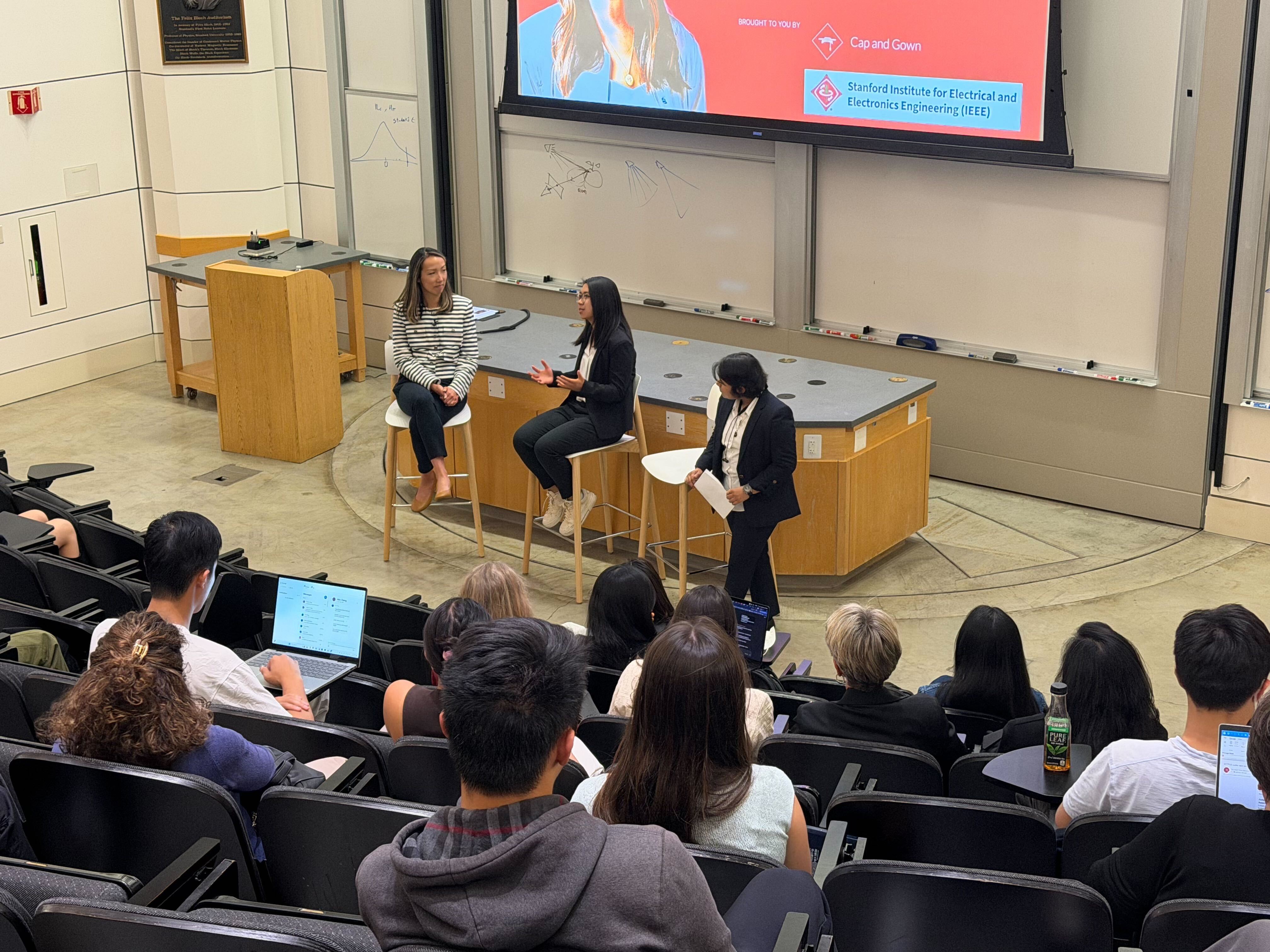
The polished career plan also met resistance. Returning to Stanford for a discussion in 2026, Shih recalled being rejected from the banking and consulting jobs she had pursued. She ended up at Google. The detour would become one of the useful parts of her story.
“I was ambitious. But I didn’t make the cut.”
Clara Shih, reflecting on early job applications, 2026
An experiment with a business address
After work at Google, Shih joined Salesforce in 2006 and worked on AppExchange, its marketplace for business applications. In 2007, she built a side project called Faceforce, later renamed Faceconnector. It brought Facebook information into the business world of Salesforce. Stanford and Starbucks would describe it as Facebook’s first business application.
The premise seems less peculiar after nearly two decades of businesses following customers onto social platforms. At the time, it required seeing a professional use for an environment associated with personal profiles and friends. Shih was interested in the relationships beneath the interface.
Her 2009 book, The Facebook Era, explained what online networks could mean for sales, marketing, recruiting, and product development. Her 2016 follow-up, The Social Business Imperative, moved further into the practical changes organizations needed to make. Publishing gave her another way to work through the problem: software could provide a tool, while a book could explain why a company should reconsider its habits.
In December 2011, at 29, she joined Starbucks’ board. She served until 2023. That placed a young software founder inside a business with physical stores, frontline employees, and everyday customers. Howard Schultz later wrote the foreword to her second book. The connection would resurface in her nonprofit work.
A founder hires her successor
In September 2020, after eleven years as Hearsay’s CEO, Shih announced that Mike Boese would take over. She became executive chairwoman. Her explanation was unusually specific about the work: a growing network of teams and offices needed someone experienced at connecting and scaling their processes.
Founding a company and running its next stage were different assignments. She had helped create the category and build the platform. Boese, the chief operating officer, had the experience she believed the next phase required. The decision put the company’s needs into a sentence that also changed her own job.
In her handover account, Shih put Hearsay’s reach at 170,000 relationship sellers across 22 countries, with $50 million raised. Those figures describe a company well past the conference-room stage. The work now included coordinating people and processes across locations, alongside the product questions that had brought the founders together.
Her announcement included a smaller appointment: room parent for her son’s kindergarten class. It is an excellent corrective to the convention that a founder’s life consists exclusively of funding rounds and airport lounges. Even a software executive can have classroom duties.
She returned to Salesforce to lead Service Cloud, then became CEO of Salesforce AI in 2023. The assignment involved making generative AI useful inside businesses that cared about customer data, accuracy, and control. A compelling demonstration had to survive the less theatrical conditions of an actual workplace.
Yext completed its acquisition of Hearsay Systems, bringing its digital engagement and compliance products into a broader digital presence business.
When the product started working
Meta announced Shih’s appointment to lead a new Business AI group in November 2024. Its audience included the businesses using Facebook, Instagram, and WhatsApp. Her work addressed a familiar imbalance: a small company could want useful AI without having a department capable of building it.
Customer-facing agents could answer questions and help with purchases. For business owners, that promised more capacity. For the people who did those tasks, the implications were harder to fit into a product launch.
At Stanford’s Marshall Forum in October 2026, Shih described noticing the consequences as Meta’s business agents gained traction. Some pilot-customer contacts told her they were losing jobs. Within her own organization, she said, entry-level hiring was increasingly deprioritized across functions. Those were her observations from building and deploying the tools, and they changed the problem she wanted to work on.
She was also hearing from young relatives asking how to get hired. A debate about productivity acquired names and faces. New Work Foundation grew out of that collision between what she could see technology doing and what people starting careers were asking her.
The scale and timing of AI’s employment effects remain contested, including among people who build it. Shih’s response has been to start a practical experiment while those arguments continue. A young person trying to enter an occupation needs something useful to do this week.
A crew for the first job
New Work Foundation launched publicly at the TIME100 Summit in April 2026. On October 1, it launched dearCC as a free career-navigation and mentorship platform. Shih leads the foundation as founder and executive director; Nick Mehta is a co-founder, and Andrew Yang is a founding advisor. She also serves on HubSpot’s board.
“The bottom rung of the career ladder is disappearing.”
Clara Shih, at dearCC’s October 2026 launch
The platform’s design makes her proposed response concrete. Field Report helps people explore occupations and labor-market changes. Game Plan examines a jobseeker’s profile and search strategy, then offers steps such as interview preparation and relevant projects. Peer groups and mentors add feedback and accountability. The Schultz Family Foundation became an anchor partner, extending a relationship with Schultz into a different kind of work.
meeting weekly+1field
mentor
A small group for a search that can otherwise feel solitary.
There is a recognizable continuity here. Camp Amelia addressed access to technology education. Hearsay addressed access to customers through trusted relationships. dearCC brings tools and relationships to the uncertain business of getting started. The audiences differ; the practical interest in helping people use a changing system has endured.
In Boston, the question arrived as a laptop without enough storage. Today it arrives as a graduate without a first job. Shih has experience with the technology on both sides of that change. Her next chapter will be judged by whether the people seeking a start can put what she builds to work.
Keep the conversation going
Writing, interviews, and places to follow Shih’s work.
New Work Foundation Her current work ↗dearCC Career tools & community ↗What No One Tells You About Entrepreneurship Stanford eCorner · Watch ↗How to Get Hired in the AI Era The Atlantic · Watch ↗The Quiet Collapse of Entry-Level Work Andrew Yang · Watch ↗Passing the Torch to Hearsay’s New CEO Shih’s own account ↗An interview on AI and the first job Platformer ↗