The modern marketing organization has a peculiar shadow. On the official chart sit the vice presidents, directors, managers and associates. Off to the side - usually in somebody’s inbox, somebody else’s spreadsheet and three unrelated payment systems - sits the group that may actually make the launch happen: the fractional strategist, the freelance creative director, the contract copywriter, the production crew hired for the season.
Lara Vandenberg knew the first half of this problem intimately. Her father ran a public-relations agency in Australia. Later, as a marketing and communications executive in New York, she became the person colleagues asked to connect with the right talent. The network worked because she remembered people. The process did not work because the entire network lived, inconveniently, inside her head.
Her first idea was to remove herself from the introduction. She tried other hiring marketplaces, studied their useful habits and irritations, and built an early version while working at the marketing-measurement company Knotch. In May 2020, after pushing back the launch more than once, she released Publicist: a vetted marketplace for freelance communications and marketing specialists.
The marketplace that outgrew its noun
Publicist arrived during the pandemic with an almost suspiciously well-timed proposition. Brands were cutting teams. Experienced marketers were going independent. Vandenberg argued that companies could buy flexible specialist support instead of defaulting to an expensive agency retainer. Clients could post a project for free, choose a professional, agree on scope and price, and complete the work through the platform. Publicist took 20 percent when money changed hands.
That solved the introduction. It did not solve Tuesday morning.
Tuesday morning was the contract waiting on Legal, the tax form waiting on the freelancer, the purchase order sitting with Finance and the hiring manager wondering whether this person could simply be rehired for the next campaign. A single contractor might require attention from marketing, HR, legal, procurement and accounts payable. Ten contractors could turn flexible work into rigid administration.
“They didn’t just need freelancers. They needed a way to run modern marketing organizations.”Lara Vandenberg, announcing the Assemble name
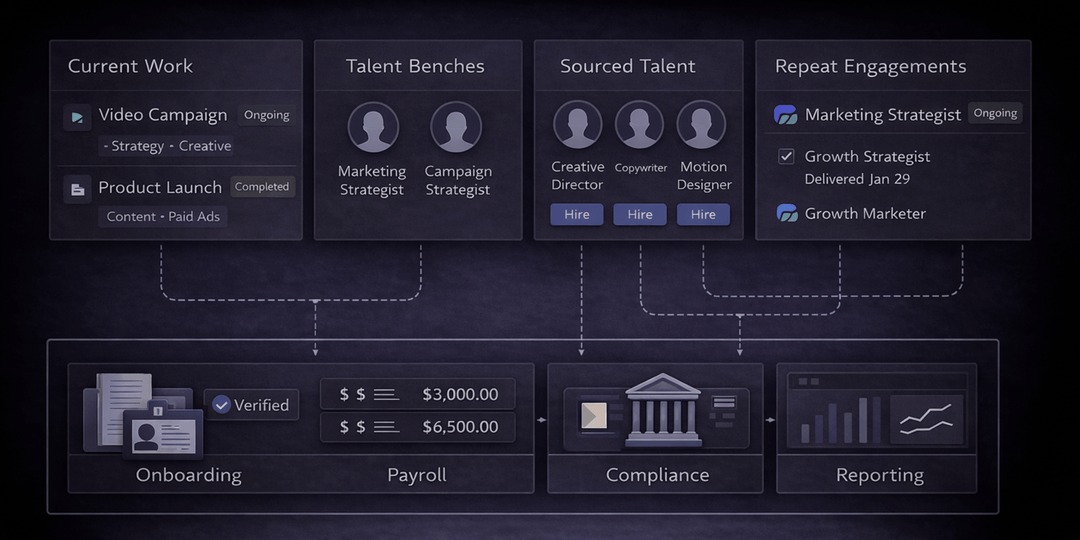
The product followed the chores. Publicist added enterprise tools. Sourcing became only the first square in a longer board: classification, onboarding, contracts, payroll, invoices, purchase-order allocation, reporting and support. Proven workers could be kept in a reusable talent bench instead of disappearing into last quarter’s email.
The revelation was repetition
The cleverest part is not the marketplace. Marketplaces are good at producing candidates. The more valuable move is turning a successful engagement into memory. Assemble calls these curated groups “talent benches.” A company can build a pool around its recurring needs, record who has already cleared the gates, and bring those people back when the calendar demands another launch, conference or content sprint.
This sounds obvious in the way useful systems often sound obvious after they exist. Companies carefully maintain lists of customers, suppliers and job applicants. Yet the freelance creative who rescued the fall campaign may be remembered only by the manager who hired her. If that manager leaves, the company forgets. Assemble’s product is partly a machine for preventing that small corporate amnesia.
By early 2026, the old name had become misleading. A publicist is a person, and Publicist sounded like a place to find one. The company had become machinery for an entire external workforce. On February 26, Vandenberg renamed it Assemble. Ownership, leadership and team stayed put. The name finally caught up with the work.
The known cost, then and now.
The original marketplace charged 20 percent on each project, with lower custom pricing for organizations hiring ten or more people. Assemble now sells an enterprise system and managed operations with rates provided through sales. Public pricing for that service is not posted.
What broke first
Publicist’s first launch was not graceful. Vandenberg has described sleepless nights, repeated delays and a product she knew was not perfect. The pandemic made the opening harder and the mission more urgent. People who had been furloughed or laid off needed work; companies needed help without adding permanent headcount.
But the more consequential failure was conceptual. “Marketplace” described the transaction and hid the operation. Enterprise customers did not merely ask for a larger pool. They asked for governance: one vendor, predictable classification, cleaner payments, visible spend and fewer fresh starts. The company changed its mind because customers kept handing it work that happened after the match.
That distinction separates Assemble from a generalist marketplace. Upwork and Fiverr maximize breadth. Curated networks such as Toptal and Braintrust emphasize talent quality. Staffing firms offer service. Freelance-management tools organize existing contractors. Assemble’s claim is narrower and more bundled: marketing expertise plus the system and human support needed to operate it.
- 01Start with the recurring capability, not a job title. Ask what work repeats every quarter, then build a bench around it.
- 02Keep the good names. Store performance notes, rates, availability and onboarding status where the organization can find them.
- 03Map the whole trip. Hiring is not finished at “yes.” Include classification, contracts, access, approvals, payment and offboarding.
- 04Count operational cost. A lower hourly rate can still be expensive when five departments rebuild the process for every engagement.
- 05Listen for adjacent chores. The task customers repeatedly perform outside the product may be more valuable than the original feature.
A system for a specific kind of mess
Assemble makes the most sense where external marketing work is frequent, specialized and distributed across budgets or business units. The buyer is not a founder who needs a logo once. It is the marketing leader who may have dozens of independent people moving through recurring programs and needs to answer basic questions quickly: Who is working? Under which agreement? Against which purchase order? At what total cost? Who should we hire again?
The model becomes less persuasive at the edges. A tiny team with one occasional contractor may not have enough administrative friction to justify another platform. A role that requires permanent institutional ownership may be better filled by an employee. Work that depends on a deeply integrated agency team may not decompose neatly into individual specialists. And a reusable bench is useful only when somebody records what happened and returns to it.
That is the small paradox at the center of the company. Independent workers promise speed because they sit outside the org chart. To use many of them well, an enterprise must build structure around the very people it hired for flexibility. Assemble is betting that structure need not become bureaucracy. It can become memory - a record of who worked, what they cost, how they entered and whether they should come back.
Vandenberg once described the original marketplace as an attempt to productize word of mouth. Assemble takes the thought one step further. Word of mouth tells you whom to call. A system remembers what happened after they answered.