Eleven days is a long time to spend getting ready for payday. In Cintra’s account of its work with Ocado, the retailer’s payroll team was caught in repeated data checks, file exchanges and manual input. One main contact had become a point of dependence. The process described covered about 1,000 employees. Cintra says its software and outsourced service helped reduce that work to a maximum of two days.
The useful number is the gap: nine days no longer swallowed by a recurring administrative job. Ocado reported £18,000 in annual savings on internal process and resource. These are results from a vendor-published customer account, with a defined payroll operation behind them. They are also a good introduction to Cintra’s business: give employers a clearer view of what they are paying, and give the people doing the work fewer things to chase.
The nine days hiding in the handoffs
Cintra sells HR and payroll software, runs outsourced payroll, and supplies software to other payroll bureaus. Its current front door is Cintra People, a platform for employee records, payroll activity and reporting. Customers can retain payroll work internally or purchase specialist help around it. The company says more than 1,500 organisations use its solutions.
At Ocado, the intervention combined a live portal, messaging inside that portal and a dedicated support relationship. The team could inspect payroll status and data without another round of spreadsheet exchanges. The lesson is fairly specific: removing repeated validation can matter as much as accelerating a calculation. A quicker calculator does little for a file sitting in somebody’s inbox.
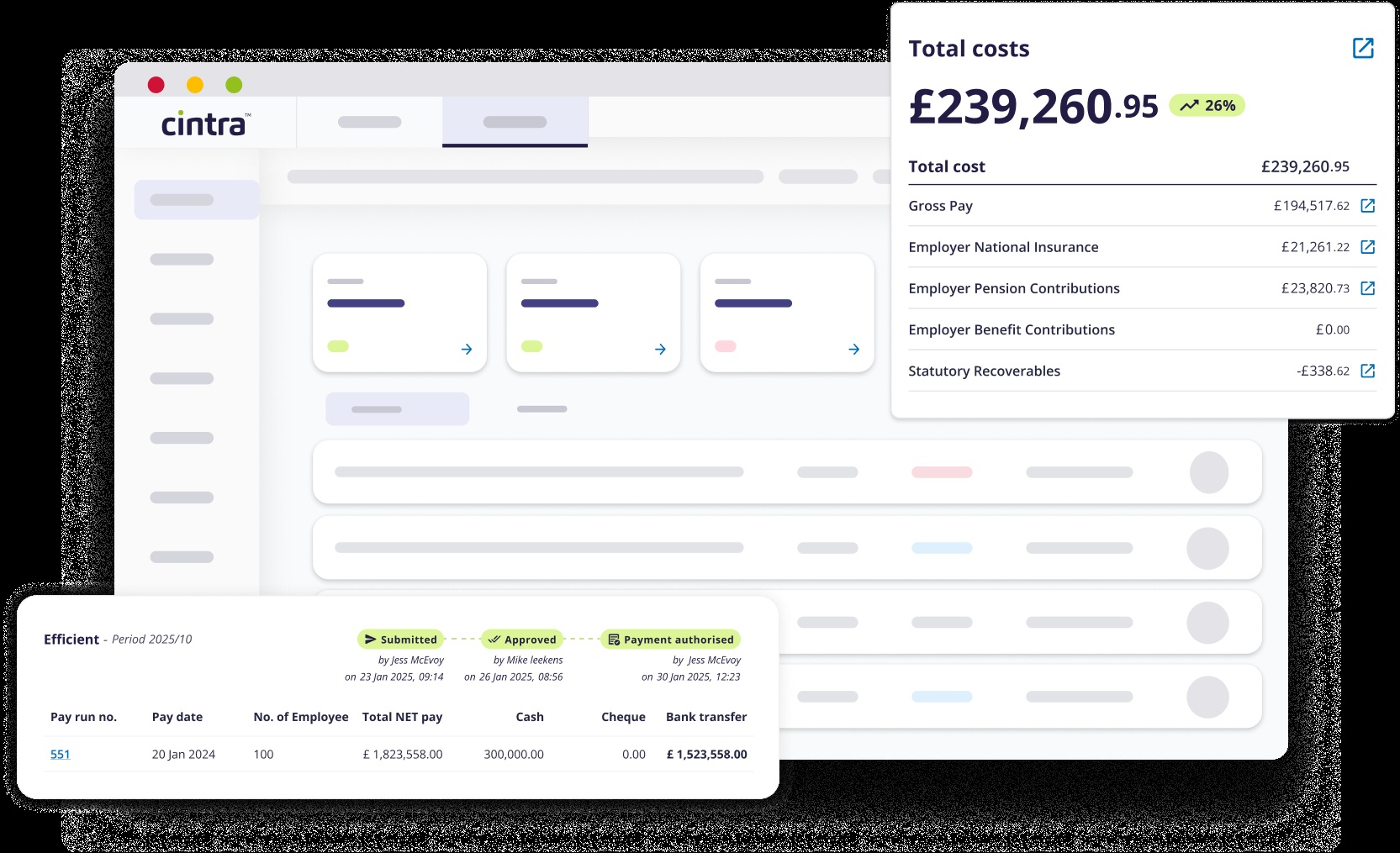
For an employer, the proposition is practical. Employee changes go into a shared workspace; the payroll team can see the consequences; approval has a visible place in the sequence. Outsourcing adds somebody to do the processing, but the buyer still needs to understand and approve the information. Cintra’s appeal rests partly on making that division of labour easier to follow.
The software maker also runs the payroll
Cintra’s own bureau is a working customer of its technology. That matters because the people encountering awkward payroll cases can feed them back to the people building the product. The company describes a continuing exchange between its developers, payroll specialists and customers. It has a commercial reason to make the software pleasant to operate: its own service team has to live in it.
The internal account is unusually candid about the original mess. Information sat across separate systems, conversations were scattered through email and other channels, and manual calculations invited mistakes. Cintra standardised client data collection, brought communication into the portal and added automatic checks and date-driven tasks. It reports a 108% increase in payroller processing capacity and a 60% reduction in errors. Those are Cintra’s internal claims, rather than a promise about another bureau’s results.
McAvoy offers a different route into the same business. The construction company’s previous payroll software had fallen behind legislative changes, according to its case study, leaving errors to untangle. Its payroll combined hourly rates, salaries, allowances, overtime and night shifts for roughly 300 people. Cintra configured the system around that complexity; McAvoy reports saving 17 hours each month on checks and administration. It also participates in a user group that feeds suggestions to engineers.
A holiday park is a payroll stress test
Brean Leisure Park makes the case for human support particularly well. At peak season, the business described in Cintra’s account has up to 370 employees, with as many as 50 people joining or leaving in a month. Hours vary and contracts differ. A neat, unchanging list of salaried employees would be easier. A holiday park does not get that luxury.
Brean arrived through a payroll company acquired by PSSG and migrated to Cintra’s outsourced service. Bulk handling of staffing changes and a dedicated contact helped it manage the variation. The case study estimates a 40% reduction in payroll processing costs, offsetting internal work, and says a four-week process became one week. Its financial controller, Michelle O’Hara, describes fewer problems and questions after payroll. The benefit reaches beyond the person operating the system.
The broader customer list explains why Cintra offers several ways to divide the work. Rigby and Peller’s case study describes a small head-office team without the required payroll expertise. Education customers face complicated pensions and employment arrangements. At organisations with multiple locations, Cintra Groups lets managers contribute payroll data for their own teams. The common difficulty is getting accurate information from the person who knows it to the person who must act on it.
The founders picked a narrow problem
Cintra began in 1981 with Hugh Keegan and John McEvoy. A company anniversary account published in 2011 records an early decision to concentrate on payroll and HR instead of continuing broader bespoke software development. It also records a relationship with its first customer, Crabtree of Gateshead, that had already lasted 30 years. Cintra still points to that first-client relationship today.
That history contains a change of heart about ownership. In a 2010 promotional feature, Cintra emphasised its determination to remain independent under the same two owners. In October 2020, it announced that it had joined the Payroll Software & Services Group, backed by private equity investor Tenzing. The announcement presented investment as a way to develop products and offer clients a broader service. Carsten Staehr moved from chief executive to chairman and shareholder.
Tenzing’s account places Cintra alongside Trace Payroll Services and UnaTerra in a group combining domestic payroll, international services and software. The investor saw room between large providers and small local businesses. Its explanation for the deal centres on additional development expertise and growth capital. Cintra’s proprietary software gave the group something to sell as a product and use in delivering a service.
That combination places it in the same broad buying conversation as ADP and Zellis, which also offer payroll technology and services. Cintra’s distinguishing pitch is the particular mix of its own product, accessible specialists and configurable workflows. Buyers should judge that mix against their actual payroll cases. A familiar company name, by itself, tells them little about who will answer a difficult question on Thursday afternoon.
A database is only as useful as its workflow
Cintra People’s pitch is that HR and payroll share a platform and database. The HR offering covers employee records, onboarding, leave, performance and engagement. Self-service lets employees handle routine information and documents. Recruitment extends through a partnership with applicant-tracking specialist Pinpoint. The commercial logic is straightforward: useful adjacent functions give an employer more reasons to keep its people data together.
There is an operational detail worth taking into a demonstration. Cintra’s payroll help documentation, updated in August 2026, assigns some advanced setup, pension configuration and statutory reporting to Cintra iQ for in-house customers. Outsourced customers pass certain changes to their bureau. Cintra People therefore needs to be assessed as part of the complete working arrangement. Ask to see a difficult pension change or an unusual payment from entry to completion.
Its import documentation is similarly revealing. Users can bring employee data in through a spreadsheet and map the fields, with checks along the way. This is a sensible acknowledgement of how payroll work arrives. Spreadsheets remain useful for collecting information; trouble begins when several versions compete to be the definitive record. A portal helps only when the organisation agrees how and when information enters it.
- 01 / EnterThe employer supplies changes.
- 02 / CheckReview calculations and variances.
- 03 / ProcessCintra validates and finalises.
- 04 / ApproveThe employer signs off payments.
Payday needs a rehearsal
Some of Cintra’s most revealing expertise sits outside the interface. A historical Pulsant case study describes a recovery arrangement with a separate workplace, a segregated network and at least two simulated activations each year. IT staff arrived first, followed by payroll colleagues. The account says the payroll team could log in and begin within an hour of the service being invoked.
“For us, every day is a deadline day.”Sheila Hughes, Cintra Head of Quality, in Pulsant’s case study
That is a concrete operational habit readers can copy: rehearse the alternative before the ordinary workplace becomes unavailable. It complements the product story about shared records and reduced dependence on one contact. More recently, Cintra won the CIPP’s 2025 Payroll Service Provider of the Year award in the category for providers processing over 75,000 payslips per month. The category matters; it identifies the scale of service being judged.
Buy back the checking time
Cintra sells through tailored quotes. Its explanation of outsourcing costs describes a generally per-payslip model, influenced by employee numbers and service requirements. A useful buying calculation therefore includes the scope of support, the internal hours still required and the work of implementation. Ocado’s reported savings concern internal process and resource. They should not be mistaken for Cintra’s fee or a universal return on investment.
The fit is strongest when a business has expensive repetition, complicated pay arrangements or a shortage of specialist capacity. It becomes less convincing if the employer leaves data ownership unresolved, expects software to repair incorrect inputs unaided, or chooses a package without testing the tasks its staff actually perform. These are practical implications of the workflow Cintra describes. The transferable idea is to count handoffs and corrections before shopping for features. For payroll teams, an uneventful payday is a useful ambition.