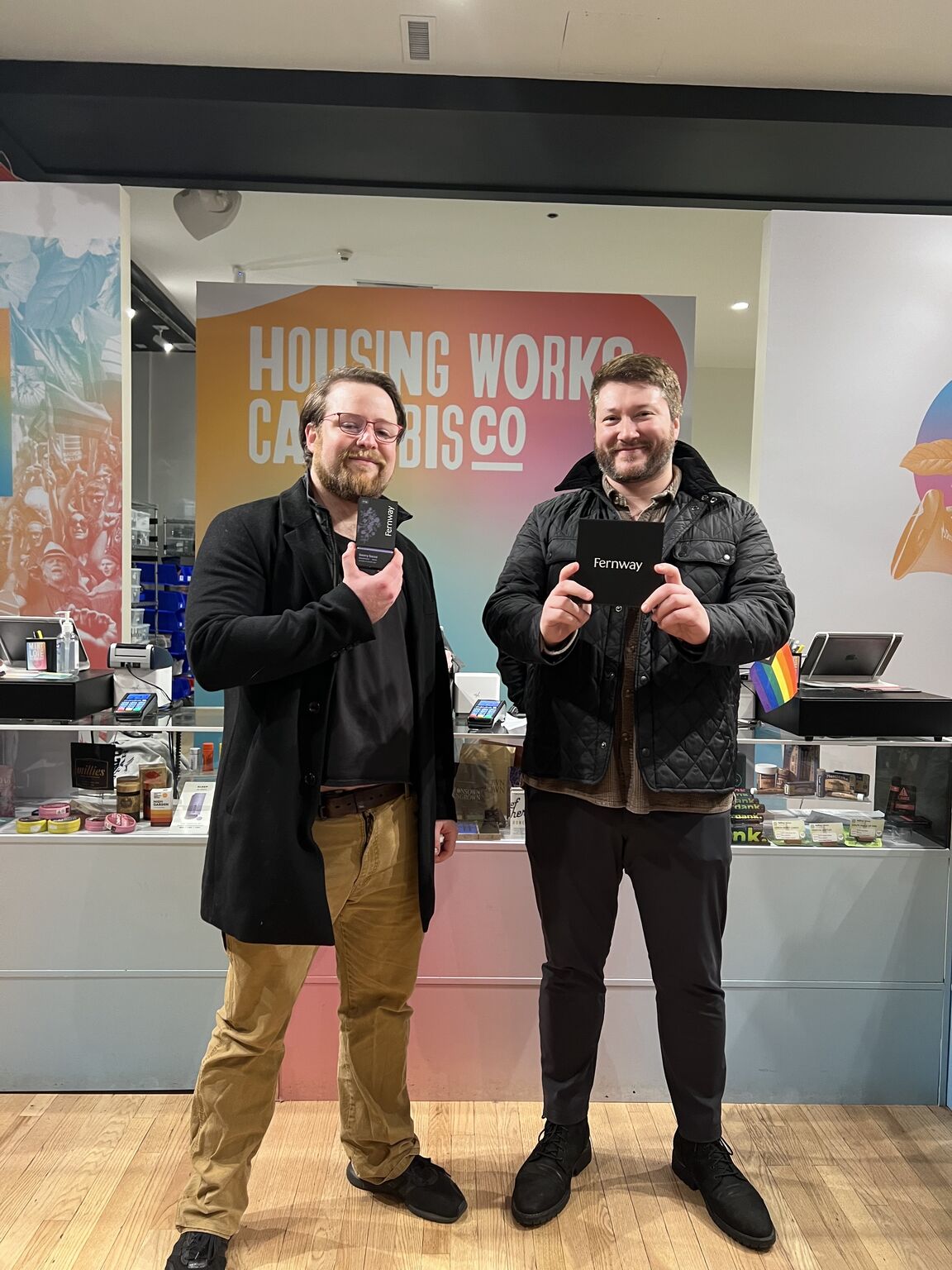
At Housing Works Cannabis Co. in New York, Christopher “Kit” Gallant finally got to do something wonderfully ordinary: buy a product from his own company. In February 2024, he marked his first New York purchase of a Fernway. For most shoppers, a trip to the counter takes minutes. His had taken more than five years.
Gallant had been living in New York when he left his job at Paul, Weiss in August 2018. Adult-use legalization in the state was still some distance away. He wanted to build a cannabis business, so he and three partners relocated to Western Massachusetts. Returning as a customer of that business made the distance measurable in a way that a map could not.
“But I knew in my heart that it could work,” he wrote, looking back on the decision. The optimism came with company. Liam O’Brien, David Van Vlierbergen and Kevin Wu had joined him in founding Fernway. He named all three in his account of the homecoming, and thanked the Massachusetts community that had given their undertaking a place to begin.
French, football and a law degree
Gallant’s earlier working life had involved a different kind of audience. From 2010 to 2012, he taught in Jackson Public Schools in Mississippi and coached boys’ varsity soccer. His subject was French. He also represented faculty on the district’s budget committee. Grammar, the touchline and public spending made for a fairly crowded professional calendar.
Community advocacy followed, at the Southern Poverty Law Center’s Youth Justice Project. He earned a history bachelor’s degree, summa cum laude, and a J.D. at New York University. By 2016, he was in the litigation department at Paul, Weiss. Two years later, the associate was ready to leave.
A career change can make the preceding jobs look like discarded drafts. Here, they are interesting on their own terms. Teaching puts a person in front of a room; coaching makes a team the unit of attention; advocacy puts institutions into view. The cannabis company would give Gallant another setting in which people, rules and coordination mattered together.
Four founders, four jobs
Fernway had four founders rather than a solitary protagonist. O’Brien later explained that he had grown up with his fellow co-founders. They were working in different industries, and each wanted to build something of his own. The company therefore began with a history between people as well as a view about a new market.
Its division of responsibilities made that partnership tangible. Gallant became CEO, Van Vlierbergen CFO, Wu COO and O’Brien CMO. In late 2020, the company still had only four full-time employees, all of them co-founders. The executive team and the entire workforce could have occupied the same small meeting.
By January 2021, Fernway’s Northampton manufacturing facility had been through a licensing inspection. There were plans to hire four more full-time employees. This was the practical scale beneath the national ambition: a production site, a handful of people and the next set of hires. Growth had to begin with a working operation.
Gallant’s later remit covered corporate strategy, sales, business development and entry into new markets. That list brings him close to several points where a consumer brand either earns trust or spends it. The retailer needs a dependable supplier. The sales team needs a product it can stand behind. A new market needs an actual beginning.
“Our brand is a promise.”
Kit Gallant, on Fernway’s brand design
A brand without its own crop
Fernway’s first commercial products arrived in Massachusetts in 2021. Its initial focus was vapes, with attention extending to the device itself. The cartridge mouthpiece, an identifying Fernway Seal and the separate Stylus battery were parts of a designed system. Hardware gave the brand a physical vocabulary before anybody read its advertising.
The July 2022 Traveler launch extended that approach to an integrated device with a rechargeable battery. Its original small and large versions held 0.3 grams and 0.7 grams. The promise of portability depended on the object being easy to carry and recognizable when taken out again. Even a pocket has its design requirements.
In March 2023, Gallant announced a move into flower and terpene-infused joints. The company chose to source flower from independent Massachusetts growers rather than cultivate it itself. “The decision not to grow our own weed was very thoughtful,” he said. He described being on the road with the team, working through a grower network to select products.
That choice placed selection at the center of the business. Fernway would be accountable for what carried its name, while growers supplied the crop. The arrangement also gave those relationships a continuing role in the finished product. A familiar package could contain work from outside the company, chosen by people inside it.
The name itself contains a small geographical joke. Fernway sounds close enough to Fenway to invite a Massachusetts assumption. Its stated inspiration is the German word fernweh, a longing for faraway places. For four founders who had moved to start the company, it was an apt word to borrow.
The numbers behind the homecoming
New Jersey came before the New York purchase. A conditional manufacturing-license approval was addressed to Gallant in September 2022; Fernway later put its New Jersey market entry in late 2023. An approval letter and a product on a shelf occupy different points in a company’s life. The interval deserves a little space in the story.
O’Brien recalled visiting the Cannabist with Gallant before that launch. They found a busy store with customers waiting on a weekday afternoon. The staff nevertheless made time to hear about Fernway. When O’Brien later announced the company’s joints arriving there, he remembered the welcome. Market expansion, in this telling, included a road trip and a generous conversation.
New York followed in February 2024. That spring brought financing too: a $6 million convertible-note round led by Delta Emerald Ventures, with Lago Innovation and existing seed investors participating. Delta Emerald had first connected with Fernway at a 2022 conference in Miami. The introduction preceded the transaction by roughly two years.
Fernway reported $7.5 million in wholesale revenue for the first quarter of 2024 and $10.2 million for the second. The latter represented 135 percent growth over the corresponding quarter a year earlier. These were dated operating results, a useful record of what happened after the New York arrival rather than a timeless description of the business.
For the third quarter, the company reported $11.1 million in wholesale revenue, up 133 percent year over year. It also estimated annualized retail gross merchandise value above $95 million. Those measures describe different things. The retail figure annualizes the estimated value of merchandise sold to consumers; it should not be mistaken for Fernway’s quarterly wholesale revenue.
In that October 2024 update, Fernway said all four founders continued to lead the business day to day. Years after the relocation, the partnership remained part of the operating account. The company also discussed a planned Connecticut entry. An announced plan belongs in the future tense until the next step actually happens.
Gallant also took the operating questions into public conversations. At a September 2023 conference, he discussed the quality-control challenges that accompany licensing a brand. In 2024, his appearance on Coffee with the Collective focused on entering new markets and engaging with the community. The topics fit the job: a familiar name has to mean something dependable when it reaches another place. For a founder whose early work included teaching, explaining how the business works had become part of the business itself.
The second life of an empty device
There is another journey in the Fernway story, shorter and less celebratory than the return to New York. It begins when a customer finishes a device. The Traveler launched with a recycling program in July 2022. In October, Fernway extended its collection program to cartridges as well.
The route ran through participating dispensaries. Customers returned used hardware to drop boxes; Fernway collected it; processing partner GAIACA broke it down into reusable bulk material. A retail relationship acquired an extra purpose after the sale. The object came back through the same sort of place where its life with a customer had begun.
O’Brien described the work behind that apparently simple route: validating the approach with regulators, finding hundreds of boxes, getting them to dispensaries and including a reminder in each Traveler package. A launch photograph would have struggled to include all of that. The details are useful precisely because a brand’s promises often depend on things that photograph badly.
Still a place for the touchline
Gallant’s connection with education and soccer also has a place outside his résumé. Elm City Internationals, the New Haven organization that combines academic support and soccer, lists him on its board of trustees. The affiliation puts those earlier interests back beside the company name, without requiring his working life to become a single uninterrupted business story.
His public reflections on Fernway repeatedly make room for other people: the three co-founders, the Massachusetts community and the team doing the daily work. The New York purchase was personal, but the account he gave of reaching it was crowded. It took a partnership to make him a customer.
That is what makes the checkout-counter milestone stick. Leaving a law firm is a dramatic opening. A financing round supplies a tidy number. Buying something at a store is almost aggressively ordinary. For Gallant, the ordinary moment was the achievement: after years of building elsewhere, he could walk into a New York shop and ask for a Fernway.