Cannabis has a portability problem. A sneaker brand can make one shoe, put it on a truck and sell it across America. A cannabis company cannot move regulated inventory that way. Every new state means licenses, local manufacturing, local testing, local distribution and another set of rules. Fernway’s answer was to make the idea portable even when the oil was not.
The Northampton company concentrates on what a brand can carry across borders: recipes, device specifications, packaging, training, retail theater and a name people remember. Licensed operators handle the state-bound plant. Dispensaries close the sale. What reaches the customer is meant to feel like the same Fernway, whether it was bought in Massachusetts, New Jersey, New York, Illinois or Missouri.
That sounds obvious only after someone has done it. In cannabis, inconsistency is structural. Inputs vary. Rules vary. Shelves are crowded. A new customer may not know a terpene from a temperature setting; an experienced one may care about nothing else. Fernway chose a narrow wedge through the confusion: vapes that taste recognizable, look considered and behave predictably.
Start with the awkward customer
Kit Gallant, David Van Vlierbergen, Liam O’Brien and Kevin Wu founded Fernway in 2018 after moving to Western Massachusetts. They were longtime friends and recreational cannabis consumers, but their timing mattered as much as their familiarity. Massachusetts had legalized adult use, vaping was growing and the legal shelf still had room for a brand built around experience rather than cultivation mythology.
Fernway did not ask every buyer to become a connoisseur. Its Flavor Collection used botanically derived terpene profiles to make choices such as Berry Haze, Mandarin Orange and Stonefruit legible before the package opened. The Strain Collection went the other direction, using cannabis-derived terpene profiles for customers who wanted a more recognizably cannabis-like taste. Later live resin and Fernway LIVE products pushed deeper into the enthusiast lane.
This is portfolio architecture disguised as a flavor menu. One lane says, “You do not need to love the taste of weed.” The other says, “We know exactly why you do.” It lets the company recruit curious adults without alienating experienced buyers. Flavor creates trial; a reliable draw has to create the repeat.
The hardware is the handshake
Fernway’s original cartridges leaned on unusually visible specifications: universal 510 threads, a borosilicate glass tank, 316 surgical-grade steel, a tamper-resistant mouthpiece and a brand seal. The Traveler packaged oil and battery together. Its successor, Traveler PRO, added USB-C charging, two ceramic coils, dual vapor chambers and a small screen showing battery and power settings.
These details matter because the customer cannot inspect the oil at the counter and may not trust a technical claim about extraction. They can understand a screen, a charging port and a device that does not clog. Fernway made an intangible promise - consistency - tactile. The industrial design is not decoration around the cannabis. It is evidence for the cannabis.
Not company revenueFernway’s estimated annualized retail gross merchandise value in Q3 2024. It measures the retail value moving through stores, while Fernway reported $11.1 million in quarterly wholesale revenue.
Wholesale revenue accelerated through 2024
Company-reported wholesale revenue. Q3 represented 133% year-over-year growth. GMV is the value at retail, not revenue kept by Fernway.The first thing to fail was convenience
All-in-one vapes solve one customer complaint and create a larger physical one. They are convenient until a battery, metal shell and residual oil become trash. Fernway knew that contradiction before launching the Traveler in 2022. According to O’Brien, customers and budtenders were already sensitive to disposable waste. The company decided recyclability had to arrive with the device.
The idea was cheap to explain and expensive to operationalize. Fernway had to validate its approach with regulators, source hundreds of collection boxes, ship them to dispensaries, print a reminder in each package, retrieve the devices and route them to certified processors. A normal trash bin was unsafe for lithium cells. A mail-back program would collide with residual regulated material. The solution had to live inside the licensed retail system.
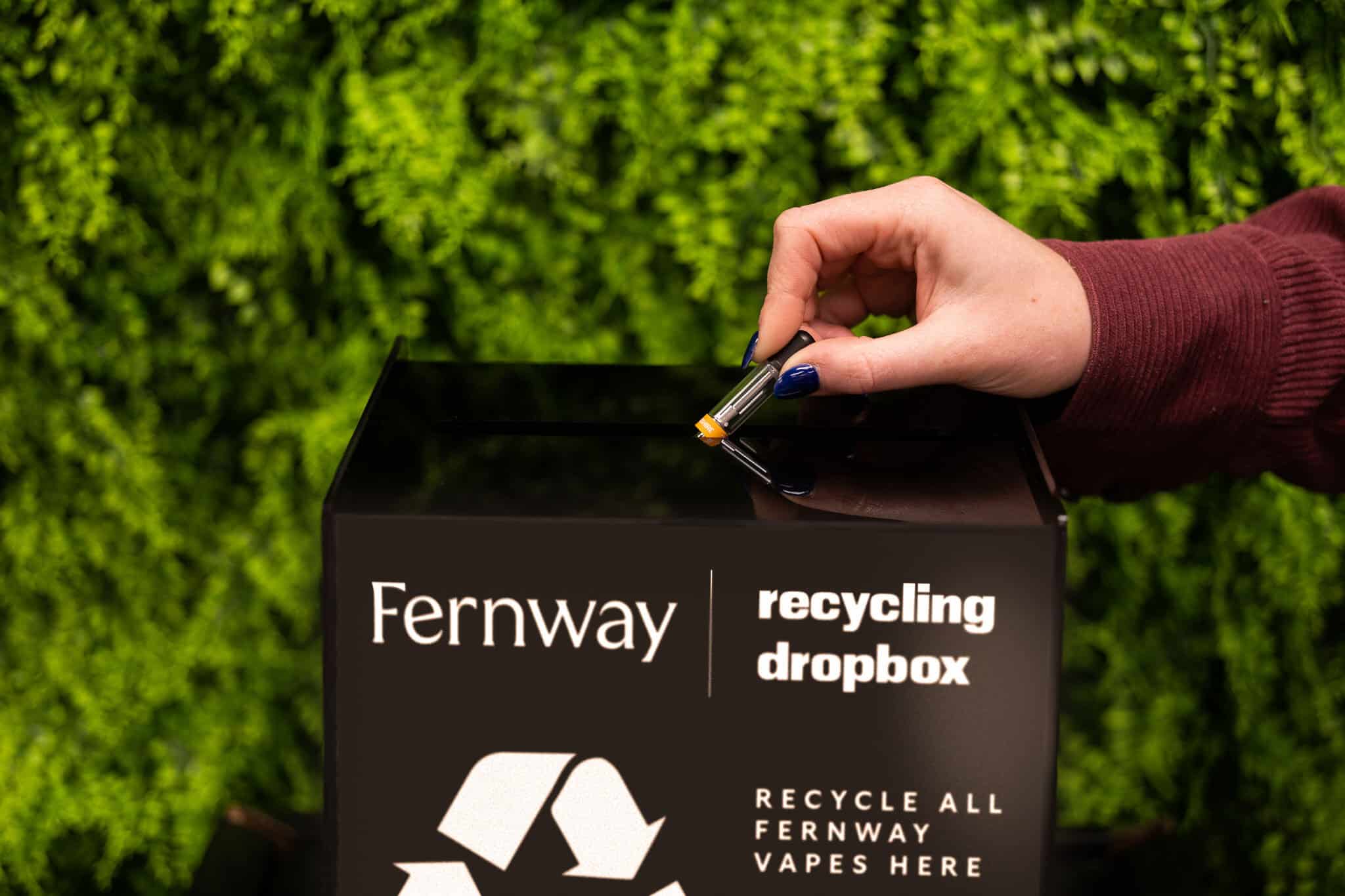
That constraint produced the strongest piece of Fernway’s playbook. Put the return point where customers already shop. The dropbox diverts hardware, gives the dispensary a service to offer and brings the customer back into the store. In some promotions, a return has also unlocked a discount. Sustainability becomes a recurring retail behavior instead of a paragraph on a package.
It is not a perfect circular economy. Collection depends on customer effort, participating stores and downstream capacity. Recycling does not erase the material footprint of manufacturing a battery. But the program changes the default from “throw it away” to “bring it back,” and Fernway says it accepts its own cartridges and all-in-one units across a growing network in its operating states.
A company that travels without its inventory
The state map explains the business. Fernway established itself in Massachusetts, entered New Jersey in late 2023 and launched in New York in February 2024 through UrbanXtracts, a licensed cultivation, manufacturing and distribution operator. In Connecticut, it signed a brand-distribution license with Rodeo. By 2026, Fernway’s own store finder also listed Illinois and Missouri.
This model is lighter than owning every cultivation facility, but it is not asset-free. Local partners must source compliant inputs, reproduce specifications and deliver on time. Fernway still needs field sales, budtender education, pop-ups, packaging and demand that earns limited shelf space. The brand may travel; quality control has to be rebuilt in every market.
Capital paid for the crossing. Commercial databases and transaction reports show an early $2.9 million round in 2020 and about $4.83 million of convertible notes in 2023. In April 2024, Delta Emerald Ventures led a $6 million convertible-note financing with Lago Innovation and existing seed investors. Two months later, Fernway secured a bank guidance line priced at the Federal Home Loan Bank of Boston rate plus six percentage points - 10.5% annualized when announced.
The cost is instructive. Regulated expansion requires working capital before a customer sees a new package. It also requires patience: a signed partnership is not a stocked shelf. Fernway’s Q3 2024 report showed the payoff, with $11.1 million in wholesale revenue and more than $95 million in estimated annualized retail GMV. Those are company-reported figures, and the distinction matters. Retail GMV includes the portion kept elsewhere in the channel.
Growth changed the question
At launch, the question was whether four friends with no legacy cultivation estate could make adults care about a new cartridge. By 2024, the question had changed: could Fernway preserve the same promise while local operators supplied the oil, filled the hardware and moved it through a different retail system? The New York partnership offered an answer. Wholesale revenue rose from $7.5 million in the first quarter to $10.2 million in the second and $11.1 million in the third as New Jersey and New York contributed to growth.
Scale also changes what can fail. A limited flavor that disappears in one state is a small annoyance. A component shortage across several markets interrupts a brand promise. A partner that misses a specification can make a familiar device feel unfamiliar. A recycling network spread over hundreds of stores is only as good as its pickups, staff instructions and downstream processors. Fernway’s visible polish sits on a decidedly unpolished stack of procurement, compliance and route planning.
That is why the founders’ continued day-to-day involvement matters. Gallant leads as CEO, Van Vlierbergen as CFO, O’Brien as CMO and Wu as COO. The arrangement maps brand, money, marketing and operations onto people who shared the original product intuition. It can speed decisions while the company is compact. It can also become a bottleneck if every state exception needs founder attention. Fernway’s next test is organizational, not aromatic: convert founder taste into systems that partners and employees can execute without dilution.
What another founder can steal
Own one frequent, frustrating use case before stretching into adjacent formats. Fernway became legible as a vape brand first.
Customers do not need a chemistry lesson. Give them two understandable doors: familiar flavor or cannabis-authentic strain.
A recycling claim is copy. A box in the store is infrastructure, proof and a reason to return.
When inventory cannot travel, make recipes, hardware standards, packaging and training portable through licensed partners.
There is also a less flattering lesson: a beautiful brand cannot repeal category economics. Fernway competes with PAX, Rove, Jetty, Select, Airo, STIIIZY and local labels for finite dispensary attention. Hardware can clog. Terpene preferences are personal. Premium positioning becomes fragile when legal-market taxes and retail markups meet a cheaper gray market.
The playbook will not work everywhere. It needs a legal adult-use market, licensed partners capable of reproducing the product, retailers willing to train staff and host collection boxes, enough density to make reverse logistics sensible, and enough margin to fund custom hardware. It also needs customers who value convenience and consistency more than flower provenance. Remove those conditions and the machine sputters.
Fernway’s achievement is not that it made vaping uncomplicated. Nothing involving batteries, psychoactive oil, five regulatory systems and reverse logistics is uncomplicated. It made the complication happen behind a small, friendly choice on a dispensary shelf. That is the business: turn an unruly system into a product that feels easy, then give the empty device a way home.