In August 2018, Christopher Gallant walked out of a formidable New York law firm and toward a 12,000-square-foot industrial building in Northampton, Massachusetts. There was no dramatic product reveal waiting inside. There was a lease to sign, a license to pursue, a facility to renovate and a market that had only just learned how to exist legally. His friends had a diagnosis for this career move: crazy. Gallant, who goes by Kit, offered a partial concession. “Maybe it WAS a little crazy,” he later wrote. “But I knew in my heart that it could work.”
The leap sounds cleaner in retrospect. At the time, Gallant was living in New York, where adult-use legalization remained far away. His plan required relocation, patient capital and three partners willing to rearrange their lives. Liam O'Brien, David Van Vlierbergen and Kevin Wu joined him. The four moved west and founded Fernway, a cannabis company with the rather old-fashioned ambition of becoming an enduring national consumer brand.
Then reality supplied its edits. Massachusetts imposed an all-out ban on vaping before Fernway had a cannabis license and long before it had sold its first vape. A global pandemic followed. Regulations changed. The young industry contracted and rearranged itself. Fernway's founding story is less useful as a tale of bold escape than as a case study in sustained adjustment. Gallant did not simply leave the law. He carried its habits into a business where every market has its own rulebook and every product detail can acquire legal weight.
The sideways résumé
Gallant's route to the factory did not begin in business school or a laboratory. It began in a classroom in Jackson, Mississippi. As a Teach For America corps member from 2010 to 2012, he taught French, coached boys' varsity soccer and served as a faculty representative on the public-school district's budget committee. The combination is almost comically comprehensive: verbs, formations and municipal arithmetic before lunch.
He next worked as a community advocate with the Southern Poverty Law Center's Youth Justice Project. After that came NYU School of Law and the litigation department at Paul, Weiss. There, Gallant represented corporate clients in disputes spanning governance, employment, insurance, product liability, contracts, bankruptcy and shareholder relations. He had already earned his undergraduate degree in history from NYU, summa cum laude.
Read as a list, the jobs are unrelated. Read as equipment, they fit. A teacher learns to explain an unfamiliar subject to a reluctant room. A coach turns individual ability into coordinated movement. An advocate meets institutions where their rules touch ordinary lives. A litigator becomes fussy about language, evidence and consequence. A founder working in state-regulated cannabis uses all four before breakfast.
The lawyer's influence appears in Fernway's first formal plan. The company defined a narrow mission: empower people to enjoy cannabis with confidence and ease. Its intended opening move was equally precise. Fernway would source oil, manufacture cartridges and sell them to Massachusetts retailers, while preserving white-label work as another revenue stream. Half of the Northampton building would initially become manufacturing space; the other half would hold offices and room to expand.
“People told me I was crazy. Crazy to leave behind a stable career for a MASSIVE professional gamble.”Kit Gallant, reflecting on the 2018 leap
A brand built as a system
Fernway's first commercial products arrived in Massachusetts in 2021. The timing had already trained the founders not to confuse a plan with a privilege. Their answer was focus: product hardware, flavor, packaging, quality control and the salesperson's relationship with the retailer. These are not glamorous categories. Together, they form the part of a consumer brand that customers feel without necessarily naming.
Gallant's job stretched across corporate strategy, sales, business development and new-market expansion. That breadth matters in cannabis. Federal prohibition prevents the tidy national supply chain available to ordinary packaged goods. Expansion is not merely sending more boxes farther away. Each state is a fresh operational puzzle involving licensing, production, distribution, testing and retailer relationships. The map is assembled like stained glass, one jurisdiction at a time.
The company eventually widened its shelf. In March 2023, Fernway moved into flower and terpene-infused joints. The interesting choice was what it declined to do. Rather than grow the flower itself, the company sourced from independent Massachusetts growers. Gallant called the decision “very thoughtful.” By avoiding a single captive crop, he argued, Fernway could select for quality across a network.
That is a founder's answer disguised as a product answer: decide which layer of the system must belong to you and which layer becomes stronger through partners. Fernway wanted control over selection, standards and the finished consumer experience. It did not require control over the soil.
The purchase that took five years
By 2023, Fernway products were on Massachusetts shelves, and its expansion into New Jersey was under way. The New York launch carried a different emotional weight. This was where Gallant had lived when he left law, the market that was not ready when the founders were. More than five years later, he walked into Housing Works Cannabis Co. and bought a Fernway product in New York for the first time.
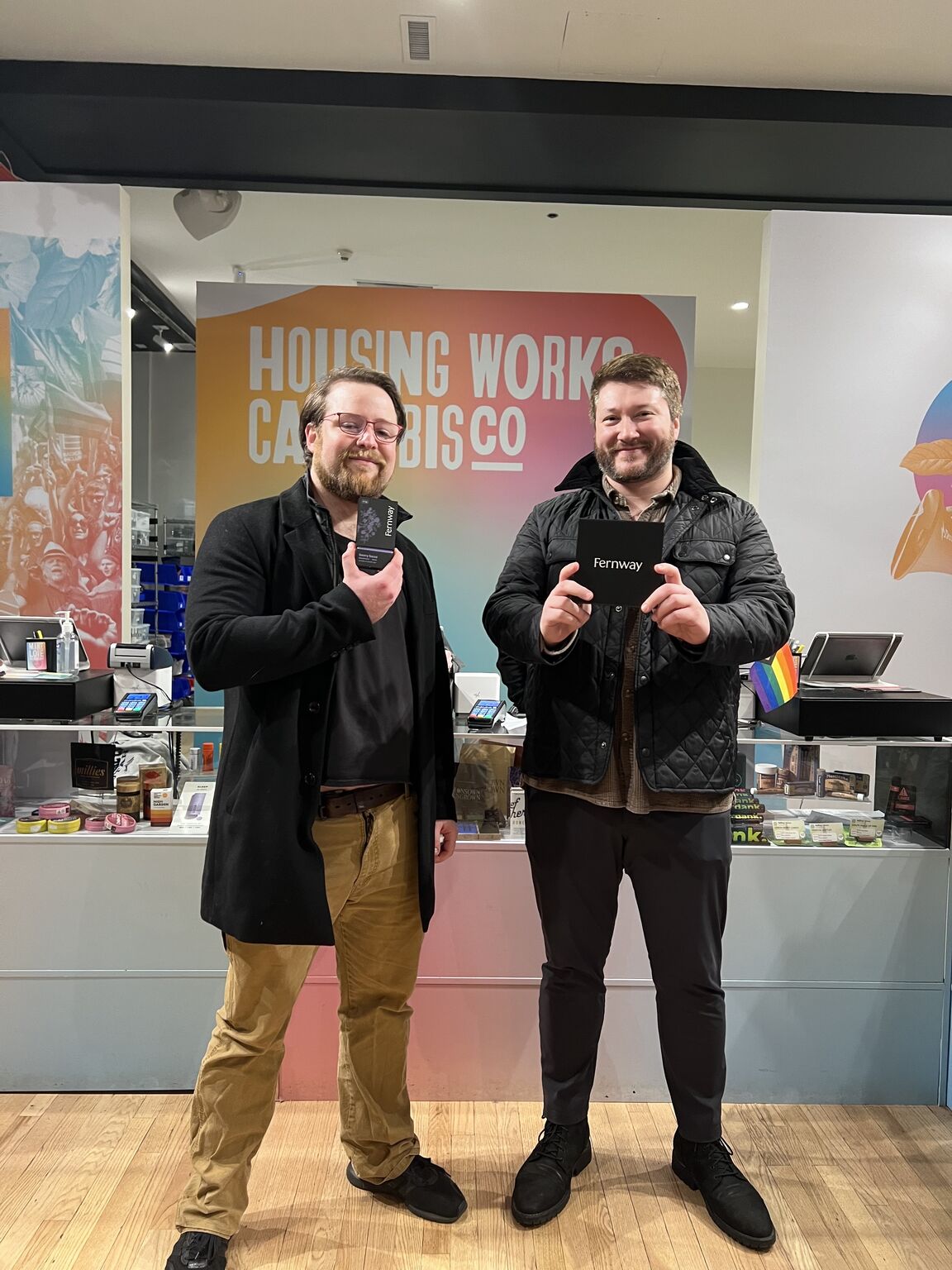
Milestones in company announcements tend to arrive as percentages. This one fit inside a shopping bag. Gallant's post about it thanked the Massachusetts cannabis community and named the obstacles without polishing them: the ban, the pandemic, the market's rapid changes. It also credited the four founders and the team. His preferred phrase for the company's ambition is “forever brand,” a slightly romantic label for a decidedly unromantic requirement: keep operating.
The operating results became more visible in 2024. Fernway reported $7.5 million in wholesale revenue for the first quarter and $10.2 million for the second. The second-quarter figure represented 135 percent year-over-year growth. A $6 million convertible-note financing closed that April, led by Delta Emerald Ventures and joined by Lago Innovation and existing seed investors. Capital did not eliminate the complexity of the market. It bought the company more room to meet it.
Even the empty device has a job
The product story did not stop when a device was empty. Fernway built a recycling program around dispensary drop boxes, giving customers a route for used vapes to enter a certified recycling process. The company now lists participating locations across its markets and accepts devices through those retail partners. Gallant framed waste as a consumer problem to solve, not an awkward detail to hide behind the word “disposable.” In a category defined by compact batteries, metals and mixed materials, the afterlife of the object belongs in the design brief.
That program illustrates the difficulty of building a premium brand in public. A handsome device can make a promise at purchase, then break it at disposal. Closing that gap requires the unphotogenic work of bins, collection and processing partners. It also requires retailers to participate and customers to remember the empty object on their next visit. The machinery behind a brand is often least elegant precisely where the values become real.
What to steal
Gallant's useful lesson is not “quit your job.” That is an action, not a strategy. The deeper lesson is to notice which skills survive a career change. Teaching, advocacy and litigation were not discarded chapters. They became a toolkit for community meetings, licenses, sales teams, investor conversations and the precise little decisions that make a product dependable.
A second lesson is to treat regulation as product terrain, not administrative weather. Fernway could not wish away state lines. It designed growth around them. The company's current public footprint includes Massachusetts, New Jersey, New York and Illinois. Each new market is both an expansion and another beginning.
The final lesson is about scale. Founders talk about national brands because ambition prefers a wide-angle lens. Customers encounter brands in close-up: one device, one flavor, one budtender's recommendation, one answer when something fails. Gallant's path from a white-shoe law office to a Northampton production floor is interesting because it passes through both views. The large idea endured by becoming a sequence of small, checkable things.
There is a neat irony here. Gallant left a profession built on precedent for an industry with very little of it. He responded by making his own precedents cautiously: one facility, one first category, one state and then the next. Crazy, perhaps. But with footnotes.