A lunch order can conceal a different business from the one on the receipt. Christopher Heffernan found his in Abington, Pennsylvania, when a Boston Market manager asked for help with larger deliveries. Food Cab, his consumer delivery service, was being squeezed by national competitors. The manager already had customers. What he needed was somebody to get their catering orders out the door.
Heffernan had started Food Cab in 2011 after noticing a Delivery Dudes sticker at a cheesesteak shop in Florida. Back home, he adapted a website intended for shoe sales to sell restaurant meals. By 2018, the useful question had changed. There was work waiting behind the ordering screen, and it came with a distinctly unglamorous requirement: lunch had to arrive.
The next city was too far away to rescue
Early on, Heffernan could become the emergency delivery driver whenever something went wrong. A driver canceled; he left the office and took the order. It was an effective response to an immediate problem and a troublesome arrangement for a founder hoping to expand. Every successful rescue kept him available for the next one.
He deliberately opened in Baltimore. From Philadelphia, he could no longer dash out to save every delivery. The distance forced him to build procedures that other people could use. Washington followed. San Francisco demanded another adjustment: online onboarding, video instruction and a knowledge check, rather than a founder traveling to introduce the app in person.
The appeal of that decision is its awkwardness. He made his business harder to supervise personally so it could become easier to operate without him. Geography supplied the discipline. There are management books about delegation; his version required another city.
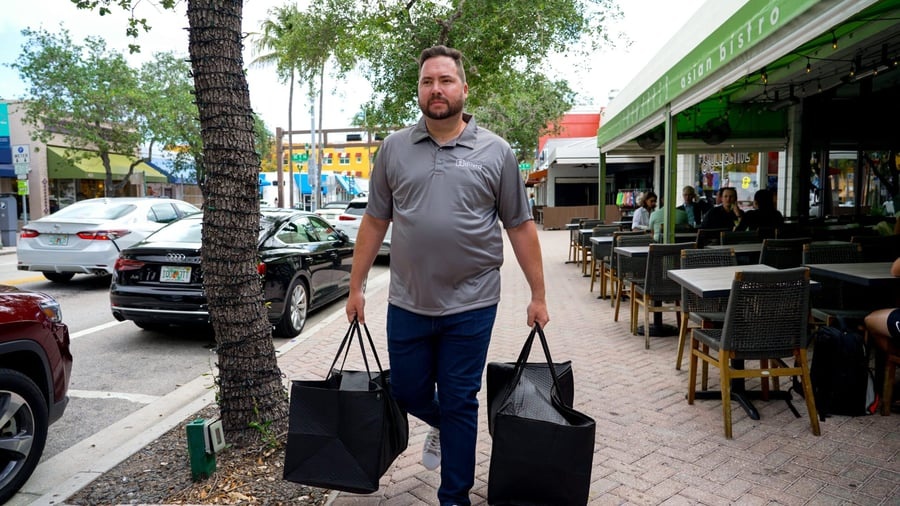
A company happy to stay off the receipt
Heffernan describes dlivrd's white-label role as working behind the scenes. A customer can order through a restaurant's own website or app and see that restaurant's branding while dlivrd supplies the delivery system. The logistics company does not need to become the name the diner remembers.
He also encourages drivers to use multiple apps. In explaining the model, he has emphasized fewer, higher-value opportunities, including corporate catering orders, rather than a constant procession of small jobs. That is a positioning choice with consequences for both sides of the transaction: the restaurant has a valuable order to protect, and the driver has a reason to take care with it.
For a founder who began by selling meals through his own site, this is a considerable change in ambition. The restaurant keeps the customer relationship. Heffernan's business works on what must happen after the sale. A successful handoff may leave no visible trace of the company that arranged it. In this trade, anonymity can be a job well done.
The driver gets a vote
In his conversations about marketing, Heffernan spends considerable time on drivers. Restaurants can sign up for a service; someone still has to accept the delivery. He has said the company intentionally spends more marketing energy getting drivers involved than getting clients to join.
Driver events become a way to meet people and a way to make material for the company's channels. He likes video, and likes the work to be fun. His comparison comes from the advertising line about happy cows making better milk. It is a cheerfully agricultural explanation for a technology business: improve the experience of the people doing the work, and customers should feel the benefit.
The proposition depends on a sequence of people doing their part. A better driver experience can improve a restaurant's delivery experience, which can encourage another order. Heffernan talks about that chain in practical terms. A pleasant ordering screen loses much of its value if the final delivery is untidy or goes to the wrong place.
“Our mission at dlivrd is to automate what you can and humanize what's important.”Chris Heffernan, 2023
Frederick has a particular job
In May 2023, dlivrd introduced Frederick, its driver-matching software. The company described a system that considers experience, certifications, equipment and vehicle type when pairing a driver with a delivery. Its stated purpose was to make the assignment appropriate to the work.
That detail gives Heffernan's automation argument some shape. Delivery is a category broad enough to include jobs with quite different requirements. A driver who can handle one order may need different equipment or experience for another. Frederick is designed around those distinctions. The useful question is whether the match makes sense for the delivery being offered.
Heffernan's separate comments about transparency put another requirement beside that one. He says he shared financial earnings information with drivers from the beginning, treating openness about an order's earning potential as a way to build trust. The assignment and the explanation belong together. People choosing work need to understand the offer.
A parking spot belongs in the product
When dlivrd launched its driver app in September 2024, Heffernan was interested in adoption. He reported that 70 percent of drivers in the initial Baltimore and Florida rollout had moved to it. The broader community was then described as 15,000 drivers in 160 markets.
The app was part of a larger effort to own the company's technology, including the customer-service dashboard. Heffernan had worked with a developer in Pakistan to assemble a team. The task went beyond giving drivers another icon on their phones; the company wanted the supporting systems under its control.
He mentioned a feature intended to help drivers find available parking. It is the sort of product detail that makes a delivery operation intelligible. An order may be ready, the destination known and the route mapped. The person carrying the bags still needs somewhere to stop. Software earns its place when it attends to that last inconvenience, too.
Getting the tools to talk
Partnerships extend that approach. In October 2024, an integration with Flex Catering connected catering management with delivery scheduling and tracking. The arrangement allowed merchants to schedule deliveries with a click, reducing the need to enter the same information manually.
In April 2025, dlivrd and FamilyMeal paired ordering tools with the delivery network and Expedite platform. Heffernan's concern was making the combination dependable for restaurants. FamilyMeal founder Peter Venti praised his mix of forward-looking ideas and practical problem solving.
These are modest-sounding connections with a recognizable purpose. A restaurant has food to prepare and customers to serve. Repeated data entry consumes somebody's time and creates another opportunity for a mistake. Connecting the tools changes the operator's day at that small, repeated point. Heffernan's business has increasingly gathered around those points.
The lunch business acquires a larger structure
In August 2025, the company announced dlivrd Technologies Inc. as its new parent and formalized Expedite as an independent brand. The plan extended beyond catering to areas such as retail, meal kits and e-commerce. The holding company would provide oversight, shared services and capital for development and acquisitions.
That structure makes the founder's current role different from the work of running Food Cab. He is overseeing a collection of capabilities that can serve other businesses. The company's history also includes the 2022 acquisition of Nimble Delivery. Expansion has involved buying as well as building.
January 2026 brought the acquisition of FULFLLD, a platform for scheduled, routed and multi-stop deliveries. The announcement said its technology operated across more than 11,000 enterprise locations. That figure describes FULFLLD's deployment footprint, rather than a count of Heffernan's employees or a new tally of delivery markets.
In April, Atlas, an AI-powered customer-support platform, joined the portfolio. Ordering, movement and support are connected parts of the same customer experience. The additions show where Heffernan's attention has gone: toward the systems around the delivery, including the conversations that happen when somebody needs assistance.
A bigger map, a familiar place
The milestones have accumulated. dlivrd announced 100 markets across the United States and Canada in March 2023, acknowledging the role of its ezCater partnership. Inc. lists the company at No. 206 on its 2024 Inc. 5000 and No. 362 in 2025. Its 2026 Northeast regional listing is No. 25.
Alongside the commercial work, Heffernan leads the Off-Premise Playbook, offering restaurant advice on menus, packaging and delivery. The dlivrd Difference nonprofit supports education and community initiatives. These projects carry his attention beyond dispatching while remaining close to the restaurants and places that helped establish the business.
His own map has expanded as well. By the time he turned 40 in 2025, he said he had visited 40 countries. Yet he still lived in Glenside, where he grew up. The business could travel much farther than its founder needed to move home.
There is something fitting about that arrangement. Heffernan learned to let an order travel beyond his ability to rescue it personally. He now builds and acquires the tools that help other people complete the journey. Lunch still has to arrive. The work behind it has grown.