Christoffer Klemming has found an unusual way to express respect for a queue: he would prefer that you go somewhere else. Keep your turn. Take your phone. Walk around. A line, in his version of events, should be perfectly capable of remembering you without requiring you to remain in it.
It is a pleasantly modest rebellion. The queue is one of those institutions that survives because everybody has something more pressing to do than redesign it. Klemming and his brother Jonas decided to make that their work. Their company, Waitwhile, grew from a side project into a platform for managing queues and appointments, then became part of the security and access company Allegion in July 2025.
The idea has stayed recognizable through those changes. People need a fair way to get served. They would also quite like their afternoon back. Klemming has spent years working on the distance between those two wishes, with a vocabulary that ranges from machine learning to the refreshingly unglamorous business of standing around.
A Swedish respect for the queue
The brothers are from Sweden, a fact they put to comic use in an early company profile. Queueing, they explained, was practically a national art. The affection came with a condition: the order should remain intact. Their objection concerned the amount of life people surrendered to preserving it.
That distinction matters. A queue is a little social agreement. Everybody ahead of you has a claim; everybody behind you expects you to behave. Removing the visible line raises an obvious question: how does anyone know where they belong? Waitwhile’s answer is to keep the sequence digitally and let people follow their progress on a phone.
Jonas became the technical co-founder and CTO; Christoffer became CEO. Their official company history dates the founding to 2017 in San Francisco. The project was already public earlier: in January 2016, Christoffer wrote about discussing Waitwhile with the Japanese startup podcast Silicon Valley Freerider. The side project had a voice before it had the founding date now attached to the business.

There is no need to dress the origin in a sudden flash of genius. Klemming’s own description is more useful. In an executive interview, he listed the sheer ordinariness of the problem among its attractions. Waiting affected many kinds of businesses, while the tools still included pagers, slips of paper and other familiar equipment.
“It’s a really boring, everyday problem and so there is still limited competition.”
Christoffer Klemming, on choosing the problem
Boring is an interesting word for a founder to volunteer. It lowers the temperature. It also directs attention towards something customers already understand. Nobody needs a demonstration of the irritation. They need a convincing alternative that works at the precise moment they are asked to wait.
From Google to the service counter
Klemming’s education included industrial engineering at KTH Royal Institute of Technology and business and economics at Stockholm University. His subsequent work at Google occupied approximately a decade and involved products including AdWords, Chromebooks, Chrome and Google Fiber. Product, marketing and growth were part of his professional vocabulary before virtual queues took over.
Those are useful qualifications for a problem that straddles two worlds. A person in a shop experiences a delay. The business sees staffing, appointments, arrivals and capacity. Software has to make those moving parts intelligible without asking either side to become an expert in operations research.
Read his writing and the repeated concern is the experience around the service itself. In a 2023 essay about queue management, he argued for giving customers alternatives to physical lines and pointed to the burden frustrated visitors place on frontline workers. The same wait is experienced from both sides of the counter.
His 2022 writing made the case for virtual queues through convenience, updates and estimates. The practical attraction is easy to picture: a customer knows more about what will happen next and has more choice about where to spend the interval. A business has a way to communicate before the customer reaches a staff member.
The connection to his earlier career is visible in the work, although he does not need an elaborate theory to explain it. A product has to be understandable. A guest needs a clear next step. A member of staff needs to use the system while doing the rest of the job. The interface enters a busy room and must earn its space.
The years before the cheque
Before outside investment, Christoffer and Jonas funded the business themselves. Kristin Baker Spohn, the CRV investor who later joined the board, described being drawn to the product’s simplicity, its range of applications and the broader possibilities of managing customer flow. The brothers had built something businesses were already using.
In February 2021, Waitwhile announced a $12 million Series A led by CRV. Klemming described a company that had been profitable since launch and said the money would support engineering, international expansion and the demands of enterprise customers. The investment followed an operating business, with the everyday obligations that come with one.
There was already a larger product idea inside the virtual line. Klemming wanted appointments and walk-ins to work together. Someone choosing the next available slot and someone booking a particular time were both making a request for service. Handling them together could give a business a more coherent view of the people it needed to serve.
That is where the simple premise becomes demanding work. A message saying your turn is near is only useful if the operation behind it can keep up. Customer information, available resources and expected waits have to agree often enough for people to trust the result. The founder’s cheerful invitation to wander off carries a substantial administrative obligation.
The details between arrival and service
Klemming’s product updates offer a less ceremonial view of his work. In February 2025, he wrote about mobile apps, adding bookings to Apple Wallet and scheduling improvements. These are changes that meet a customer or employee in the middle of a task, when a missing detail can become a fresh delay.
In March, the subject included copying settings across locations and configuring services and resources at scale. A useful feature for one shop becomes another kind of problem when an organization has many locations. Somebody has to repeat the setup, keep it consistent and change it without losing the afternoon to administration.
May brought flexible booking start times and drag-and-drop handling of waitlists. The topics sound small because they are close to the work. A booking that can begin at the right interval, or a list that can be rearranged more easily, matters to the person trying to keep a day moving. His public record contains plenty of those particulars.
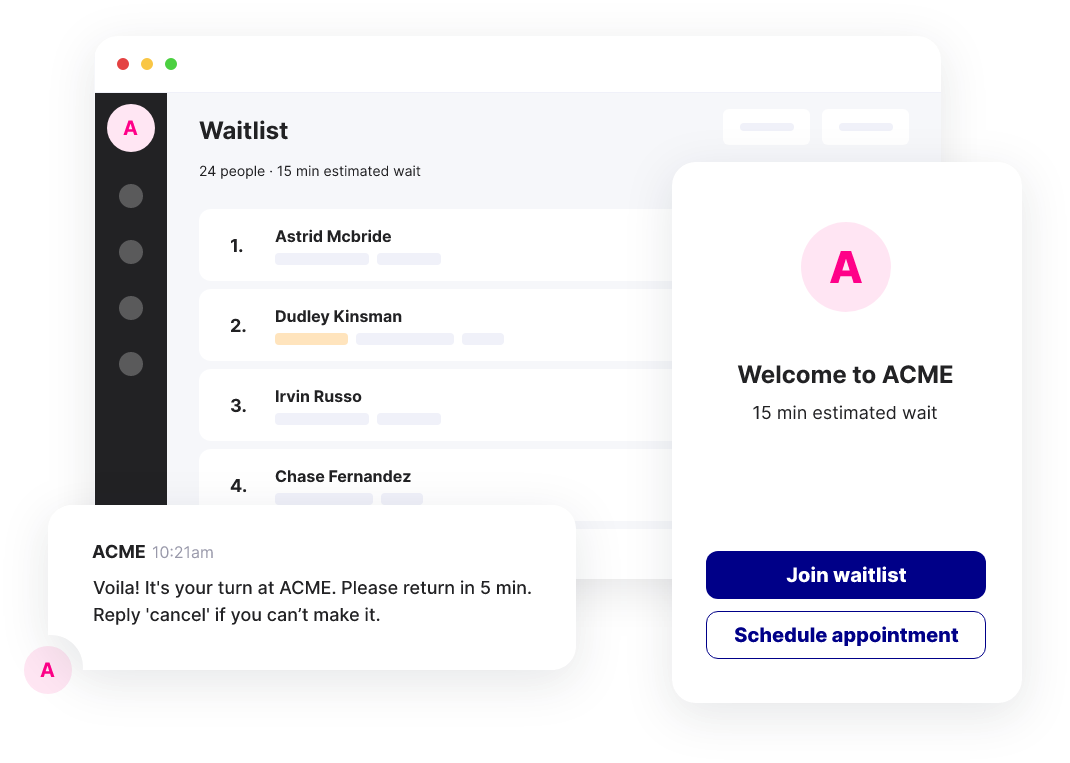
- 01JoinGet a digital place in the queue.
- 02GoFollow your progress while elsewhere.
- 03ReturnReceive a notification when it is time.
An illustration of the virtual-queue experience, not a promise of instant service.
He also writes about the less measurable part of waiting. His February 2025 essay on customer experience begins with emotion: how a wait feels affects how the encounter is remembered. For a business, the greeting at the counter arrives after the customer has already had an experience of the place.
Klemming’s humor tends to acknowledge the oddness of his chosen subject. Sharing a CNBC appearance, he joked about his enthusiasm for queues. His X biography has described him as a tech nerd and an aspiring musician. Elsewhere, when sharing a short Waitwhile explainer, he invited feedback on how to tell the story better next time.
A 2025 team gathering in Spain supplies another glimpse. He described time spent discussing plans and the company they were building, alongside mountain climbing, padel and sangria. For a team that rarely met all together, being in the same place mattered. A company organized around waiting remotely still found a reason to bring everybody into one room.
A queue meets a door
On July 8, 2025, Allegion announced its acquisition of Waitwhile. Klemming would continue leading the business. The pairing brought a queue-management company into a group whose work includes security and physical access. The digital place in line had acquired a connection to the door.
At the time, Klemming reported that Waitwhile had powered more than 300 million visits across over 50,000 locations. Those are the company’s figures, attached to that moment in its history. They describe the distance the brothers’ project had travelled, rather than the size of any one person’s queue.
His announcement to customers emphasized continuity: Waitwhile would retain its brand, product and team. The planned work included more integrations, AI-powered scheduling and ways to connect digital service flows with physical spaces. A person making a booking, arriving, checking in and getting served experiences one visit, however many systems sit behind it.
By April 2026, the company was describing further work on App Clips and reporting. Its product and customer-success leaders discussed reducing check-in effort and giving managers clearer views of bookings and future capacity. The recurring concerns were familiar: fewer steps for the visitor, better information for the people running the service.
There is a pleasing limit to Klemming’s ambition. Software cannot make every service instantaneous. The useful question is how much of the surrounding inconvenience people actually need to endure. He and Jonas built a business by treating that question as worth answering carefully. Your turn can remain yours while you do something else. Even a queue should be able to manage that courtesy.