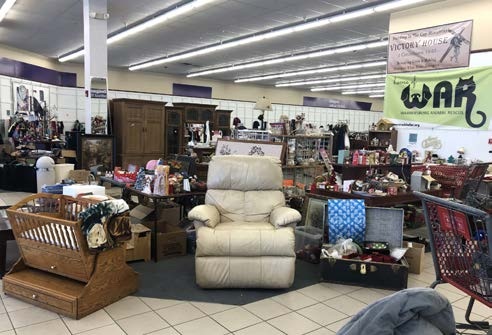
The white recliner sits in the middle of the floor like a minor monarch. Around it: a wooden crib, framed pictures, lamps, clothes, baskets, small appliances and the accumulated evidence of lives that had too much stuff. Above the disorder hangs a green Warrensburg Animal Rescue banner. This was not a boutique, and nobody had mistaken it for one. It was a former department store in Warrensburg, Missouri, filled with donated things and a proposition: what if the town’s castoffs could become working capital for the town’s ambitions?
Christina Burke helped give that proposition a system. In 2021, the co-owner of Axion Internet Services was one of the organizers behind a charity garage sale whose floor stretched across 22,000 square feet. Most objects cost roughly a dollar. Adult coats went for a dollar; children’s clothes could be fifty cents. The building was donated, Axion paid the utilities and volunteers kept adding merchandise. The proceeds were divided between Warrensburg Animal Rescue and Standing in the Gap Ministries.
There is a dry way to describe this: a business supported a fundraising event. It misses the clever part. The low prices meant people could buy things they actually needed. The purchase also financed an animal shelter or a community program. The same dollar could serve a shopper and a charity before it had finished its day’s work.
A fundraiser with a checkout line
Burke’s public résumé is an unusual pairing. One half belongs to a regional technology business. Axion, based in Warrensburg, supplies IT support, internet service, application development, cloud work and other technical services. Public business records identify Burke as its chief compliance officer; local reporting identifies her as a co-owner. The other half of the résumé is written in board meetings, volunteer rosters and crowded sale aisles.
She has put the connection plainly: Fundraising is my hobby; it’s my passion.
That line sounds breezy until one considers what the hobby required. Donations had to be collected, moved, sorted, priced and displayed. A cavernous retail floor had to be made navigable. Volunteers had to arrive. Beneficiary groups had to agree on how money would be divided. Shoppers had to know when the doors opened. The fun depended on a great deal of unphotogenic competence.
In April 2021, organizers set a $50,000 goal, already more than triple the event’s previous high of $16,000. By November, the annual target had become $80,000. Before the final sale, they were only $7,000 short. Burke’s verdict was both candid and cheerful: We thought we were crazy but we’re almost there.
The arithmetic is striking because the unit economics were so small. A room of quarter and dollar items added up to tens of thousands. Burke called that fact kind of mind-blowing honestly.
It is also a lesson in volume, trust and the social life of objects. A coat does not need to command a large margin when the building is full, the inventory is donated and the purpose is circulation rather than profit.
Borrowed passion, practical help
Burke’s route into local causes often begins with another person’s enthusiasm. She has described meeting someone inside an organization, seeing the force of that person’s commitment and deciding she should help raise the money that would let the work continue. It is a revealing instinct. Some civic leaders collect causes; Burke seems to collect the connections that causes need.
Warrensburg Animal Rescue was one such connection. The organization formed in 2020 as the local animal shelter faced a funding crisis. Burke joined near the beginning. She planned events, made her business available for board meetings and served in several roles - community coordinator, fundraising coordinator and, later, vice president. Shelter director Kayla Frank noted at the time that Burke did the work as a volunteer, without compensation.
Those contributions were not abstract advocacy. They were rooms, calendars, sale tables and the steady translation of sympathy into receipts. Burke also worked with Change for Change in Centerview, which used in-person and online garage sales to direct proceeds to Johnson County charities. The recurring idea was simple enough to fit on a price tag: help local groups raise money while making useful things affordable to local people.
“Fundraising is my hobby; it’s my passion.”Christina Burke, 2021
That model resists the tidy categories often assigned to charity. Who is helping whom when a parent buys children’s clothes for fifty cents and the money helps fund an animal shelter? The buyer receives value. The shelter receives cash. The donor clears space. The volunteer turns disorder into inventory. Axion contributes the overhead and gains no need to pretend that a branded banner is the same thing as participation. Everybody occupies more than one role.
The small-town value loop
The useful middle
Profiles of founders and executives usually hurry toward scale. Burke’s story asks for a different measure. Axion describes a service radius centered on Warrensburg. Her charitable record is similarly local: Johnson County, its shelters, its neighbors and its volunteer networks. The boundaries are not an apology. They are what make the work legible. She can see the people whose goals need backing, the building that might hold the sale and the shoppers who need a winter coat.
That closeness changes the texture of accountability. A national campaign can report a conversion rate and move on. A local sale has to face the same shopper next month, the same volunteer at the next meeting and the same charity when the utility bill arrives. Success is visible in a prosaic register: whether the racks are stocked, whether a family can afford what it finds and whether the promised money reaches the intended program. The model runs less on novelty than on reputation.
Her work also complicates the supplied title of founder. Public material is more precise in other ways: co-owner, compliance officer, organizer, vice president, community-engagement coordinator. These are roles in the useful middle, where rules meet people and enthusiasm meets execution. Compliance and fundraising sound like opposite temperaments, but both depend on making sure the pieces arrive in the right order.
The pattern has continued beyond that busy 2021 sale floor. Warrensburg Cat Advocates now lists Burke as its community engagement coordinator and as an advisory board member helping with fundraising, marketing and systems. The organization uses a foster-based model and trap-neuter-return work rather than operating a traditional shelter. Once again, her stated responsibilities sit at the junction between a mission and the machinery required to carry it.
In August 2025, she was also listed as a co-organizer of a Warrensburg fundraiser intended to establish The Anchoring, a proposed nonprofit centered on a self-sustaining homestead model. The project was someone else’s vision. Burke’s presence beside it followed the same old logic: locate a worthwhile ambition, then help it acquire the resources to become less hypothetical.
No trophy shelf required
Burke was 39 when the Warrensburg Star-Journal selected her for its 2021 “20 Under 40” group. The accompanying profile mentioned that she was a mother of four and chronicled the many hours spent volunteering. Yet Burke was careful about the implied bargain between service and recognition. She said she did not do the work for awards and was content not to have received one recently.
That attitude can sound suspiciously polished in a profile, except that the details support it. Her most visible achievement was a room full of other people’s unwanted possessions. Her preferred instrument was not a gala but a garage sale. The prices were intentionally unimpressive. Even the central insight belongs less to personal branding than to plumbing: cover the expenses, keep the goods affordable and send the proceeds where they can be used.
There is humor in choosing this as one’s hobby. Fundraising usually means asking acquaintances for money or standing beneath fluorescent lights while everyone else has gone home. Burke’s version included both fluorescent lights and an armchair presiding over a small republic of bric-a-brac. Yet she described the sale as fun. Shoppers returned on successive days because volunteers kept refreshing the floor. The event became somewhere to go, not merely something virtuous to endure.
The recliner in the middle of the floor eventually went somewhere. So did the crib, the coats and the small avalanche of knickknacks. Their destinations are not recorded. That is fitting. Burke’s model did not require any single object to be memorable. It required thousands of ordinary objects to move, and enough people to believe that moving them together could make something else possible.
In the grand literature of enterprise, the dollar bin rarely gets a chapter. It should. It is where Christina Burke found a compact version of the community she wanted: useful, affordable, a little unruly and capable of adding up to far more than its price tags promised.