From his office, Jacob Slayton can see the hospital where he was born. It is an efficient little joke about ambition: after college in Arizona, a banking career and the top job at a regional nonprofit, he can point through the glass and measure his progress in blocks. The geography is compact. The work is not.
Slayton, known as Jake, runs Goodwill Industries of South Central California, a network whose familiar blue signs conceal a rather improbable machine. One side receives the objects people no longer want. Another sorts, prices and moves them through stores. The proceeds support jobs for people whom the ordinary labor market too readily overlooks. In 2026, the operation was heading toward 12 stores and employed more than 300 people. About 70 percent of the workforce, Slayton has said, faces a disability or social disadvantage.
The newest Bakersfield location makes the machinery visible by sheer scale. It fills 17,000 square feet of a former Rite Aid at Rosedale Highway and Allen Road, replacing a shop of roughly 5,000 square feet nearby. Donations that once had to wait outside can now be processed indoors. The floor holds tens of thousands of items, and the stock changes fast. The move also added about a dozen full-time jobs.
These numbers belong together. The store is not merely where the mission raises money after doing the noble part elsewhere. Retail is the operating engine. More room means more goods can be recovered, more shoppers can participate and more workers can be hired. A former pharmacy becomes a secondhand department store; a donated shirt becomes wages; an awkwardly empty box on a real-estate plan becomes useful again. Slayton likes systems with several wins tucked inside them.
A banker spots the iceberg
He did not grow up planning to run Goodwill. Slayton studied economics at the University of Arizona, added a minor in business administration and entered banking while finishing his senior year. The field suited a young man without one consuming professional passion. Each client offered a window into another business: how it worked, why it failed, which details mattered when the numbers stopped cooperating.
Banking brought him back to Bakersfield. He rose to commercial relationship manager and worked as an assistant vice president and commercial loan officer at Mission Bank. Then, in 2013, the local Goodwill searched for a chief operating officer. A friend on its board made the connection.
The mission made immediate sense to a local. The surprise was everything behind it. Slayton has compared Goodwill to an iceberg: a recognizable shop above the waterline and a huge logistical operation below it. Donations arrive without purchase orders. Inventory is different every day. Products must be judged, moved and sold quickly enough to finance a social purpose. For someone trained to study the mechanics of businesses, it was catnip with coat hangers.
The operation beneath the storefront
Slayton spent six years as COO and became president and CEO in August 2019. The promotion put him in charge of the whole iceberg. It also clarified a lesson he had learned in a much less grand workplace.
The Blockbuster school of fair management
His first job was at Blockbuster Video. What survived the rewind era was not a fondness for laminated membership cards but the memory of his manager, Sabrina. Slayton remembers being treated with respect and fairness. Decades later, he still runs into her around town.
That early example now sits behind a more demanding employment model. Slayton says 95 percent of Goodwill's jobs are full time, with access to benefits, a striking reversal of the part-time-heavy staffing common in retail. The point is not to move every employee through as quickly as possible. Some people may find Goodwill is the right long-term workplace. The organization has employees whose tenures stretch across 20 or 30 years.
“We live on the dignity of work.”Jacob Slayton
Stability is easy to praise and expensive to practice. A worker facing a barrier may miss a shift or begin to struggle. The conventional retail response is disciplinary and quick. Slayton describes a different opening question: what is going on, and can another community organization help? The answer is not limitless indulgence. It is management that treats a problem as information before treating a person as disposable.
He is candid about his own managerial weakness. Asked about his worst business failure, he pointed to decisions he did not make soon enough. Wanting a project to succeed can turn obvious problems into background scenery. His corrective is to step back, look more objectively and act faster. It is a banker’s discipline applied to a mission-driven organization, where optimism can be particularly seductive.
Choose your reaction.Slayton’s working maxim, in brief
A life measured in Bakersfield miles
The local attachment is not branding copy. Slayton’s maternal family came from Texas during the Dust Bowl migration of the 1930s. Both parents were born in the Central Valley. They became small-business owners, and their son learned early that commerce was not a theory discussed at dinner. It was dinner.
In 1986, his parents opened Jake’s Tex-Mex on Oak Street and named it after their six-year-old. Slayton declines the temptation to inflate this into a family myth. There were four children, he says, and Jake simply sounded best on a restaurant. Childhood photographs of the namesake remain on the wall, the sort of archival system only a family business can enforce.
At 16, he helped his father build the kitchen at Buck Owens’ Crystal Palace. His later civic résumé would include the Leadership Bakersfield program, youth leadership work through the chamber of commerce, a redevelopment oversight board in Shafter, an education foundation and Rotary vocational service. The institutions vary. The radius stays small.
This hometown continuity gives his job a useful lack of abstraction. The people shopping, donating and applying for work are not demographic segments on a slide. They live in the same place where his old manager buys groceries and embarrassing childhood pictures hang beside enchiladas. Accountability has a face, and sometimes it has known you since elementary school.
What happens after the closet clear-out
Recently, Slayton’s operating world has widened from local employment to the national problem of textile waste. He has taken part in site visits and public conversations about textile recovery and circularity, including a 2025 facility visit in Stockton and a panel on the path to a more responsible United States textile system. The subject puts Goodwill in an interesting position: old enough to have practiced reuse before circularity acquired a conference badge, large enough to understand the bottlenecks.
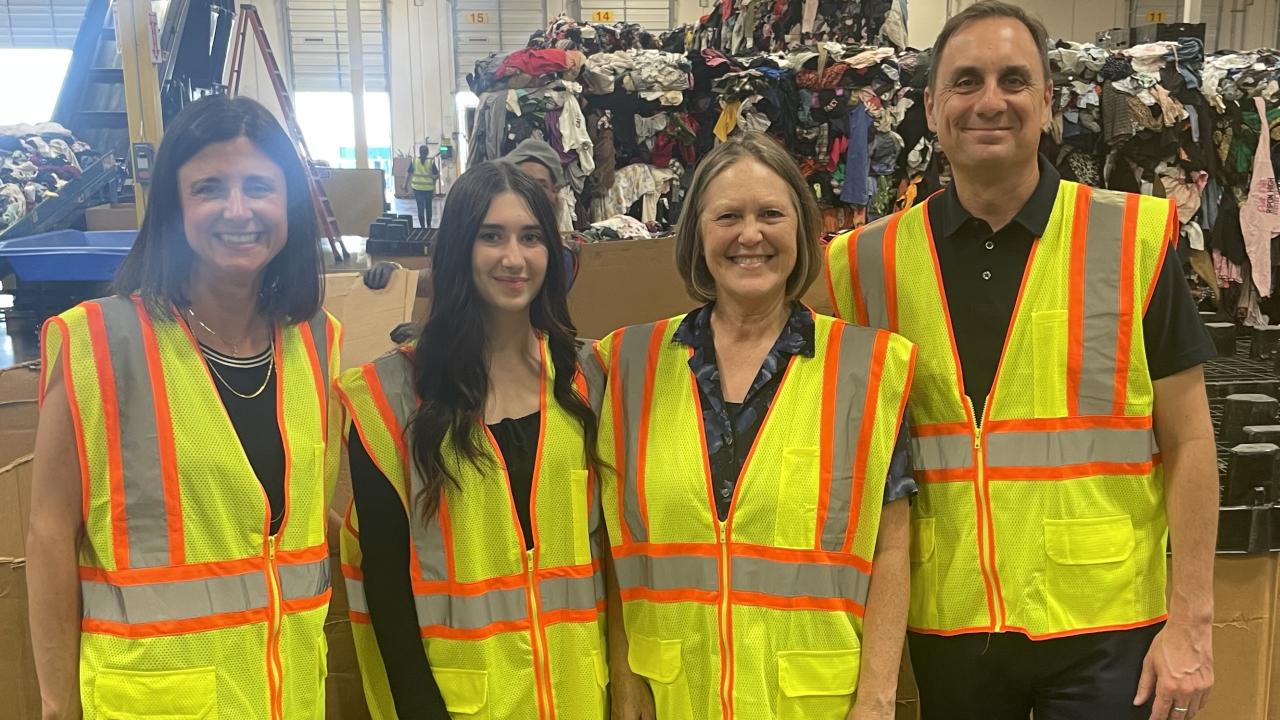
The warehouse view corrects the tidy arrows of recycling diagrams. Textiles arrive in unruly mountains. Quality varies. Sorting takes labor and equipment. Some material has a second customer waiting; some does not. Rules can assign responsibility for end-of-life products, but operators still have to build the pipes through which those products move.
Slayton’s credibility in that discussion comes less from lofty environmental rhetoric than from having to make donated goods behave like an inventory system. He knows reuse depends on mundane competence: indoor processing, enough floor space, reliable transportation and employees who understand the stream. Sustainability becomes real at the exact moment somebody must decide what to do with a stained duvet.
That is why the new stores matter beyond their ribbon cuttings. Tehachapi opened in early 2026 with 17 employees and roughly 30,000 pieces of merchandise ready for shoppers. The new northwest Bakersfield store followed in September, and another former Rite Aid conversion was in development at Panama Lane and Old River Road. Expansion gives the system more local intake, more sales capacity and more places to work.
The next useful life
There is a pleasant symmetry to Slayton’s career. Banking taught him to inspect how businesses work. Goodwill handed him one of the stranger businesses around: an enterprise that buys none of its retail inventory, receives its supply from the public and measures success partly by the people other employers fail to hire. The challenge is to be commercial enough to sustain a mission without confusing the engine for the destination.
Slayton’s public persona is not all sober operations. The official portrait features him grinning with a Nintendo GameCube and controller. He admits to a devotion to chocolate and a fear of frogs. These facts do not explain his leadership, which is precisely why they help. A chief executive can discuss workforce stabilization and still know that the GameCube handle was excellent industrial design.
His more serious ambition is visible in the choices: larger stores, jobs designed for steadiness, a willingness to ask what support a struggling employee needs and a seat in the difficult conversation about where unwanted textiles go. None of it promises a clean final victory. Reuse is repetitive by definition. The work returns tomorrow in another donation bag.
From the office near his birthplace, Slayton has not escaped Bakersfield. He has made staying into an operating strategy. The distance from the hospital to Goodwill may be short. It contains a bank, a video store, a family restaurant, a warehouse full of clothes and hundreds of jobs. Some careers travel outward. His keeps finding more to do right where it began.