The first thing Christa Hull did was ask a question. She was standing in front of marketing students at Simon Fraser University, invited to speak about community, and she asked every person in the room to share a little about theirs. Before frameworks or case studies, the students heard one another. A lecture became a gathering. The method was the message.
Hull has spent more than two decades noticing what changes when people are treated as participants instead of targets. Her career has moved through some of Vancouver's recognizable lifestyle businesses: Whistler Blackcomb, lululemon, Saje Natural Wellness, Bailey Nelson, Stoko, Lagree West, and Jaybird Studios. The industries vary, but the assignment underneath is steady. Help a company express what it believes, then give people a meaningful way to join.
Today she works as a fractional CMO, leadership coach, and consultant, and she co-founded Community Academy with fellow marketer Michelle Lazar. Her work sits in a useful seam. Brand strategy meets organizational design. A customer gathering meets a commercial plan. The leader with the idea meets the team expected to carry it. Hull's premise is that none of those pieces can be healthy for long in isolation.
01 / The long memoryA phone call that kept compounding
In her first week leading global brand and community work at lululemon, Hull called yoga teacher Ryan Leier. The invitation was to become one of the company's first global yoga ambassadors. They went deep quickly. She has written that there may even have been tears. It sounds small next to a global expansion plan: two people speaking on the phone. Yet the relationship lasted.
Leier had already been a local ambassador for five years. A decade after Hull's call, he remained a global ambassador. The relationship passed through product controversies, a much-discussed television interview, studio closures and openings, personal loss, internal moments, and a yoga festival at the Great Wall of China. Its durability made the original call look less like outreach and more like infrastructure.
“We built the brand through real relationships with our community. One authentic, experiential touch point at a time.”Christa Hull, reflecting on her lululemon years
This is the part of community marketing that resists a tidy dashboard. A relationship can produce an event, a recommendation, a sale, a piece of useful criticism, or a decade of mutual credibility. Its value appears in different places at different times. The executive challenge is to support that uncertainty without letting the work drift into vague goodwill.
Hull learned the tension at scale. As Head of Strategic Sales and Director of Global Brand + Community at lululemon, she worked across international markets, events, ambassadors, sales, and brand experience. She helped lead programs such as the Unroll Europe Tour, a six-city sequence that brought more than 2,500 people together through yoga in London, Paris, Zurich, Munich, Stockholm, and Copenhagen. Each stop was local and embodied. Together, the stops helped a global company feel personal.
02 / The operating systemCommunity moves to the center
Companies often place community at the edge of the org chart. It becomes a social channel, a calendar of events, or a role held by an energetic junior marketer with a modest budget. Hull's work argues for a different location. Community touches product education, partnerships, retail, leadership, hiring, customer insight, culture, and retention. Put it at the edge and those connections depend on heroic improvisation. Put it in the strategy and the organization can design for them.
The community growth loop
What brings us together?
What role can people play?
What compounds?
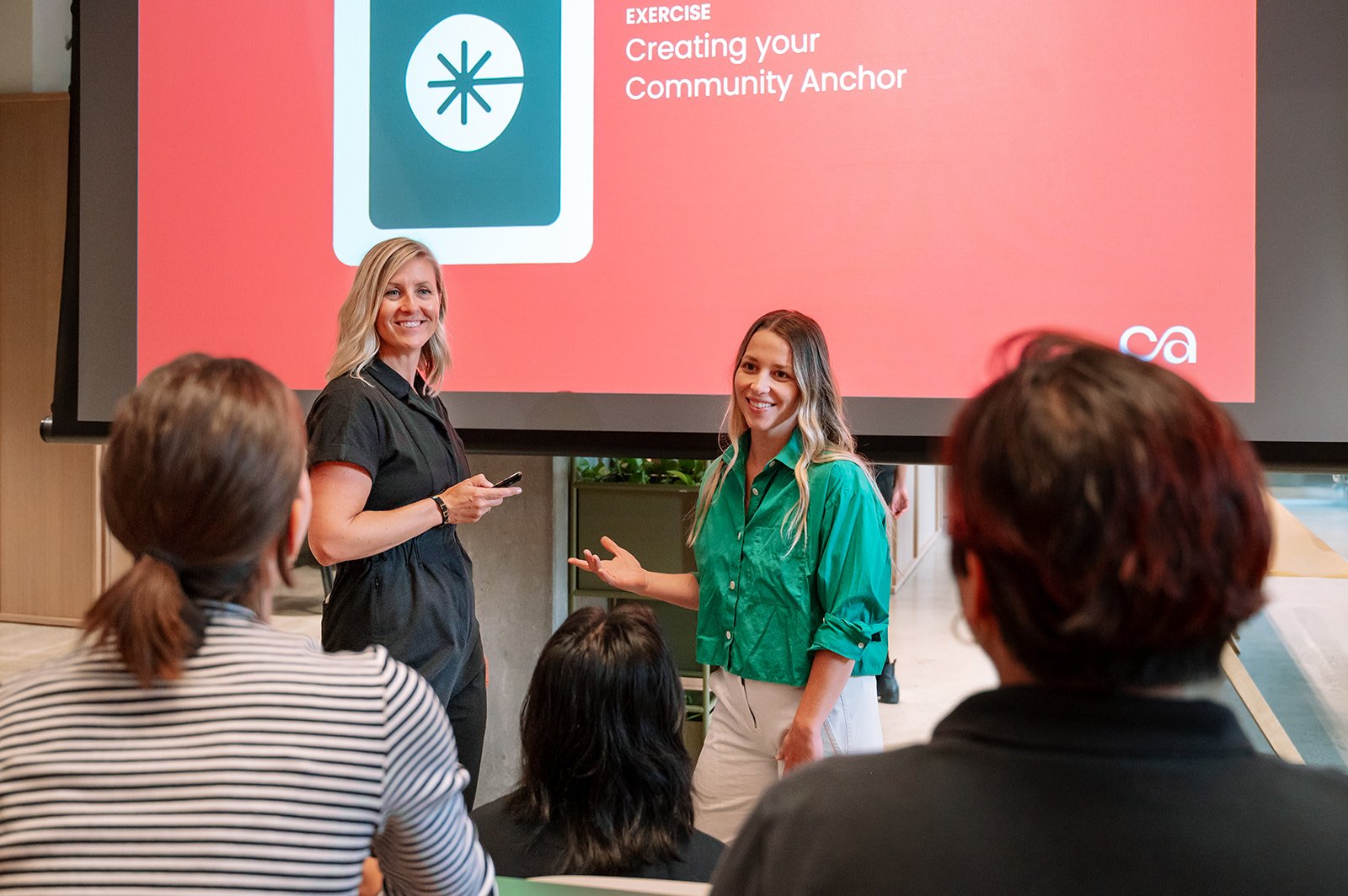
Community Academy translates this view into concrete work. There are workshops for individuals and teams, an audit that produces a snapshot and a 90-day roadmap, a six-module self-paced course, monthly BrandTogether conversations, and fractional CMO engagements. The forms are intentionally varied. A team may need vocabulary before it needs a program. A scaling brand may need a senior operator embedded for a season. A founder may need to discover that a loyal audience is already gathering around something the company has not named.
Hull and Lazar call that something a community anchor. It is the shared idea that makes participation coherent. Product alone is rarely enough. A good anchor clarifies who the gathering is for, what people can do together, and why returning feels worthwhile. It also constrains the brand. If every activation qualifies, the anchor is probably decorative.
The academy's current work responds to a blunt market problem. Paid ads are expensive, organic distribution is unpredictable, and brands do not own the platforms mediating their attention. Community does not remove those channels. It gives them somewhere more durable to point. The objective is not to escape measurement, but to measure a fuller chain: participation, repeat behavior, referrals, qualitative insight, and the capability built inside the team.
03 / The career editFrom brand leader to builder of conditions
Hull describes herself as a “connector, creator, leader, and people alchemist.” The last phrase is less corporate and more accurate than it first appears. Her work is usually about conditions. A gathering where customers can meet. A retreat where a team can align. A coaching conversation where a leader can hear their own thinking. An operating plan that turns a founder's conviction into repeatable behavior.
After senior corporate roles, she founded Christa Hull Coaching + Consulting in 2022. The move collected several strands of her career under one roof: fractional executive leadership, growth and commercial strategy, brand and marketing, people and culture design, experiential work, facilitation, and one-to-one coaching. In 2024 she added a leadership coach credential from the Co-Active Training Institute. She had already trained as a facilitator and qualified as a 200-hour yoga teacher, another clue that her approach to leadership involves attention, presence, and practice as much as presentation.
Strategic sales, events, ambassadors, and international community leadership at lululemon.
Community engagement director at Bailey Nelson during the opening of its Vancouver flagship.
Christa Hull Coaching + Consulting begins in Vancouver.
Community Academy launches with Michelle Lazar.
Fractional CMO work, leadership coaching, brand advising, and community education converge.
The thread also runs through her brand portfolio. At Bailey Nelson, she spoke about eyewear in the language of how a person might feel walking out of the shop. With Saje Natural Wellness, her work included Saje Academy, an internal program for leadership development, product education, and brand engagement. Her lululemon portfolio ranged from ambassador summits to Women of Leadership retreats. These are marketing activities, but they also shape employees and partners. The brand is not only what the customer sees. It is what the people representing it learn to notice.
“Nothing lights me up more than bringing community together, in an intentional way, for the purpose of growth, connection and even transformation.”Christa Hull
04 / The useful stealGive people a part to play
There is a practical idea inside Hull's biography for any founder with a small team. Stop asking only how to reach more people. Ask what the people already close to the brand can do. Can they teach? Host? Offer feedback? Welcome newcomers? Introduce two members who should know each other? Participation creates memory, and memory is one ingredient of loyalty.
Then design the internal conditions. Someone needs clear ownership. Leaders need to agree on the purpose. Events need a reason to exist beyond photographs. Partnerships need reciprocity. The team needs permission to learn from conversations that do not arrive pre-sorted into spreadsheet columns. Hull's fractional model is built for this middle space. She can help set direction while mentoring the people who will eventually own it.
That final point matters. A fractional executive earns leverage by leaving capability behind. Community Academy describes its embedded leadership as strategy, playbooks, program development, and team mentorship. The deliverable is not merely a campaign. It is a group of people better able to build the next one with judgment.
Hull's own career reads the same way. She has moved from executing community programs, to leading the teams behind them, to teaching other leaders how to make the work their own. The scale changed. The unit of progress did not. One phone call. One room. One honest question. One person who decides to come back and bring someone else.
Marketing technology can make attention cheaper to process. It cannot make belonging automatic. Hull's wager is that companies willing to do the slower human work gain an asset that does not vanish when a platform changes its rules. People know one another. They remember the experience. They understand why the brand exists and where they fit inside the story.
Back in that classroom, the lesson began before the lecture did. Every student named a community. The room acquired texture. People who had arrived as an audience became visible to one another. It was a small move, almost free, and impossible to automate without losing the point. Hull had given them a part to play.