Chris Leahy went to California with the wrong idea about the hiking. Her former CDW colleague Ann Ziegler had persuaded her to come. Around her were people who had prepared with impressive seriousness. Leahy, as she later told the story, had come to relax. The itinerary had other arrangements.
She ended up at the back of the group, where a guide named Jessie kept her company. His advice was simple: stay vertical. Keep a position that lets you see the ground ahead and the surroundings. Leahy liked the instruction enough to take it home. In 2019, newly installed as CDW’s chief executive, she told a gathering of women executives how that advice had become a reminder to preserve perspective.
There is a welcome absence of executive glamour in the episode. The company’s chief executive is bringing up the rear and accepting directions. As an introduction to Leahy, it is more revealing than a polished account of an inevitable ascent. Her career contains plenty of upward movement. It also contains several changes of terrain.
“Stay vertical.”
Chris Leahy’s reminder, borrowed from a hiking guide
The lawyer changes the question
Before CDW, there was a career in corporate law. Leahy practiced at Sidley Austin in Chicago, becoming a corporate partner. She had a bachelor’s degree from Brown University and a law degree from Boston College. In 2002, she joined CDW as its first general counsel. The route into the business began with its obligations, agreements and decisions.
That starting point matters because the later appointments changed what she was responsible for. She became senior vice president for international operations, helping develop the international strategy that included the acquisition of Kelway, subsequently CDW UK. The legal work and the operating work overlapped. By July 2017, the company was ready to give her a different kind of brief.
The newly created chief revenue officer position put all customer-facing units under her responsibility. Corporate customers, public-sector customers, small businesses, international operations and technology solutions were part of the assignment. Christina Corley took an expanded commercial and international role reporting to her. It was a change in the organisation as well as a promotion for Leahy.
Read those appointments together and the career becomes less mysterious. The lawyer acquired responsibility for how the business operated across borders, then for how it met customers. Becoming president and CEO in January 2019 put the whole enterprise within her remit. The sequence took seventeen years from her arrival at CDW. Any account that jumps straight from law firm to corner office misses most of the education.
An unlikely teacher at the next desk
Years before the CEO appointment, Leahy had offered a piece of career advice with some pleasing grit in it. You can learn from people whose company you would not naturally seek. A colleague might be a gifted negotiator or an excellent strategic thinker while possessing a manner you have no desire to acquire. Study the useful part.
She made the argument in a 2010 career reflection. It leaves room for judgment: you can recognise a strength, borrow a technique and retain your own style. The perfect mentor is a demanding job description. Under Leahy’s approach, the imperfect person at the next desk may still have something to teach you. Office life becomes a little more educational, even when it remains an acquired taste.
Her own interests, recorded in that same profile, were ordinary and specific: travel, cooking, running and family. Her first job was catering. These details give the executive biography a little air. They also belong to an earlier moment in her life, before the bigger titles, when she was already thinking about how people learn from each other.
Her account of growing up in a large entrepreneurial family provides another starting point. She identifies hunger, humility and honesty as values formed around the dinner table. The combination is demanding: want to do more, accept that you have more to learn, and be direct about where things stand. In an executive biography these can sound like decorative nouns. The value of the small stories is that they give the nouns something to do.
Leahy helped establish a women’s network at CDW and has sponsored the Women’s Opportunity Network. Peer learning gives her career advice an organisational form. Someone who can solve a problem, describe an unfamiliar role or make an introduction becomes easier to find. The work depends on people sharing what they know before another person has had to learn it the expensive way.
A company that has to earn the invitation
When Leahy discussed the changing workplace with the Executives’ Club of Chicago, she used the idea of an office as a watering hole. It is an unusually hospitable image for a management discussion. It asks what attracts people to a place: the conversation, the help, the chance to reconnect with work that has a purpose.
The discussion returned to employee engagement and customer satisfaction, and to keeping a shared culture as the company changed. That is an operating question for someone running CDW. A business can buy technical expertise. Getting people to work well together requires attention after the transaction. A new name on an organisation chart cannot hold the conversation for them.
The scale of those transactions became clear in 2021. CDW agreed to buy Sirius Computer Solutions for $2.5 billion in cash. Sirius brought approximately 2,600 coworkers and capabilities spanning infrastructure, security, data and cloud services. The purchase expanded the kinds of problems CDW could take responsibility for, along with the number of people whose skills it needed to connect.
By the time Leahy became board chair in January 2023, CDW described a business that had grown from roughly $16 billion in sales to approximately $24 billion for the trailing twelve months ending September 2022. Those are company results, produced by many people. They also explain why her task had grown: more services, more relationships and more decisions that had to work together.
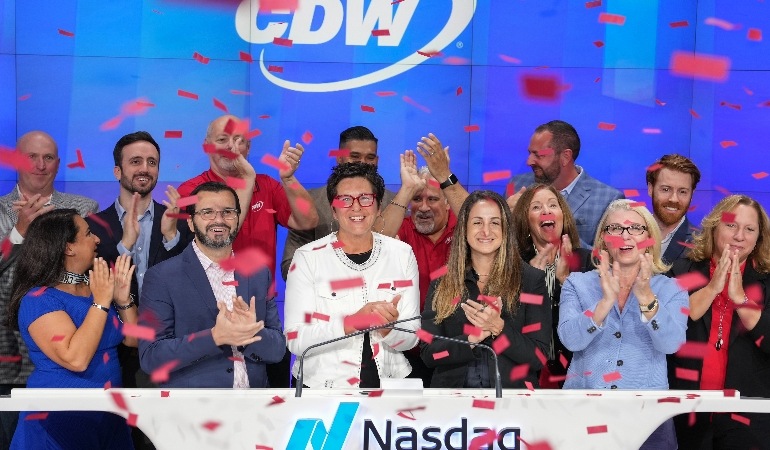
That September, Leahy and a group of CDW coworkers rang Nasdaq’s opening bell in Times Square to mark the tenth anniversary of the company’s 2013 IPO. Finance chief Al Miralles and strategy executive Michael Drory joined the occasion. The photograph offers a cheerful interruption to the language of operating models: a company milestone needs people in the picture.
The boardroom has more than one door
Leahy’s work outside CDW provides another view of how she approaches responsibility. At Children’s Home & Aid, now Brightpoint, she served on the board and became its chair. In 2019, the organisation credited her with helping launch its five-year Every Child Campaign, supporting facilities and championing the use of technology to measure its work.
Nancy Ronquillo, then the organisation’s CEO, had described a useful starting point for that involvement: Leahy was clear that she lacked fundraising experience. She took on the work anyway. The sequence is revealing. Acknowledging unfamiliar territory came before learning how to operate in it. That sits comfortably beside the career advice she had offered years earlier.
At Target, she occupies a different seat as lead independent director. Running CDW and helping oversee another public company involve different responsibilities. Target’s account of her qualifications points to experience in risk, financial management, people, supply chains and governance. The lawyer’s early work remains relevant even after the operating roles have filled out the résumé.
Her connections also include Junior Achievement of Chicago, the Economic Club of Chicago and Corporate Leadership Center. In October 2025, the Executives’ Club named her its International Executive of the Year. The recognition placed a Chicago-area career in an international frame. The more interesting continuity is the range of rooms in which she has learned to work.
What the next climb requires
In September 2026, CDW completed another acquisition, this time of Lovelytics, a data and AI services firm. It brought more than 600 people across the United States, Canada, Argentina and Colombia. Their work includes modernising data, governing it and helping organisations put AI into use. The announcement adds a current chapter to the move toward services.
The choice also makes the ambition tangible. Useful AI depends on a business being able to work with its own information and connect new tools to existing systems. Acquiring people who specialise in that work is an investment in the practical steps between an idea and its daily use. The promised benefits still have to be delivered.
+10.0% year over year
Year-over-year change, Q2 2026 versus Q2 2025. GAAP operating income: $428.6 million. Bars share a zero baseline.
The recent numbers contain their own reminder about perspective. CDW reported second-quarter 2026 net sales of about $6.57 billion, up 10 percent from a year earlier. Operating income rose 2 percent. Sales and earnings from operations moved at different speeds. For Leahy, expanding what the company can do sits alongside the continuing work of making the economics function.
Her April 2026 shareholder letter included employee development and AI fluency among the priorities. The ambition depends on people learning as the market changes. In a business that sits between technology makers and customers, that learning has to travel: through the company, into a recommendation and eventually into something a customer can use.
The letter addressed 250,000 customers, 1,000 technology partners and 15,000 coworkers. Each group sees a different part of the business. Customers want a problem solved. Partners need a route to organisations that can use their products. Coworkers need the skills and support to connect those demands. Her responsibility includes holding those views together without letting the corporate overview become so distant that the individual customer disappears.
The hiking story lasts because Leahy allows herself to be the person who needs the advice. There is room in it for ambition, poor preparation and a guide who knows the ground. Back at work, the terrain keeps changing. She has given herself a short instruction for looking up often enough to notice.