When Presidio bought Bob Cagnazzi’s company in February 2012, it also gave him the keys to its own. BlueWater Communications Group, the business he had founded six years earlier, was joining a much larger technology services operation. Its founder would become the buyer’s chief executive. An exit, in this instance, came with considerably more responsibility.
BlueWater was reported at roughly $250 million in revenue around the transaction. Presidio was roughly a $2 billion business. Cagnazzi had been working on communications, networks, data centers and cloud services. The combination offered a bigger base from which to invest in the things his customers were beginning to require. There was a vacancy at the top, too: Presidio had been without a CEO since Joel Schleicher’s departure the previous year.
“It’s going to be a lot of fun,” Cagnazzi said at the time. The sentence is worth keeping beside the transaction figures. Here was a founder explaining the sale of his business with the air of someone accepting an interesting assignment. He would spend the next fourteen years finding out just how much work that assignment contained.
The buyer needed a builder
The bargain made sense from both directions. BlueWater needed the size and scope to develop managed and cloud services faster. Presidio was acquiring a company with capabilities in unified communications, video, wireless networking and data centers. It also gained a leader who had already run a larger organization. Cagnazzi had been CEO of Dimension Data’s North American business from 2001 to 2006.
That history matters. He arrived as a founder with experience beyond the startup he was selling. The job required both perspectives: understanding why a smaller company might join a larger one, and understanding the obligations that arrive with the larger company’s resources. A customer buying a network still expected that network to work after the acquisition announcements had disappeared.
“It’s going to be a lot of fun.”
Bob Cagnazzi, on the BlueWater deal, 2012
A family business learns new tricks
Cagnazzi’s earlier career belonged to a family enterprise that kept changing with its market. His father, Victor, had built a business selling business forms. The sons helped move it toward computers, supplies and networks. Integrated Systems Group became part of that story. The family’s commercial inheritance was something to keep adapting, rather than a product line to preserve indefinitely.
There is a pleasingly unglamorous quality to that beginning. Business forms do not usually receive a chapter in the mythology of technology entrepreneurship. Yet customers needed them, then needed computers, then needed those computers connected. The opportunity moved. A business serving those customers had to decide how much of the journey it could make with them.
Cagnazzi holds a Bachelor of Science from St. John’s University and an MBA from NYU Stern. His account of entering the networking industry begins in the mid-1980s; the family business became a Cisco partner in the early 1990s. It was sold to Dimension Data in 2000. He stayed, taking responsibility for North America.
In 2006, he left. He later explained that the travel was taking him away from his family. BlueWater began as a local, regional infrastructure services business. Within six years, it was being acquired by Presidio. That sequence gives the career its unusual shape: a move toward a smaller operation led back to a larger leadership role.
- 2001Dimension Data
North America CEO - 2006BlueWater
Founder & CEO - 2012Presidio
Chief executive - 2026Enterprise AI
Next investment
The recurring part of the relationship
At Presidio, Cagnazzi’s strategy increasingly linked infrastructure, cloud and security. In 2016, he described reorganizing established skills in networking, collaboration, data centers and mobility around those needs. The company’s existing technical experience would have to travel into a different kind of customer conversation. Buying equipment was becoming one part of a longer relationship.
The reasoning was practical. A customer could need advice about where an application should run, help building the underlying environment, protection for the resulting system, and someone to manage it. Those decisions overlap. Choosing a cloud platform creates questions about security and costs. Moving an application can expose dependencies elsewhere. The useful service is often the work of joining the decisions together.
By 2023, Cagnazzi was drawing a careful distinction inside the word “recurring.” Reselling a multiyear software license did not, in his definition, give Presidio the same kind of recurring business as operating a service for a customer. The vendor might receive recurring revenue from that license. Presidio’s own management contracts involved a continuing commitment of its own.
He put that “true recurring” share at about 20 percent of revenue, compared with about 4 percent four or five years earlier. Those figures describe his account at that moment. They also explain the direction: more work carrying on after a project’s completion, more responsibility for what happens during the customer’s ordinary working day.
More of the work continues.
Buying a new set of possibilities
Acquisitions supplied some of the capabilities behind that change. In 2020, Presidio bought Coda Global, a cloud consulting company working with AWS, Microsoft and Google. The purchase added expertise in a field where a customer’s plans could extend from moving an existing application to developing a new one. It broadened what Presidio could take into an account it already knew.
Arkphire addressed another part of the map. Presidio announced the completion of its purchase of the Dublin-based technology procurement and services business in January 2021. Arkphire served customers across more than 90 countries. Cagnazzi described it as a platform for expansion in Europe and Asia Pacific. A local relationship could now draw on a wider international operation.
The two acquisitions show why “growth” is an incomplete description of a deal. One brought cloud expertise. The other brought an international base and procurement reach. Each created work beyond signing the agreement. Colleagues had to learn what the combined organization could do, and customers needed a reason to use those additional capabilities.
The regional thread continued. In November 2025, Presidio announced the acquisition of Virginia-based Achieve One, adding coverage and expertise around Virginia and Washington, D.C. Cagnazzi emphasized cultural alignment as part of the rationale. The same concern follows a business from a small team into a larger organization: the people doing the work have to be able to work together.
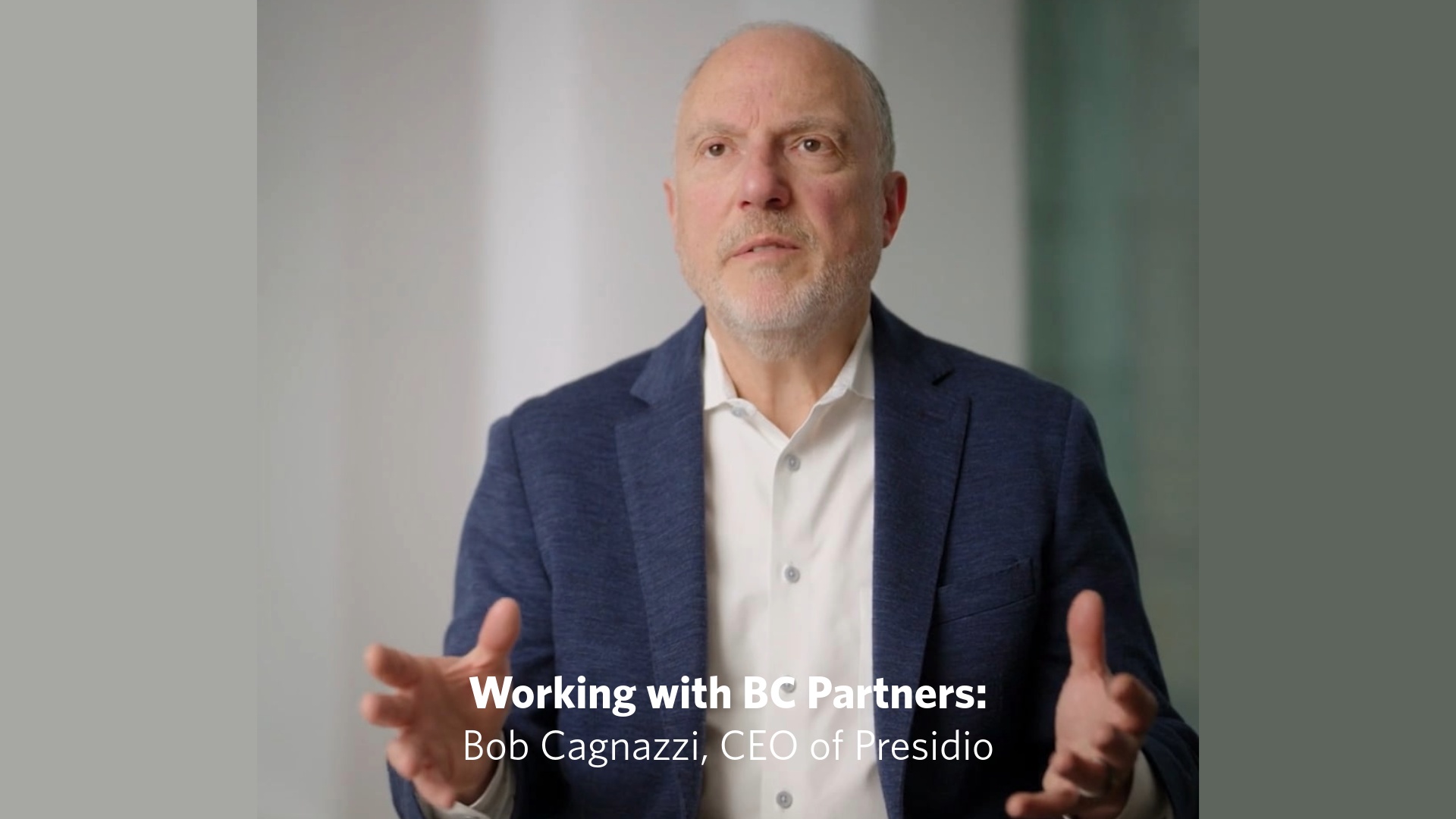
One detail from the Arkphire negotiations makes the process unusually tangible. Cagnazzi said he and his colleagues did that deal without visiting the company’s Dublin offices. Executives met in Bermuda to work through the terms. For a business that puts weight on management teams and cultural fit, completing an acquisition at a distance placed particular importance on getting to know the people involved.
The investors change seats
Cagnazzi has stayed while the ownership arrangements around Presidio have changed. Apollo-affiliated funds acquired the business in 2015. Presidio went public in 2017. BC Partners took it private in 2019 in a $2.1 billion transaction. In 2024, CD&R acquired majority ownership, with BC Partners retaining a minority interest. The CEO’s tenure connects those different chapters.
The 2024 announcement set out an ambition to expand digital solutions and managed cloud services. It also named CD&R operating partner Bill Berutti as the incoming board chair. Cagnazzi remained CEO. For readers accustomed to seeing him described historically as chairman and chief executive, the distinction matters: the continuing role is running the company.
His own experience as a seller gives an acquisition conversation an interesting starting point. He has taken a business from independence into a larger organization, then accepted responsibility for the larger organization. When another founder asks what happens to employees or customers afterward, his career includes a substantial amount of afterward.
His stated management preference is for strong teams whose members can assess a business objectively and make difficult decisions without getting caught up in their own egos. “You’ve got to have the right team,” he has said. It is a modest-sounding requirement with consequences for an acquisitive company: every purchase introduces another group of people with knowledge the buyer needs to retain.
The family connection continues inside the present organization. Chris Cagnazzi, his brother and a former BlueWater finance leader, is Presidio’s chief innovation officer. His responsibilities include research and development and acquisitions. The company’s next direction is being worked on by people whose careers extend back through earlier versions of the business, alongside the teams added along the way.
The next handover is to AI
By July 2026, the next investment had a different vocabulary. Presidio announced an AI Blueprint, a dedicated consulting group called Lighthouse, and an innovation lab called P.A.T.H., the Presidio Programmable AI Technology Hub. The stated purpose was to help enterprises move beyond pilots. A demonstration would need to become something capable of operating across a business.
“Our customers are done experimenting with AI. They need to scale it,” Cagnazzi said. The announced method moves through three stages: Clarify, Realize and Scale. In ordinary language, that means choosing a useful business problem, building and validating a solution, then governing and maintaining it. The final stage gives the services organization plenty to do.
Clarify
Choose priorities.
Plan the work.
Realize
Build solutions.
Test in practice.
Scale
Govern operations.
Keep improving.
On October 20, Presidio announced its inclusion in CRN’s inaugural AI Innovators list. The recognition belongs to the company and its teams. For Cagnazzi, it marks the current subject of a familiar operating question: what capabilities must the organization develop so customers can keep moving? The technology changes faster than the responsibility to make it useful.
A little work left under the hood
Away from the corporate transactions, Cagnazzi restores muscle cars. He has described a collection including older Chevrolets and a 1967 GTO. His working relationship with vehicles began much earlier: he paid his way through college plowing snow with a 1968 Chevrolet truck. Before the larger assignments came a machine with a very clear job.
There is no need to turn the garage into a management seminar. Old cars are allowed to be old cars. Still, it is an appealing detail in a career full of technology transitions. Some things are worth keeping, some parts need work, and getting everything to run together can occupy a person for years.