The real-estate company had plenty of data. Its employees were still assembling the answers by hand. Information came from SAP systems, Pentaho and other sources; people turned it into reports about customers, contracts and vacant space. Somewhere between the database and the boardroom, useful information became a daily chore. Axity’s assignment was to shorten that distance.
- Axity designs, builds and runs enterprise technology across Latin America.
- Its distinguishing bet is coordination across applications, data, networks and security.
- Its Polux tools bring AI into practical work: assessment, code and IT operations.
That assignment is a good way into the company. “Digital transformation” can sound like an expensive renovation with no agreed floor plan. Here, the floor plan was tangible: stop making people reconstruct business indicators every day. The company’s case study reports 35% less effort spent generating reports. The interesting question is what happened before that number became possible.
01 A company assembled for the handoff
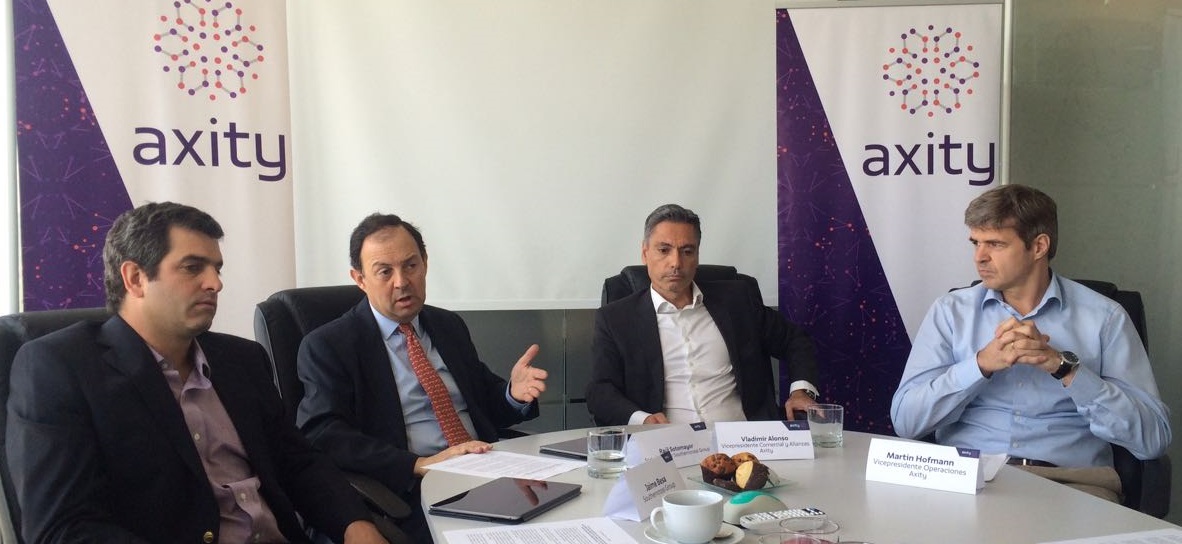
Axity arrived in 2017 through the combination of Intellego, Getronics operations, Spirit and Extensión, backed by private-equity firm Southern Cross Group. These were established regional businesses. The new name therefore came with an unusual advantage: it could claim a long operating history without pretending that the brand itself was old.
The merger addressed a change in the job. In a 2019 interview, Pablo Gómez described how specialties that once worked independently were converging. A business needed software, communications, information management and security to cooperate. Axity spent roughly two years shaping the combined organization around six areas, including consulting, automation and infrastructure. Putting the specialists together was only the beginning.
“Somos una empresa latinoamericana para Latinoamérica.”
Pablo Gómez, 2019
A Latin American company for Latin America.
The ambition placed Axity between regional specialists and international services groups. Gómez named Accenture and IBM as competitors he wanted to challenge. In Chile, early coverage identified Sonda as a direct alternative. Axity’s argument rests on breadth and regional delivery: a buyer can keep following the problem when it crosses from one technical discipline into another.
02 The 33 reports that explain the business
Return to that real-estate customer. Axity describes building a corporate data lake called SmartBI, with daily updates from commercial systems. It put more than 20 business rules into data marts and brought 33 reports into production. Four dashboard types covered monthly sales, daily sales, vacancy and contract management.
The improvement was organizational as well as technical. Automating a report requires agreement about what its numbers mean. A vacancy indicator has to mean the same thing to the people generating it and the people using it. Connecting the systems creates the route; agreeing on the rules makes the route useful. This is where a broadly equipped integrator earns its place.
less effort generating reports
A separate consumer-goods case makes the same point from another direction. Axity moved daily-sales processing to AWS, using Glue for transformation and Step Functions to coordinate the workflow. It also reviewed business rules and documented critical points from SAP HANA Cloud to the new process. Moving the computation mattered. Cleaning up its logic mattered too.
03 Selling the work after the launch
Axity’s offer reaches beyond project delivery. Its SAP practice covers migration and conversion to S/4HANA, implementation, monitoring and managed application support. Its cloud practice includes architecture, adoption and continuing operations. Cisco networking and collaboration work sits alongside cybersecurity services. BMC tools support service management and automation. The portfolio is built for technology that has to keep working on Monday morning.
Commercially, this is an enterprise services business: consulting and implementation work, partner technology and continuing management. A customer can need a defined modernization project or an operating team that stays involved afterward. Axity’s public customer-story library includes Alpina, insurer SMNYL, universities and Operación Sonrisa Colombia. The mix suggests a shared requirement: dependable systems supporting people doing very different jobs.
For a buyer, the economics should follow the particular workflow. Reporting effort, incident diagnosis and service availability provide different measures of value. A reduction in manual hours creates capacity; converting that capacity into financial savings or better service depends on what the organization does next. The procurement question is whether the proposed scope addresses that specific constraint.
04 AI gets a shift on the support desk
In Axity’s mining application-support case, the bottleneck was a demanding maintenance operation: slow handling, inconsistent results and overloaded technical teams. AI assistants were trained to analyze logs, explain recurring errors and suggest first-line solutions from incident histories and technical documentation. This is a modest-sounding assignment with a useful property: someone can check whether the work got easier.
Polux extends that approach across a portfolio. Assessment Advisor helps evaluate application estates; Code Assistant supports code, tests and documentation. AI Hub addresses coordination and governance across enterprise AI initiatives. AIOPS targets operational workflows and incident handling. Each is presented as an accelerator for work already inside the customer’s organization.
September 2026 coverage describes Polux agents classifying requests, correlating incidents and handling access tasks. Automatic corrective actions depend on rules set by each organization. That dependency deserves attention. An agent needs current operational records, access controls and a record of what it did. Give it stale information or ambiguous permissions and the promise becomes much harder to deliver.
05 Start where the work gets stuck
Axity’s own generative-AI policy supplies a telling detail: access to its internal Polux One tool requires completion of a prompting course. The policy also calls for human review and constructive skepticism. Even inside a company selling AI capabilities, adoption involves teaching people how to question the output.
The copyable lesson is straightforward. Pick one expensive handoff. Map the systems, the rules and the people responsible. Automate the repeatable part, then measure whether the bottleneck shrinks. Axity’s story is interesting because its broad portfolio keeps returning to these small, concrete tasks. A report arrives sooner. An error takes less investigation. The pieces finally cooperate.
Follow the work
Explore Axity’s website, customer stories, blog and newsroom.