Before Chris Clover could help the Navy put out a virtual fire, his young company had to pay for the equipment. There were projectors to buy, computers to assemble, mirrors and video distribution systems to account for. A simulated emergency required an inconvenient quantity of real hardware. The financing, too, belonged firmly to the physical world.
Mechdyne’s first full-scale assignment was a shipboard firefighting simulation for the U.S. Naval Research Laboratory. To deliver it, Clover recalled, the company borrowed more than twice what someone would borrow for a house. That comparison gives the beginning of his career an unusually domestic scale. Forget an abstract funding round. Imagine the price of somewhere to live, then double it, and spend the money on making a room behave like somewhere else.
The project worked, and other customers followed, including GM, Rockwell and Boeing. Clover had found a commercial use for an interest in video and computer technology that went back to childhood. The company he co-founded in 1996 would take him from university research into the business of helping other people see what their ordinary screens could not readily explain.
Thirty years later, he remains Mechdyne’s president and CEO, based in Marshalltown, Iowa. The business now spans immersive environments, audiovisual systems, software and IT services. Its range has widened considerably. Yet that first assignment still offers a useful way into Clover’s working life: choose a practical problem, assemble the necessary expertise, and make the result usable by someone with a job to do.
Three degrees, one recurring interest
Clover’s education makes an interesting procession across an Iowa State University résumé: aerospace engineering in 1991, an MBA in 1992, then a doctorate in mechanical engineering in 1996. There is the machine, the business, and the deeper investigation of how things work. Together they gave him more than one language in which to describe a technical problem.
His doctoral work brought mechanical systems and visualization together. A NASA project with professors James Bernard and Carolina Cruz-Neira gave him an opportunity to investigate the mechanics and computing behind immersive environments. Simulation became a substantial part of his dissertation. Before it became a company proposition, the connection between seeing and understanding was a research problem he could work on.
At Iowa State’s Virtual Reality Applications Center, Clover, Jim Gruening and Kurt Hoffmeister developed the experience that would underpin Mechdyne. They founded the company together in 1996. Their shared university background matters because this business required several kinds of engineering to cooperate. A convincing image depended on physical structures, computing, projection and software behaving as a single system.
By 2001, Clover had received the technology category award in the Iowa/Nebraska Entrepreneur of the Year competition sponsored by Ernst & Young. The following year, Iowa State included him among alumni featured in its State Fair exhibit. His company’s work already extended from military simulation to virtual environments for improving farm equipment. The distance between those applications was considerable; the engineering question connected them.
engineering
administration
engineering
Three Iowa State degrees. Engineering and business, on the same résumé.
The company grows beyond the room
The next chapter involved combining businesses as well as technologies. In November 2002, Mechdyne and Fakespace Systems announced plans to merge. Clover would lead the combined enterprise as CEO, while Fakespace president Carol Leaman would oversee day-to-day operations as president. The completed merger was reported in March 2003.
For Clover, the combination joined product lines, technical experience and customer support. Visualization clients needed equipment that could be delivered and maintained, alongside the means to work with their data. In 2005, Mechdyne announced it would acquire VRCO, a developer of interactive 3D visualization software. The sequence shows a company adding the capabilities around its displays, rather than treating the display as the end of the assignment.
There was a physical counterpart to that expansion in Iowa. In 2010, Mechdyne enlarged its Marshalltown Technical Center to accommodate development, verification and anticipated hiring. Its teams assembled complete systems before shipping them to customers. For an installation composed of interdependent parts, a rehearsal on home ground was an eminently sensible habit. Better to discover an awkward interaction before the equipment has acquired a passport.
Clover described the expansion as an investment in the company’s future and Iowa’s economy, following another year of growth despite a difficult global economy. That decision anchors the international business in a particular place. Marshalltown was where engineers could build, test and work through the details before a system took its place in somebody else’s building.
“dead simple”Chris Clover’s standard for the customer’s experience, 2015
The engineer’s disappearing act
By 2015, Clover was articulating a demanding test for his team’s work: a customer should be able to use the finished system without being conscious of the technical complexity inside it. The principle sounds modest. Anyone who has spent a meeting negotiating with a display will recognize how much ambition it contains.
His phrase for the desired experience was “dead simple”. Those two words carry much of his public approach to engineering. The customer has already brought a difficult task: reviewing a design, interpreting information, teaching a class or coordinating colleagues. Operating the equipment should not become an additional occupation. A sophisticated room has failed a fairly basic test if everybody is waiting for the one person who knows which button to press.
The same year, the University of the Sunshine Coast in Australia prepared to open its Engineering Learning Hub, a A$37.2 million building. Mechdyne was the principal systems integrator for its visualization facilities. Immersive technology allowed students to investigate complex information spatially; a collaboration studio could bring material from multiple devices onto a large touch-enabled screen.
Clover spoke of continuing to support the university and helping its students and staff make discoveries. The ongoing relationship belonged in the picture alongside the installation. A learning space has to function after opening day, when a lecturer has a class waiting and the equipment is expected to get on with it. The ceremonial ribbon has a shorter working life than the system behind it.
A wider job description
The university project also helps explain how Clover’s business grew beyond its original specialty. Customers who knew Mechdyne through virtual reality brought it other technology problems. The company followed those requests into additional fields. Its account of that development places existing client relationships at the center of the expansion.
One concrete step came in 2017 with the acquisition of ABS Associates, an IT managed services provider. The local chamber newsletter recorded the transaction beside an archival photograph of Clover, Gruening and Hoffmeister. It is a pleasingly compact record of a broadening business: the original founders in the picture, a new area of service in the accompanying news.
That growth changes what it means to run the company. An immersive installation, a software assignment and an IT support operation ask different things of a team. The connection is the customer’s dependence on the finished service. Clover’s emphasis on usability provides a way to judge all three. The cleverness involved should leave somebody else better able to work.
His public LinkedIn activity offers a small view of where he directs attention. He has celebrated his team’s work on a curved Crystal LED display installation and shared colleagues’ updates about geospatial development and IT services. These are professional signals rather than a private diary, but their subject is consistent: teammates, technical work and the expanding range of things the company can do.
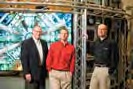
Three founders, more things to fix. Clover, James Gruening and Kurt Hoffmeister in a Marshalltown chamber newsletter.
Thirty years, and another layer of machinery
In April 2026, Mechdyne announced a strategic alliance with Silverdraft Supercomputing. The arrangement paired Silverdraft’s GPU-dense computing platforms with Mechdyne’s integration and deployment experience. The intended applications included advanced visualization, simulation, media production and enterprise computing.
The division of work was specific. Silverdraft would concentrate on developing its computing architectures. Mechdyne would resell and integrate its workstations and servers into larger environments, drawing on its deployment and managed services capabilities. The announcement placed Clover in a familiar position: connecting specialized engineering to a customer’s complete working system.
Mechdyne also marked its thirtieth anniversary in 2026. Anniversary arithmetic can flatten a career into a single number. Clover’s three decades contain several different tasks: turning research into a first contract, combining companies, expanding a technical center, and running a business whose customers now require much more than immersive images. Longevity here has involved revising the job description repeatedly.
There is a local dimension to that continuity. Mechdyne’s community contribution program includes paid volunteer time for employees and a committee drawn from across the organization to review financial giving. These are company practices, rather than claims about Clover’s private generosity. They give a concrete form to the responsibility to local communities that the business includes among its stated values.
The early Navy simulator and the Silverdraft partnership are separated by thirty years of changes in computing. One required projectors, mirrors and a substantial loan; the other brings concentrated graphics processing into contemporary systems. Both ask an integrator to make separate pieces work together. Clover’s career has kept returning to that practical obligation.
The customer eventually enters the room, opens the application or starts the session. If the engineering has done its work, the machinery asks for very little attention. That is a curious achievement to build a career around: years of study, borrowing, testing and coordination, all so somebody else can think about something else. For Chris Clover, making it look easy has been a remarkably involved occupation.