At four in the morning, Brent was fog and darkness. Chris Bosworth and Rob Finkbeiner pushed away from the store and into a day that would end 17 hours later at Opeongo. The route followed the Petawawa and Crow rivers, crossed Lake Lavieille, and arrived at one of Algonquin Park’s better-known tests, the Dickson-Bonfield portage. A typical canoe party could spend at least four days covering it. Bosworth and Finkbeiner did it between breakfast and a very late dinner.
This was 2004, and the trip was one section of the Meanest Link, a canoe circuit created to connect four Algonquin Outfitters locations. The route is an odd monument to a retailer: roughly 420 kilometres of rivers, lakes, upstream travel and portages, conceived in memory of company co-founder Bill Swift Sr. It celebrates the kind of knowledge that does not fit neatly on a product page. Where is the current strongest? How much daylight is left? Which piece of equipment matters when the weather turns?
Bosworth eventually became Chief Marketing Officer of Algonquin Outfitters. But the early-morning departure helps explain the more interesting part of the title. He markets a place he has had to navigate, not merely describe.
The route before the résumé
Bosworth’s career begins in the practical geography of an outfitter. He worked first at Algonquin Outfitters’ Opeongo location and later at the Huntsville store. One sits at the edge of a large access lake in the park; the other sits in town. Together they offer a compact education in the business: a wilderness trip has a supply chain, and an outdoor store has weather.
The work also became personal. In Huntsville, he met Patricia Durand, one of several relationships that began among Algonquin Outfitters colleagues. The company has told those stories as part of its own history. In a seasonal business, the staff list can act like a community directory, full of guides, paddlers, managers and families whose lives keep intersecting after a summer job ends.
Bosworth studied at York University and Swansea University and earned a Bachelor of Commerce. The business education matters. So does the other curriculum - Opeongo mornings, Huntsville customers, and enough days in a canoe to know that a trip plan is a promise made to a future, more tired version of yourself.
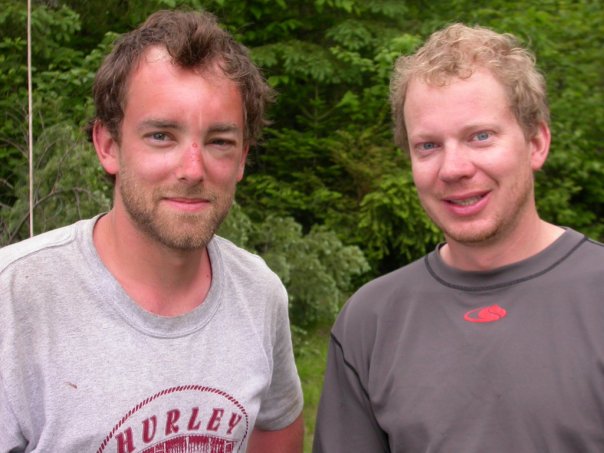
In June 2008, Bosworth and Will Lougheed attempted the complete Link. They planned for 14 days and arranged two food drops. The trip carried additional meaning: their friend Clarke Wallace had died the day before they left. They named their carbon-Kevlar canoe C.W. 1 and dedicated the journey to him.
They travelled about 14 hours a day and finished in nine days, becoming the second party to complete the continuous circuit. The point of the Link, by its own rules, is not speed. It is the journey. Bosworth’s result still offers a vivid measure of familiarity, preparation and persistence.
The Meanest Link · one continuous loop
Four outfitter locations. Lakes, rivers and portages between every dot.
“The word I always use is ‘freedom.’”Chris Bosworth on stand-up paddleboarding
Selling the first good hour
Years later, discussing stand-up paddleboards, Bosworth reached for a word more emotional than technical: freedom. Newer boards, he explained, are shaped for lakes, with greater stability and easier steering. Beginners can start on their knees. If they need a break, they can sit down and float.
That is product advice, but it is also a small philosophy of outdoor retail. The expert’s job is not to make the threshold look heroic. It is to lower it. A stable board, a delivered canoe or a guided fall paddle turns a vague wish into a manageable first hour. The customer does not need to become Bosworth on the Meanest Link. The customer needs to imagine leaving shore.
The same instinct appears in his comments about cycling in Algonquin. His pitch is breadth: road bikes, mountain bikes, e-bikes, fat bikes and cruisers, with options from leisurely to demanding. “There’s really something for every cyclist in Algonquin,” he said. It is a marketer’s line grounded in an operator’s useful question: where can this particular person begin?
The region is the product
Bosworth’s work has widened from the store to the visitor economy around it. He joined the Muskoka Tourism board in 2023 and now serves as vice-chair. The biography published by the organization describes him as an outdoor advocate who has lived in Muskoka for more than 20 years. His remit is both commercial and civic: help more people understand the place, then make sure the businesses and communities in that place can work together.
Consider Camp Tall Pines. For the 2023 Tall Pines Music & Arts Festival, Algonquin Outfitters provided tent and canoe rentals as part of camping packages. Bosworth’s explanation was plain: camping and canoeing would make the Muskoka experience more complete. It is partnership marketing with no need for jargon. A festival attracts the visitor. An outfitter helps the weekend feel located.
Another project begins with paddles as blank canvases. Algonquin Outfitters’ Paddle Art Auction has connected artists, public displays and cultural organizations while raising money for local arts. In 2025, canoe murals joined the paddles. Bosworth called them “absolute showstoppers.” The objects travel between function and symbol: a paddle moves a boat, then hangs in a gallery, then funds more creative work in the region that inspired it.
He also represents Algonquin Outfitters on the District of Muskoka’s IDEA Advisory Group, which works on inclusion, diversity, equity and anti-racism or anti-hate initiatives. That appointment adds another layer to the idea of access. Outdoor participation is partly about having the right gear and information. Regional welcome is broader, involving who feels invited into public life and local institutions.
Package the hesitation
One of the smallest items carrying Bosworth’s byline is a guided fall paddle at Canoe Lake. It lasts two hours. A guide provides paddling instruction and shares knowledge of the park while the shoreline turns red, orange and yellow. To an experienced tripper, two hours is barely a warm-up. To a day visitor, it may be exactly the right size.
That difference is the business opportunity. Outdoor companies often celebrate the hard edge of adventure: distance, isolation, endurance. Those stories matter, and Bosworth has one of his own. But a functioning outfitter must also notice the quieter obstacles. A visitor may not know how to steer. A family may not have roof racks. Someone may want the view without committing to an overnight route. Instruction, rentals, watercraft delivery and a defined return time each answer a hesitation that might otherwise cancel the outing.
The pattern is visible across Algonquin Outfitters’ offers. A canoe is paired with route planning. A campsite can be paired with delivery. A festival can be paired with a tent and a paddle. The work is less about bundling products than sequencing confidence. Each service removes one decision from a day already crowded with unfamiliar ones.
Bosworth’s own long trips make that attention to beginners more credible, not less. Expertise can create distance when it performs itself. It becomes useful when it remembers the first question. His public language repeatedly returns to that first question: Is there a ride for me? Can I balance on the board? Will this weekend feel like Muskoka? The marketing answer is designed to get a person moving without pretending the terrain is effortless.
The interesting unit of outdoor marketing is not the product. It is the crossing - from curious to capable, from visitor to participant.
A career with a memory
There is an easy way to flatten Bosworth’s story into a familiar ascent: store employee becomes executive. The actual route is less vertical and more useful. Opeongo taught one edge of the customer experience. Huntsville taught another. Long canoe trips tested the advice. Education added commercial language. Partnerships expanded the field from a company to a destination.
The result is a career in which old experiences remain active. A 4 a.m. launch is not just youthful lore. It is a reference point when the company talks about trip planning. A nine-day loop is not a stunt that sits apart from the day job. It establishes that the landscape behind the inventory is real, connected and sometimes difficult. Board service is not a departure from retail. It acknowledges that a regional outdoor business depends on a resilient network - guides, artists, event organizers, accommodation owners, municipal partners and visitors.
This is where Bosworth’s public comments are most revealing. He does not describe paddleboarding by beginning with construction. He begins with freedom. He does not describe festival rentals as units. He describes a more complete Muskoka experience. He does not narrow Algonquin cycling to insiders. He finds an entry point for every cyclist.
A company can buy reach. A local operator accumulates context. Bosworth’s context happens to include the view from both sides of the counter, four dots on a demanding canoe loop and more than two decades in Muskoka. His job is to turn that memory into an invitation - accurate enough for the landscape, generous enough for a beginner, and connected enough to benefit the place when the visitor arrives.