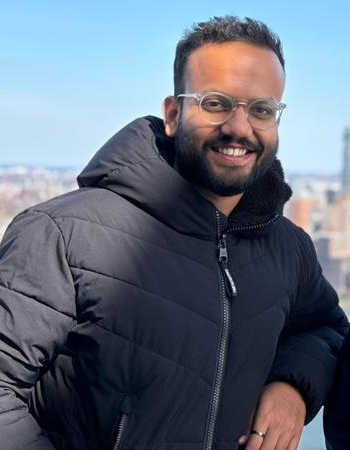
The founder who decided a phone call was worth fixing
The turning point for Chetan Reddy did not happen in a lab or a pitch meeting. It happened in a hospital, where his wife was recovering from spine surgery in the United States. The operation went well. What stayed with him was everything around it. "I spent 80% of the time she was in hospital making phone calls and filling in forms, rather than at her bedside," he later told Forbes. The medical care impressed him. The paperwork did not.
Reddy is an engineer by training, a graduate of the Birla Institute of Technology and Science in Pilani, where he studied chemical engineering and mathematics between 2013 and 2017. He had already spent years building software for industries that ran on manual, repetitive work. His first ventures pointed at drones and infrastructure, not doctors. But the hospital experience reframed a problem he thought he understood. The American healthcare system, famous for both its technology and its fragmentation, was drowning its own staff and patients in administrative noise.
Healthcare didn't need more tools. It needed help.
Chetan ReddyThat single sentence became the thesis for Confido Health, the company he co-founded in New York in 2024 with Vichar Shroff. Instead of shipping another dashboard for overworked clinic staff to learn, Reddy wanted to build something that could take the work off their plate entirely. Before writing much code, he did something unusual for a technical founder: he spent months shadowing front-desk staff, schedulers and care coordinators across medical practices in the Midwest, watching how the work actually moved.
From drones to the front desk
Reddy's path to healthcare ran through some unlikely places. Earlier in his career he served as a director at Enercomp Solutions, a drone manufacturing and AI company working on imaging and mapping. He founded DroneNation, building AI for infrastructure mapping, monitoring and workflow automation. He also co-founded BurnCal, a personalized virtual fitness app. The industries changed. The instinct did not. Across all of them, Reddy kept circling the same idea - that automation earns its keep only when it removes real human effort, not when it looks impressive in a demo.
AI only matters when it replaces real human effort. The hardest problems live in messy, real-world workflows.
Chetan Reddy, on his product philosophyHealthcare's front office turned out to be one of the messiest workflows he could find. A single patient call can touch scheduling, insurance eligibility, prescription refills, referrals, intake forms and billing - often bouncing between systems and staff before anything is resolved. Providers cannot easily hire for these roles, and the ones already doing the job carry the stress. Reddy saw an opening that was less about flashy intelligence and more about patient, reliable execution.
What Confido actually does
Confido Health builds AI voice and messaging agents designed to answer every patient call, around the clock, without hold music. The agents pick up on the first ring, authenticate the caller, check eligibility and then resolve what the patient actually needs - booking or changing an appointment, confirming insurance, requesting a refill, sending a reminder, taking a payment or handling post-visit follow-up. Every interaction is documented straight back into the clinic's electronic health record or practice management system in real time.
The results show up in the unglamorous metrics clinics care about. At Dallas Renal Group, one of Confido's customers, more than 66% of patients confirm appointments instantly through outbound AI calls, inbound wait times dropped from minutes to around 15 seconds, and staff reclaimed close to 50 hours a week. Confido's agents now run across specialties including pediatrics, orthopedics, gastroenterology and dermatology. In roughly eight months, the company's patient reach grew about tenfold, from around 150,000 patients to more than a million.
Growth, and a healthy fear of getting it wrong
Investors noticed. Confido raised pre-seed money from Momentum Capital, then a $3M seed round led by Together Fund in December 2024. In September 2025 it announced a $10M Series A led by Blume Ventures, with participation from Schema Ventures, Vicus Ventures and existing backers, bringing total funding to roughly $13M. The new money is aimed at pushing the agents beyond scheduling into the fuller sweep of front- and back-office work.
For all the momentum, Reddy talks about the downside as much as the upside. In an industry where trust is fragile and mistakes are expensive, he is blunt about the stakes of deploying AI into patient-facing work. It is a notably cautious posture for a founder in a field prone to overpromising, and it shapes how Confido builds.
All it takes is one mistake for the industry to lose the confidence of its customers.
Chetan ReddyThat tension - move fast enough to matter, carefully enough to be trusted - is the through-line of Reddy's story. He is not trying to reinvent medicine. He is trying to give clinic teams back the hours that phone calls and forms quietly steal, and to make sure a patient's family can spend a hospital stay at the bedside instead of on hold. As he puts it, the point was never automation for its own sake. "The goal wasn't automation for its own sake; it was giving teams time back without breaking trust or workflows."
Career TimelineA decade of automating the boring parts
- 2013 - 2017Studies chemical engineering and mathematics at BITS Pilani.
- Early careerDirector at Enercomp Solutions, a drone manufacturing and AI imaging company.
- Earlier venturesFounds DroneNation - AI for infrastructure mapping, monitoring and workflow automation.
- Earlier venturesCo-founds BurnCal, a personalized virtual fitness app.
- 2024Co-founds Confido Health in New York with Vichar Shroff; raises pre-seed from Momentum Capital.
- Dec 2024Confido announces $3M seed round led by Together Fund.
- Sep 2025Confido raises $10M Series A led by Blume Ventures; total funding reaches ~$13M.
Fun facts & footnotes
People also ask
Who is Chetan Reddy?
He is the co-founder and CEO of Confido Health, a New York based startup building AI voice and messaging agents for healthcare front-office operations.
What is Confido Health?
Confido builds AI agents that answer patient calls around the clock and handle routine tasks like scheduling, prescription refills, eligibility checks, reminders and payments, updating the clinic's EHR in real time.
Why did he start the company?
After his wife had spine surgery in the US, he was struck by how much of his time went to phone calls and paperwork instead of caring for her, which exposed the administrative burden in healthcare.
How much has Confido Health raised?
About $13M in total, including a $3M seed led by Together Fund in December 2024 and a $10M Series A led by Blume Ventures in September 2025.
What is his background?
He studied chemical engineering and mathematics at BITS Pilani and previously worked on AI for drones and a fitness app before founding Confido Health.