A canceled project is usually an instruction to stop. Charles R. Trimble treated it as an invitation to negotiate. In 1978, he bought Hewlett-Packard's abandoned marine navigation technology for $50,000 and started a company. Four years later, when HP abandoned a GPS project, he bought that too. The future arrived with a previous owner's fingerprints on it.
There is something agreeably unglamorous about this beginning. No revelation over a whiteboard. No immaculate invention appearing fully formed. An engineer looked at work a large company had decided to put away and asked whether it could earn its keep somewhere else. Twice. The question would carry him from navigation instruments to a business whose name became familiar to people measuring the planet.
Today, a location appears on a phone with such little ceremony that we become irritated when it takes a moment. Trimble's early customers had a less casual relationship with the sky. The satellites were few, the equipment expensive, and the business case depended on uses narrow enough to work before the grand vision did. His career is a useful corrective to the idea that seeing the future makes the present easy.
The orchard, the summer job, the detour
Trimble grew up on an avocado ranch in Fallbrook, California. Sputnik drew his attention toward mathematics, science and space. At Caltech, he considered mathematics, moved toward physics, then chose engineering partly because it made summer employment easier to obtain. Intellectual curiosity and the need for a paycheck seem to have got along perfectly well.
He earned his bachelor's degree in engineering physics in 1963 and his master's in electrical engineering in 1964. Harvard Business School was supposed to follow. Instead, a summer job at Hewlett-Packard supplied a more persuasive curriculum: a difficult problem and permission to own it. His manager, Al Bagley, wanted to keep promising engineers in engineering. Offering Trimble a project worked.
That intervention matters because the eventual founder was already interested in the meeting point of technology and business. He did not have to choose one interest and suppress the other. Building something useful at HP gave him a place to practice both. A temporary job became fourteen years. Business school can be an expensive way to meet a mentor; Trimble's mentor put him on the payroll.
At HP, his work included signal processing, fast analog-to-digital conversion and extremely fine measurements of time. These are less photogenic accomplishments than a rocket launch, but they belong to the same practical world. A satellite signal must become something an instrument can interpret. The engineer who can extract useful information from an awkward signal has work to do long before anyone starts naming the market.
Two purchases from the cancellation department
When he left HP in 1978, Trimble began with Loran-C, a navigation system using radio signals from transmitters on land. His company operated in about a thousand square feet of former insurance offices in downtown Los Altos. Its customers included ocean racers and Alaskan salmon crews. These were people with destinations, boats and reasons to care where they were.
The company was founded with colleagues including engineers Thomas Coates and Daniel Babbage, and administrator Kit Mura-Smith. Remembering the administrative founder alongside the engineers is appropriate. A receiver needs circuitry. A company needs someone to make the company function. Even an enterprise concerned with precise positioning can get lost in its own paperwork.
GPS entered the business in 1982 through another discontinued HP program. Trimble bought its breadboard for $80,000. A breadboard is a working arrangement of components, rather than a polished product ready for a shelf. He had acquired a starting point. The remaining problem was to make receivers affordable enough for the markets he imagined.
Acquisition prices for the canceled HP projects, not the total cost of building the business.
The distinction between a functioning receiver and an affordable receiver was central. A costly instrument might demonstrate that satellite navigation worked. A design whose cost could fall over successive generations could make a much broader business possible. Trimble wanted digital electronics to carry more of the job, drawing on the continuing investment in integrated circuits.
That is an unusually practical form of imagination. The interesting question was how the object would change after the first sale: what could shrink, what could become cheaper, what could move into a chip. He was designing for a future price as well as a present technical requirement. The first customer and the eventual mass market could scarcely have had more different shopping lists.
A hotel room with two receivers
In his later recollection, Trimble took two prototypes to an Institute of Navigation conference in Boston and demonstrated them in his hotel room. The company could not afford an exhibition booth. He brought two so visitors could see that the result was reproducible. One might look like a lucky experiment. Two suggested that a business could make another.
A Northrop division manager became the first GPS customer, paying $100,000. The first commercial receiver sale came in 1984. There is a pleasing economy to the scene: the maker of expensive equipment saving money on floor space. The engineering had to look convincing enough to overcome the accommodations.
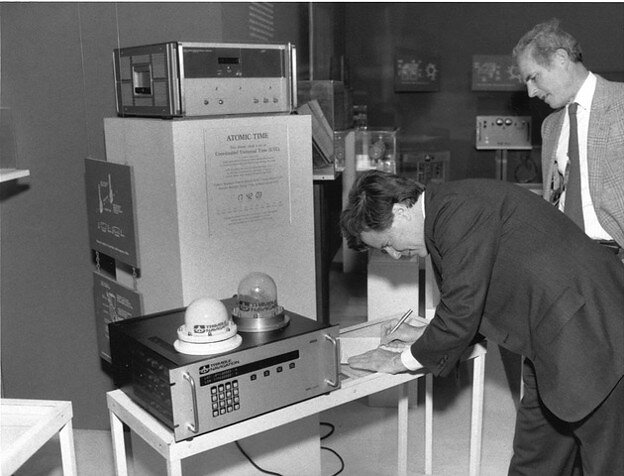
A sale also answered a different question from the one a prototype answered. Someone had agreed that the information was worth buying. The satellite infrastructure belonged to a much larger public undertaking; Trimble's task was to put its signals to work. Commercialization lived in that distance between an available signal and a customer willing to pay for a useful result.
Seven satellites and a smaller question
Then came 1986. The Challenger disaster interrupted the planned expansion of the GPS constellation. There were only seven GPS satellites in orbit. The navigation future on which Trimble had wagered was delayed, and lenders became reluctant. A small business could redesign a receiver. It could hardly arrange its own replacement launch program.
The company turned toward surveying and timing. Surveyors could make valuable measurements without the continuous coverage needed for everyday navigation. Timing customers needed synchronization. Both uses encouraged Trimble to look more closely at what GPS supplied: information about position and time, with applications extending beyond finding a route.
This was a severe test of the original idea. If your business depends on a system still being assembled, its construction schedule becomes part of your balance sheet. The response was to ask a smaller question. Which customers could use what was already available? A narrower application could keep the company working while the larger market waited for the sky to fill.
That episode also helps explain why precision industries became so important to the company. Surveying asks a receiver for a measurement that can be used in a job. Its value is tied to the work it enables. GPS could become useful before it became ubiquitous, provided someone was willing to learn the customer's problem in enough detail.
“Our assumptions are more confining than the laws of physics.”
Charles R. Trimble · a favorite expression recorded in 1992
Freedom with someone checking in
Trimble led the company through its initial public offering in 1990 and left in 1998. During his tenure, its work extended into real-time kinematic positioning, bringing centimeter-level precision to practical applications. Surveying, construction, agriculture and transportation offered places for that precision to earn its living.
His management credo was brief: “Trade autonomy for commitment.” The wording has a bargain inside it. An engineer receives room to work and accepts responsibility for the result. That arrangement depends on a leader being interested enough to understand the work. Freedom handed out without attention can feel remarkably like abandonment.
Bryn Fosburgh, a longtime Trimble executive, later recalled Charlie walking through the office in the evening, stopping at engineers' desks to ask what they were doing. It is a modest picture of leadership: a conversation over a current problem. The technical curiosity that brought him into engineering had a social use too. Asking about someone's work was a way to stay connected to the people doing it.
Away from the office, the picture becomes quieter. In 2016, Trimble and his wife Lily welcomed interview visitors to a family holiday home on a wooded island near the U.S.-Canada border. He had sketched its design for his aunt and uncle in the 1970s; local craftspeople built it using island wood. The interviewer described a house without a display of career trophies. Even a navigation founder is allowed somewhere to stop moving.
Before an idea has respectable evidence
Trimble's later work brought him back to Caltech as a trustee and supporter of early research. The Trimble Fund began in 1996. In 2022, the Trimble Foundation added an $8 million gift to expand its resources. Charlie described its timing precisely: “The Trimble Fund comes in before proof of concept.”
That is a recognizable stage in his own history. Before a receiver is ready for sale, someone must spend money finding out whether a design works. Before a research proposal can produce persuasive evidence, someone must pay for the attempt. Funding the earliest work gives an idea time to become convincing. It also means accepting that conviction and certainty are different things.
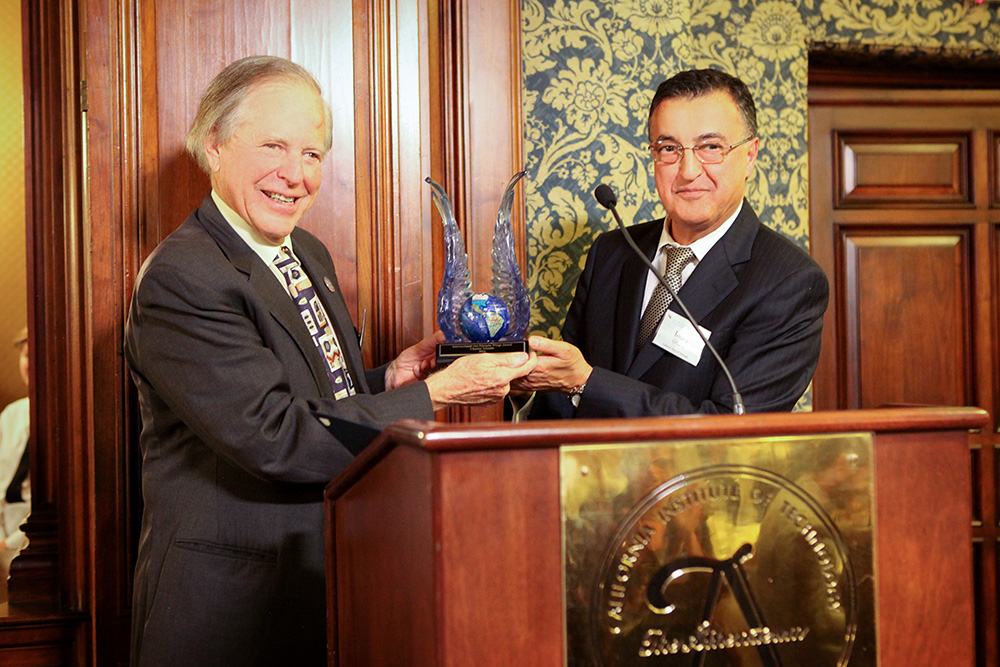
The honors have accumulated: Caltech's Distinguished Alumni Award in 1995, the International von Kármán Wings Award in 2016, and selection for the American Geographical Society's O.M. Miller Cartographic Medal announced in August 2026. His public conversations have continued as well. At the 2025 GoGeomatics Expo in Calgary, he discussed early GPS and the possibilities of software-based receivers.
The detail that lingers is smaller than any medal. Asked in a 2022 interview whether he had foreseen what GPS would become, he answered, “No, of course not.” The laugh accompanying the answer makes room for everything that had to be learned along the way. He had seen enough possibility to start. The rest required customers, colleagues, redesigns and repeated adjustments to an inconvenient world.
A canceled project gave Charles Trimble something to work on. A customer gave it a purpose. Years later, his research funding gives other people a similar interval in which to find out what an unfinished idea might become. Somewhere between the first sketch and the convincing evidence, there is still plenty of work to do.
Follow the coordinates
More conversations, the early engineering, and the company that grew from them.