Charles Owens had lost the company. He still had the list. On a flight home after an unsuccessful bid for Superfos, the roadbuilding business he had run, his fellow bidder Ned Fleming asked whether they could build another one. Owens reached into his wallet and produced a small piece of paper. It contained ten prospective acquisitions. “Absolutely, these are our next 10 acquisitions,” Fleming recalled him saying.
Fleming told that story at Construction Partners’ 2025 investor day. By his recollection, they eventually bought six or seven of the businesses on the list. Corporate origin stories usually acquire a conference room, a whiteboard and an implausibly useful napkin. This one has the considerable advantage of a wallet: an object designed to keep things its owner expects to need.
Owens helped found Construction Partners in 2001 and served as its president and chief executive until March 2021. The business went public under the ticker ROAD in 2018. His contribution began much earlier, in the accumulated knowledge that made a list of companies more useful than a general intention to start again. He knew the industry from the clerk’s desk through to the chief executive’s office.
The education between shifts
Born in Enterprise, Alabama, in 1950, Owens grew up in nearby Midland City and graduated from Dale County High School in 1968. His introduction to roadbuilding came through summer work at Couch Construction. In 1971 he joined full time as a clerk, while taking night classes at Troy State University in Dothan. He completed his undergraduate business administration degree in 1980.
His work at Couch took him into field supervision, estimating and management, across ready-mix concrete and asphalt. Sam Torrence and Quin Flowers were among the owners under whom he learned. That progression gave him several views of the same business: the price attached to a job, the work required to complete it and the organization responsible for both.
By the time he became president of Couch, he had worked inside the business he was leading. He subsequently ran Superfos Construction U.S., the North American operation of a Danish public company. At Superfos he oversaw roughly 35 acquisitions and integrations before its 1999 sale. Buying a company and getting it to function within a larger group had become recurring work.
classes at night
begins operating
on Nasdaq
Owens also had a family growing alongside that working life. He married Julia Ann Bryan of Abbeville in 1971, the year he began full-time work at Couch. They had two children, Brandon and Alicia. In his Hall of Fame biography, he credited Julia’s support of the family as part of his success. That acknowledgment gives the familiar outline of work and night school another dimension: a career took shape within a household, with commitments beyond the company.
The two experiences belonged together. Operating jobs exposed him to what happened inside a company; acquisitions required him to consider how another company might fit alongside it. The wallet story catches those years of preparation at a particular moment. A bid had failed. Owens could already name alternatives.
Buying a business without moving its judgment
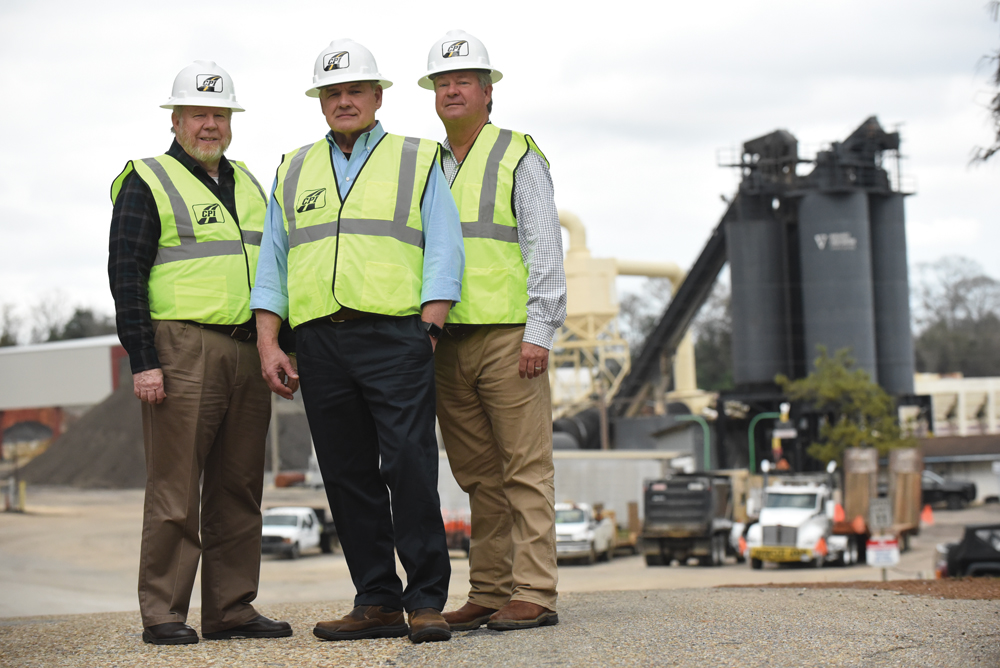
Construction Partners brought Owens together with Fleming, a founding partner of Dallas investment firm SunTx Capital Partners, and finance executive Alan Palmer. SunTx supplied the initial investment backing. Owens brought operating experience in the industry they intended to grow within. Their territory was the Southeast, and their acquisition prospects included privately owned paving and asphalt businesses.
A family company offers a buyer more than equipment and contracts. There are also the people accustomed to running it. Owens’s stated approach was to retain local management and keep daily decisions local, while standardizing important practices and providing support from the senior team. The parent company would grow without asking every decision to make a round trip through Dothan.
That arrangement gave the acquisition strategy a human subject. Many owners were approaching retirement and considering what would happen to their businesses. In 2018, Owens described an interest in smaller family-held companies whose owners wanted to sell. The transaction could provide an exit for the owner while keeping an operating team inside an organization with room to expand.
The arrangement also created a route for people to advance. A larger group could have more positions and more responsibility to offer than a single family business. Palmer pointed to those opportunities when discussing the company’s acquisitions. Keeping managers involved therefore served two connected purposes: continuity for the business joining the group and a supply of experienced leaders for the group itself.
Owens was attentive to a seller’s timetable. During a December 2020 earnings call, he explained that owners knew their own goals and what they wanted for their companies and employees after leaving. Deals would not all arrive together. Having several conversations underway allowed the company to wait for timing and cultural fit. An acquisition prospect was a conversation with an owner who had plans of their own.
A road crew goes to Times Square
On May 4, 2018, Construction Partners celebrated its initial public offering by ringing Nasdaq’s closing bell. The company team appeared in Times Square in hard hats and bright safety vests. ROAD was an unusually economical piece of financial branding. Anyone uncertain what the business did could consult either the ticker or the clothes.
At the listing, the company served customers in Alabama, Florida, Georgia, North Carolina and South Carolina. Public work included roads, bridges and airport runways. Private work extended to paving and sitework for developments, industrial parks and local businesses. The public-company identity gathered together work that remained rooted in particular places and projects.
The business had grown through both acquisitions and new operations. Its investor materials distinguish between acquiring an established platform, adding businesses around that platform and opening new facilities. Those methods gave Construction Partners several ways to expand. An acquisition could bring a new team or market; a new operation could extend a business already inside the group.
By August 2018, the acquisition of Scruggs in Georgia had brought the company’s acquisition count to sixteen since its founding. Five were classified as platform deals, with the others adding to the existing businesses. Its payroll was then reported at 2,150, compared with 1,150 in 2010. Those figures describe an organization adding people as well as assets. They also help explain why the ability to retain and develop operating managers occupied so much of the founders’ attention.
The listing made the company’s scale more visible. It also placed a familiar operating approach in front of a wider audience. The family-business acquisitions, local management teams and regional focus had preceded the stock-market ceremony. For Owens, the milestone came after years of putting those pieces together. Times Square supplied the occasion to gather for a photograph.
The buyer’s successor had been a seller
Jule Smith entered Construction Partners through precisely the kind of transaction Owens pursued. In 2011, Smith’s family business, Fred Smith Company, joined the group as its North Carolina platform. Smith continued leading the operation. He spent nearly a decade inside Construction Partners before the company announced that he would become chief operating officer, effective October 2020.
In March 2021 came the next handoff. Smith would succeed Owens as president and CEO at the close of business on March 31. Owens would become vice chairman, remain active and continue participating in strategy, growth and acquisitions. The founder’s experience would still be available while another executive took responsibility for running the company.
“I believe this transition makes our company even stronger.”
Charles E. Owens, March 2021
Smith publicly credited Owens’s mentorship and his ability to build industry relationships. Their shared history gave the announcement substance: the successor had spent years leading an acquired business inside the organization. He had experienced its model from the position of a family-business operator before taking charge of the parent.
The handoff also extended Owens’s central management choice into the leadership of Construction Partners itself. An operator brought into the group through an acquisition could rise to its top job. The company was then describing a workforce of approximately 2,500. Responsibility for those people moved to Smith, with Owens continuing beside him on the board.
The next address is still Dothan
Owens’s public recognition remained close to home. In April 2024, he was inducted into the Dothan Business Hall of Fame. Two years later, he joined company and civic leaders at the groundbreaking for a $20 million corporate headquarters on Whatley Drive. His comments concerned the people the building would accommodate and the local hiring it could support.
“Dothan’s our home, and it’s our headquarters,” he said. He named accounting, technology, operations and legal among the functions already based there. For a company whose growth could be described through acquisitions across states, a new headquarters represented another kind of investment: making more room in the city where its central team worked.
Owens remains Construction Partners’ vice chairman. He also joined the board of Suncrete, bringing his construction-materials and acquisition experience to the ready-mix concrete business.
His later roles keep him near the work that occupied much of his career: choosing businesses, advising operators and considering how a group can grow. The names and titles have changed since Couch Construction. The industry has supplied enough successive jobs to fill a lifetime, beginning with summer work and a clerk’s position.
There is a pleasing economy to Fleming’s recollection of that flight. A complicated future was represented by ten names on a small piece of paper. Owens had spent years learning enough to write them down. When the question came about building another company, he could reach into his pocket.