Consider the humble brochure. Before anyone reads it, somebody has approved the artwork, checked an address, chosen a paper, ordered a quantity and decided where the boxes will go. Multiply that exercise across a company’s branches. The object is simple. The coordination gets interesting. That gap is where Champion Industries, the Huntington, West Virginia printing company behind Chapman Printing, makes its case.
- Commercial printing connected to mailing, storage and fulfillment.
- Local account teams backed by shared production capabilities.
- An online brand portal for organizations ordering across locations.
Its history offers a useful puzzle. How does a business built around presses become a business concerned with permissions, inventory and the person who ordered the wrong version? Look closely, and the physical product starts to seem like one step in a much longer transaction.
The job can travel. The relationship stays put.
Champion’s legal birthday is July 1, 1992. The operating story is older. In 1964, a company formed by Marshall T. Reynolds and John Harrah bought Chapman Printing from John Chapman. Acquisitions subsequently expanded the printing operation and added office supplies and furniture. Champion completed its public offering in January 1993.
There was a practical idea inside that expansion: a customer could deal with familiar local staff while work moved to the equipment suited to it. The company’s historical description gives a wonderfully specific example: sell a color job in Charleston, print it in Parkersburg, bind it in Huntington.
Illustrative route described in Champion’s 2015 filing. Shared equipment, one customer relationship.
That arrangement avoids installing an identical factory in every market. It also changes the salesperson’s promise. The representative is selling access to a network, with responsibility for making its parts cooperate. For the buyer, the appeal is having someone to call when the deadline gets uncomfortable.
The expensive detour
Expansion also took Champion somewhere much riskier. In September 2007, it bought Huntington’s daily newspaper, The Herald-Dispatch, for $77 million before adjustments. The financing included a $70 million term-loan facility and a revolving commitment of up to $30 million. This was a substantial bet alongside the print business.
The initial picture was encouraging. Champion announced record fiscal 2007 net income of $6.08 million; the newspaper contributed about six weeks of results. The acquisition rationale included diversified cash flow, overlapping functions and a platform for growth. Those were the expectations. The later filings tell a more difficult story.
Purchase price before adjustments; sale proceeds after customary costs. These figures are transaction values, not a calculation of total investment return.
Champion later attributed its 2011 and 2012 losses primarily to newspaper-related goodwill and intangible-asset impairments, with an additional deferred-tax valuation allowance in 2012. By 2013, debt pressure was explicit. The newspaper sale brought approximately $9.7 million after selling commissions and customary closing costs, and the proceeds went toward debt repayment.
It would be tidy to describe this as a sudden conversion to discipline. The documents support a narrower conclusion: the expansion assumptions had met losses and financing constraints, and Champion sold assets. The distinction matters. Businesses change course through cash requirements as well as through ideas.
The warehouse meets the browser
Today, Chapman’s offer brings the story back to organizations that need things made and delivered. Its website puts an account representative and customer-service team beside a customizable online brand platform. The Huntington chamber’s description emphasizes fitting that platform to an organization’s workflow and keeping approved collateral available across departments and locations.
“the personal touch of a local partner and the capabilities of a national operation”Chapman Printing’s description of its service
Imagine a branch manager ordering a fresh batch of stationery. This is an illustrative use case: headquarters approves the design, the manager selects an authorized item, and the supplier handles production or draws from inventory. The benefit depends on removing repeated decisions. Nobody needs another email asking which logo file is current.
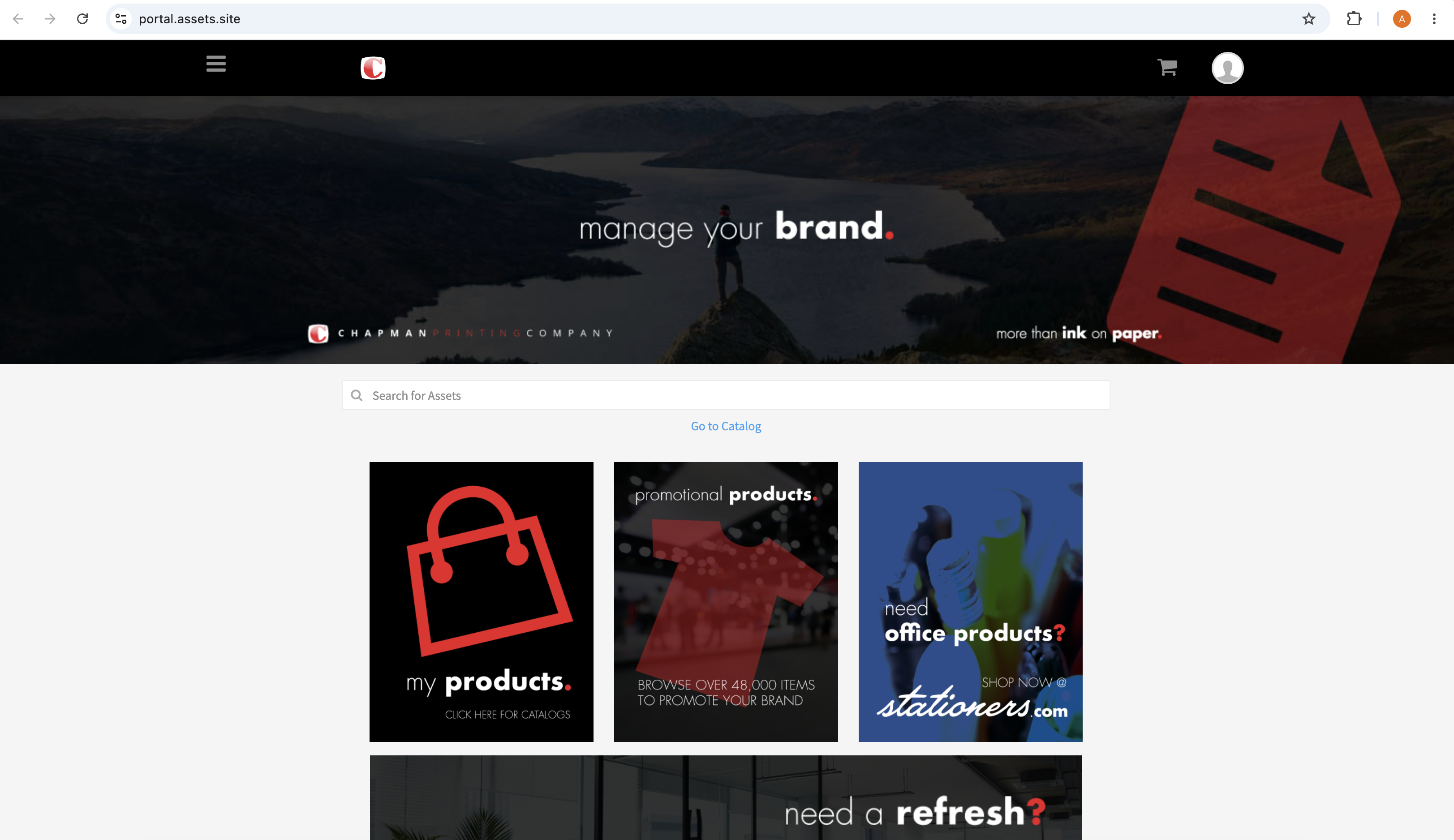
The portal is the visible doorway. Behind it sit choices about quantities, storage and replenishment. A clean ordering screen cannot rescue an obsolete template or an enthusiastic over-order. Buyers still need rules about who approves changes, who owns inventory and when old stock should disappear.
Paper has a surprisingly long job description
The range runs from sales collateral to operational paperwork. Chapman lists carbonless forms, tags, tickets and checks alongside brochures. Its direct-mail work includes list handling and personalized printing. Wide-format products move the message onto windows and walls; merchandise puts it on objects people carry away.

The business model follows those needs: sell manufactured print and distributed products, then handle related services. A 2005 filing already included warehousing, distribution and reporting within fulfillment. Online ordering extends that relationship. Treating the company simply as software would miss the machinery, materials and delivery obligations supporting the screen.
Historically, Champion targeted manufacturers, institutions, financial-services companies and professional firms. The common requirement is repeat work with consequences: a document must arrive, a form must function, a location must have approved materials. That puts Champion between a neighborhood print shop and the larger providers competing for organizational accounts.
Count the handoffs before the copies
For a prospective customer, the sensible comparison starts with the entire job. Specify proofs, quantities, personalization, postage, freight, storage and replenishment. Ask who corrects a mistake. A low printing price can leave substantial coordination on the buyer’s desk; a broader service needs to earn its additional cost.
For example, a buyer comparing two suppliers could give both the same branch list, reorder schedule and artwork requirements. Then compare the complete proposal, including the work employees would still do internally. This is a purchasing exercise, not a promised Champion saving. Its purpose is to make coordination visible enough to price.
There is another useful question: what happens when the design changes? A supplier may have printed everything correctly and still be holding boxes that nobody should use. Agreeing on approval authority and stock disposal before production gives the relationship a better chance of working. The portal makes choices accessible; the customer must make those choices sensible.
A simple one-off order may offer little reason to assemble that relationship. A company with repeated requests across locations has more to gain. The transferable lesson is to map where work gets handed off, then put clear ownership around the troublesome transitions. Champion’s most interesting product may be the distance between ordering a brochure and knowing it reached the right hands.