A childhood spent visiting cement plants is an unusual preparation for a career in taste. Chai Mishra grew up visiting steel mills, warehouses and food-processing facilities, accompanying the world of his father’s trading company. The interesting part of a product was what happened before anyone bought it. Somewhere between the factory gate and the shopping basket, an ordinary object acquired a price, a story and a surprising number of travelling companions.
Most customers encounter that journey in reverse. They see a price tag, perhaps admire the packaging, then give the matter precisely as much thought as a Tuesday shopping trip deserves. Mishra made the journey itself his subject. His career has taken him from hardware supply chains to an online grocery experiment, then to The Essential, which now sells furniture and home goods directly from factories. Along the way, he has kept returning to an awkward question: what, exactly, are we paying for?
The question has room for both accounting and ethics. It asks how much a producer receives, how much the customer spends, and what happens in between. It also makes for a peculiar professional identity. At a party, announcing an interest in supply chains risks being stationed beside the coats. Mishra has built a company around it. More recently, he has put himself behind a microphone to ask other people how they build things.
A factory before a lecture hall
Born and raised in New Delhi, Mishra moved to Berkeley at 17 and enrolled in mechanical engineering at the University of California. The choice suited his interest in how things were made. His grandfather’s joke about having “refractories in my blood” suggests that the family had noticed this tendency well before a university admissions office did.
He left the engineering program and went to work on bringing products to market. His work took him through several countries, connecting designers and hardware businesses with the practical business of production. There is a particular education in that work: a promising design still needs someone to manufacture it, a price that holds together, and a route to the person who wants it.
Berkeley nevertheless supplied a consequential introduction. Mishra credits entrepreneurship teacher Ken Singer with introducing him to startups and Silicon Valley. That connection matters because it complicates the familiar dropout story. Leaving a course and learning something lasting from a university can belong to the same life. The institution supplied a vocabulary and a relationship that outlasted his enrollment.
The coffee that sent him back
While working for a coffee company in Germany, Mishra spent his days talking with farmers and considering the long route between their work and a retail purchase. The company wanted to connect customers with green coffee beans. For Mishra, the conversations opened up a larger problem: a supply chain could be expensive for the buyer while returning very little to the person at its beginning.
He returned to Berkeley to start Movebutter. His account of that decision carried the indignation of someone who had looked behind a curtain and disliked the arrangement of the furniture. “I felt like a whistleblower,” he said. His response was to try building a retailer that worked directly with producers and gave customers a clearer view of what they were buying.
There was a practical obstacle beyond price. Online food shopping requires a small act of faith. Someone else chooses the avocado. A photograph cannot tell you whether the fruit will be ready for dinner. Mishra’s early answer was a smaller, selected range and more information about its makers. The retailer would take responsibility for choosing, and the customer would have to decide whether that judgment deserved trust.
comparison Mishra used
Movebutter proposition
The mayonnaise department gets a trim
When Movebutter launched nationally in June 2017, Mishra described a business organized around frequently purchased staples. His team had studied grocery sales and concluded that a relatively small portion of the assortment generated most of the buying. They wanted to concentrate on those products, choose suppliers carefully, and avoid reproducing an entire supermarket on a screen.
That approach sounds pleasantly simple until someone has to execute it. A long aisle lets customers make their own compromises. A short list transfers more of the decision to the retailer. Choosing a supplier becomes an editorial act, with a delivery schedule attached. If the chosen product disappoints, there is less opportunity to hide behind the abundance of alternatives.
The logistics also resisted the tidy pitch. In the launch period, suppliers packaged products before sending them to a San Francisco sorting facility. Delivery could take between one and five days, depending on location. Mishra favored careful forecasting and limited inventory over surplus. Fewer products could reduce complexity, but each remaining product still needed to arrive in usable condition, at a price customers accepted, when they expected it.
For a founder interested in the invisible middle of commerce, this was a suitably unforgiving arena. Grocery shopping returns every week. The customer’s verdict is repeated, practical and rarely sentimental. An appealing explanation of the supply chain may earn a first order; the contents of the box have a considerable say in the second.
Let the customers argue about soap
Mishra’s early customer conversations extended into product decisions. He described asking shoppers which soap variety the company should stock and sending samples for weekly taste tests. Customers could record their impressions and discuss them in the community’s Facebook group. Granola sweetness and milk sizes became subjects on which a founder was expected to have an open mind.
There is something usefully unglamorous about this version of entrepreneurship. The grand ambition was a different retail system. The working conversation concerned what someone actually wanted in the cupboard. Mishra described enjoying exchanges with customers across generations about how they would use the products. An online store, in this telling, could have some of the conversational life of a neighborhood shop.
Customer participation also raised the stakes of listening. Asking people to vote creates an expectation that the answer matters. It gives the business information, but it gives customers a memory of having been consulted. For a retailer hoping to substitute trust for endless choice, those ordinary exchanges were part of the product.
“I felt like a whistleblower.”
Chai Mishra, on the supply-chain experience that preceded Movebutter
Membership, then ownership
The business subsequently operated as Move, with a membership model and a continuing emphasis on a selected assortment. Its 2019 fundraising material explained that Movebutter had been the beta. Mishra described ending that test and preparing the official Move launch. The changing names can obscure a more useful continuity: he was still experimenting with the relationship between the maker, the store and the buyer.
Membership made that relationship explicit. In the 2019 offering, a year normally cost $199. An upfront fee put a visible price on access to the retailer’s selection and service. It also asked customers to commit before a long sequence of weekly purchases could establish the habit. The company’s economics and the shopper’s confidence were unusually close neighbors.
Raised from 1,246 investors on Wefunder. The campaign is marked last funded January 2021.
Move also invited people to become investors. Its Wefunder campaign records more than $1.18 million raised from 1,246 participants and identifies January 2021 as its last funded date. The distinction matters: these are historical fundraising figures, rather than a statement about the company’s present sales or value. They show that the community idea reached beyond deciding which products belonged on a shelf.
The company attracted a more familiar sort of recognition, too. Mishra appeared on the Forbes 30 Under 30 Retail & Ecommerce list for 2021. Investors associated with the business included Joe Montana and Muse’s Matt Bellamy. An investor list can be an entertaining dinner-party detail. A customer still has to like what arrives in the parcel.
From the pantry to the living room
Today, The Essential’s Y Combinator profile describes a factory-direct business selling furniture and home goods. It lists Mishra as founder and CEO and places the company in the Winter 2017 batch. The merchandise has changed considerably from the early grocery pitch. The interest in shortening the distance between production and purchase remains recognizable.
A chair makes that question tangible in a different way from a jar of almond butter. Customers consider materials, appearance, price and how an object will live in their homes. The retailer’s selection still carries a judgment. Factory-direct selling places the manufacturing relationship near the center of the proposition, where Mishra’s career had put it from the beginning.
His current public work also includes serving as an entrepreneur in residence at Wefunder. That role follows a business history in which customers were invited into both product selection and funding. There is a consistent interest here in who gets to participate. The experiment has involved goods, money and, increasingly, conversation.
A warm introduction to the next chapter
In September 2025, Mishra introduced Warm Intro, a video podcast presented by Wefunder. He explained that conversations with other builders had helped him through running his own company, and that he wanted to make those exchanges available to more people. The guest list reaches beyond startup founders to artists, chefs and political figures.
The format gives his curiosity another job. Instead of asking how an object reaches a market, he can ask how a person arrives at a decision. Episodes have included the street artist fnnch and illustrator George McCalman. The range allows the show to treat building a business and making creative work as subjects that might have something to say to each other.
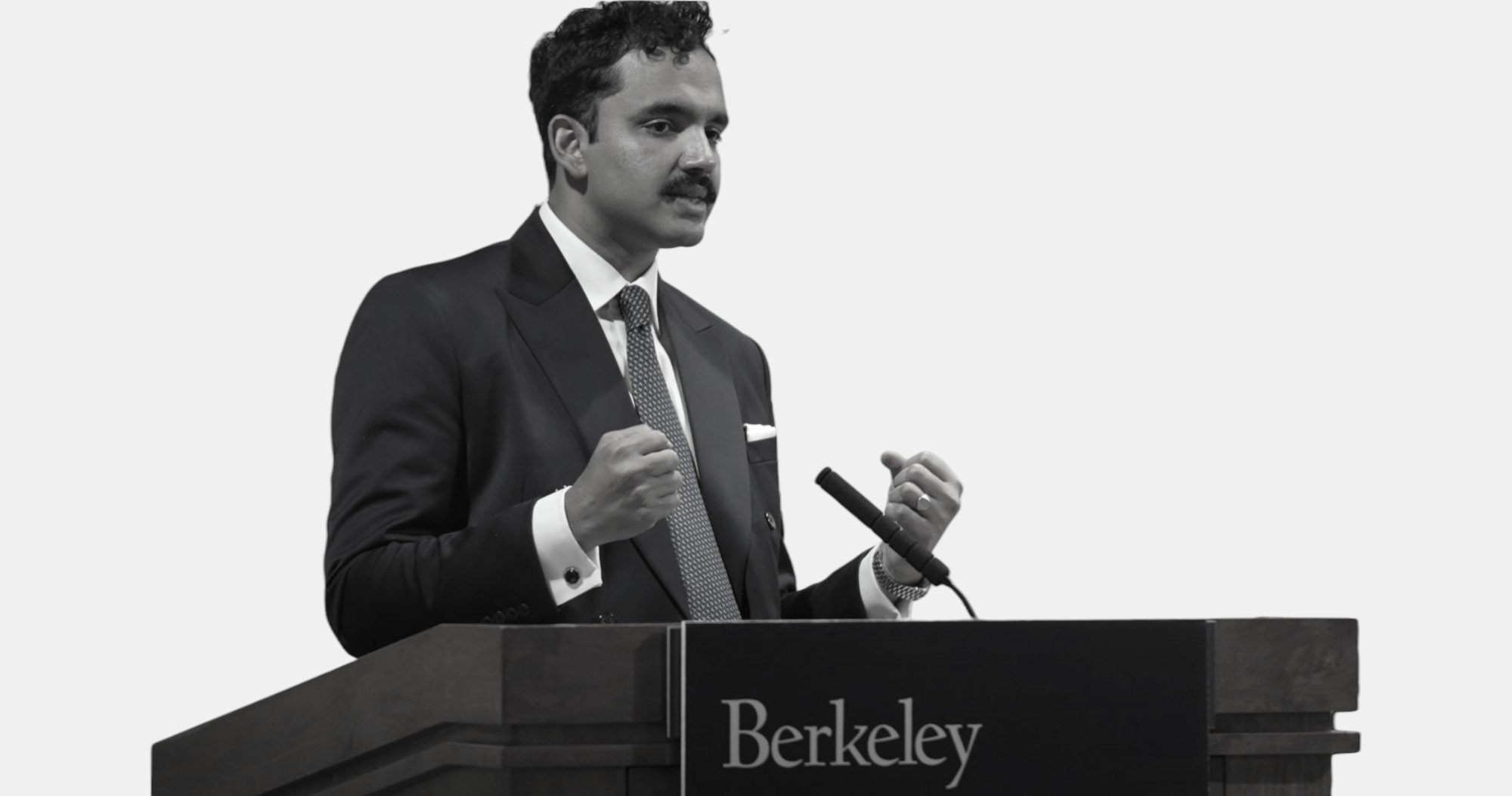
Berkeley brought the story back around in 2025, when he spoke at the Sutardja Center’s inaugural certificate ceremony. The student once introduced to entrepreneurship was now addressing a graduating group. He still lives in Berkeley. Between the factory visits, the grocery experiments and the microphone, the persistent feature is an appetite for the work behind the finished thing. Before the price tag, before the polished introduction, someone has to make it.
Follow the work
Article photograph: Chai Mishra’s personal website.