The most ignored object in a hotel room is also one of its most stubborn. It sits beside the bed, wearing a tiny paper map of the property: front desk, housekeeping, room service, emergencies. The guest may never lift it. The hotel still has to know that it works. Cetis, Inc. has spent decades turning that awkward fact into a business.
From a campus at the base of Pikes Peak in Colorado Springs, Cetis designs, manufactures and supports analog and VoIP telephones under three names: Teledex, TeleMatrix and Scitec. Together, the company says, those brands have put more than 30 million phones into at least 100,000 locations. The customer is usually not a person choosing a cute gadget. It is a hotel owner, franchise group, management company, hospital, university or government buyer trying to make hundreds of rooms behave the same way.
That distinction explains nearly everything. A consumer phone wins with novelty. A hotel phone wins by surviving spills, misplaced cordless handsets, renovation cycles, old cabling, new phone systems and the occasional guest determined to discover whether plastic can bounce.
A scientist listens to the refurbished-phone market
Bing N. Sun did not arrive in business through telecom. He studied physics and materials science, completed graduate work in France and came to the United States as a researcher. After repeated searches for academic funding led to a plateau, he changed direction. His line about the pivot is refreshingly plain: “I didn't have millions to start a business, so I went into the consulting business to sell knowledge.”
Sun founded Scitec - short for Science and Technology - in 1993 as a consulting and custom-manufacturing company. Listening to customers revealed a market hiding in plain sight. Hotels were buying large numbers of refurbished 2500 Series desk phones because they needed reliable sets at economy prices. Scitec designed an alternative under the Aegis name and, before releasing it in 1995, pre-sold more than 30,000 phones to over 200 hotels.
This was the change of mind that mattered. Sun did not begin with a love for telephones. He began with a customer signal: buyers were already spending money on an imperfect substitute. The first product was not a science project seeking a market. It was a cleaner answer to an observable purchasing habit.
The dollar cost of starting Scitec has not been made public. The useful numbers are behavioral. The company says it initially grew without bank debt and posted 120 percent growth for three consecutive years. It sold directly to hotels until June 1998, then moved to channel distribution. Maintenance Warehouse, now HD Supply, began carrying its products, while an endorsement from Choice Hotels gave an unfamiliar supplier institutional credibility.
Three brands, one procurement decision
By 2005, Scitec was growing, debt-free and competing with TeleMatrix, then the second-largest specialist in hotel phones. Sun learned TeleMatrix might be for sale. The deal closed in 2006 with bank financing, which the company says it repaid within 18 months. In December 2009, the group acquired the assets of Teledex, the established category leader. Cetis, Inc. was formed in 2010 to hold the three brands.
The acquisition prices are not public. What Cetis bought is easier to see: coverage. Scitec serves economy and utilitarian applications. TeleMatrix leans into engineered midscale designs. Teledex stretches from basic models to the more design-conscious end of the guest room. A distributor can quote multiple tiers without introducing a different manufacturer, support process or faceplate vendor.
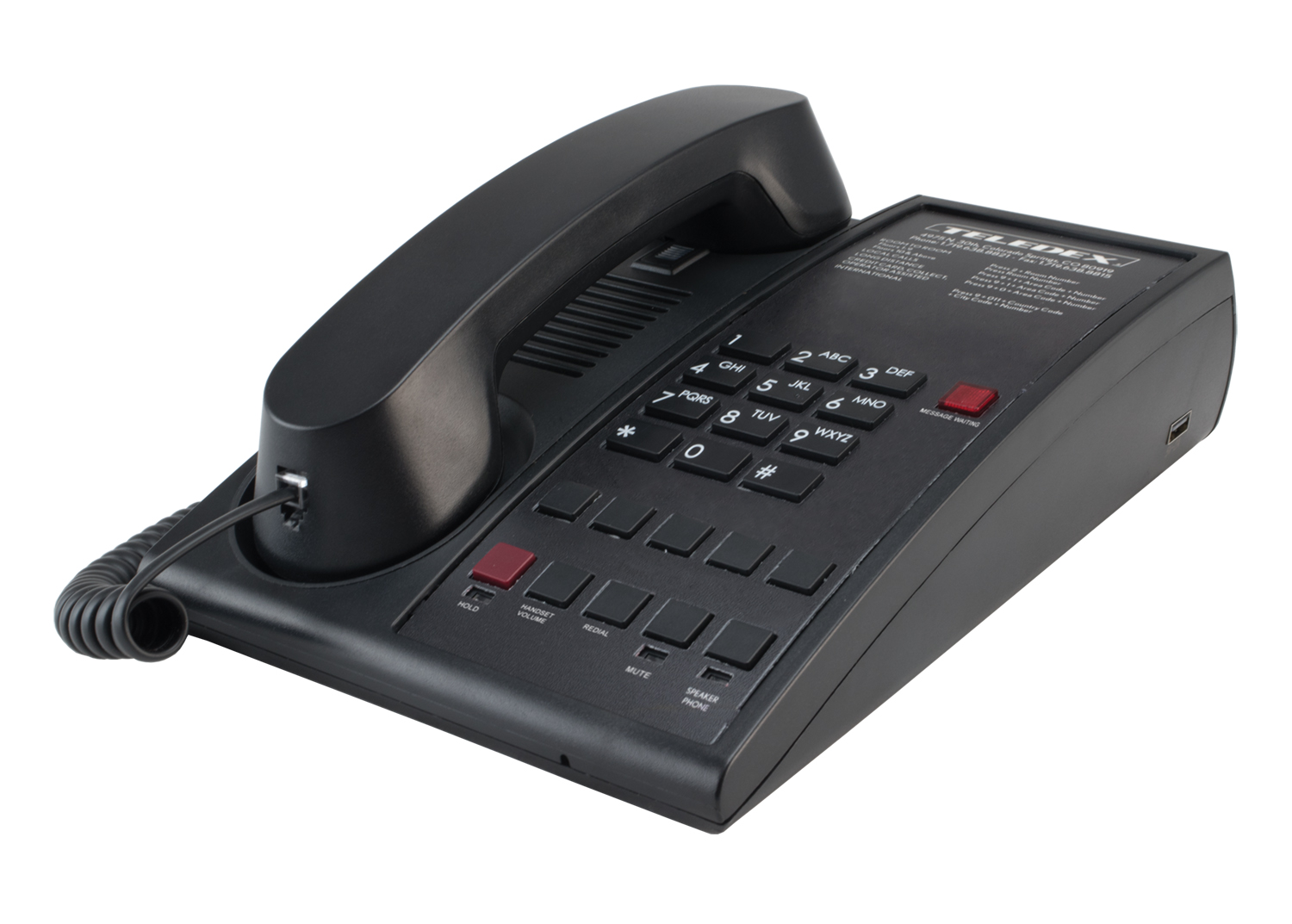
The product is a phone. The sale is risk removal.
Cetis's catalog can look comically specific: single-line or two-line, analog or SIP, corded or cordless, zero to 10 guest-service keys, lobby or bedside, ash or black, speakerphone or no speakerphone. That variety is the point. A hotel brand can choose one design language while accommodating different wiring, room types and budgets across a portfolio.
The differentiators are less about making calls than making a deployment predictable. Custom faceplates put the hotel's own instructions and service numbers under a clear overlay. OneTouch retrieves voicemail. AutoSync pairs a replacement cordless handset when it lands in the base, reducing the chance that a handset moved from another room becomes a maintenance ticket. USB ports turn the phone's guaranteed patch of nightstand into charging real estate.
Compatibility is another product. Cetis publishes SIP documentation and lists interoperability with systems from Avaya, Cisco, Mitel, NEC, Panasonic, BroadSoft and others. Its partnership with TRIAX addressed a nasty renovation constraint: older hotels with coaxial cable but no Ethernet to each room. Ethernet-over-coax could carry a Cetis VoIP endpoint without opening walls for new cable. That does not make the phone exciting. It makes the project possible.
What failed first?
Between 2000 and 2006, Cetis engineering leader Greg Danner evaluated more than 20 cordless-phone samples and rejected them. Competing sets were already appearing in hotels, but he did not believe they could survive deployment by the hundreds. TeleMatrix spent another year developing the 9600MWD before its 2008 release.
That story captures the hidden requirement of institutional hardware. A sample that works on a desk is not the same as 500 units that work after handsets migrate between rooms, batteries age and housekeeping rearranges the nightstand. Cetis could afford to be late because the buyer's fear was not missing a feature. It was multiplying a failure across every room.
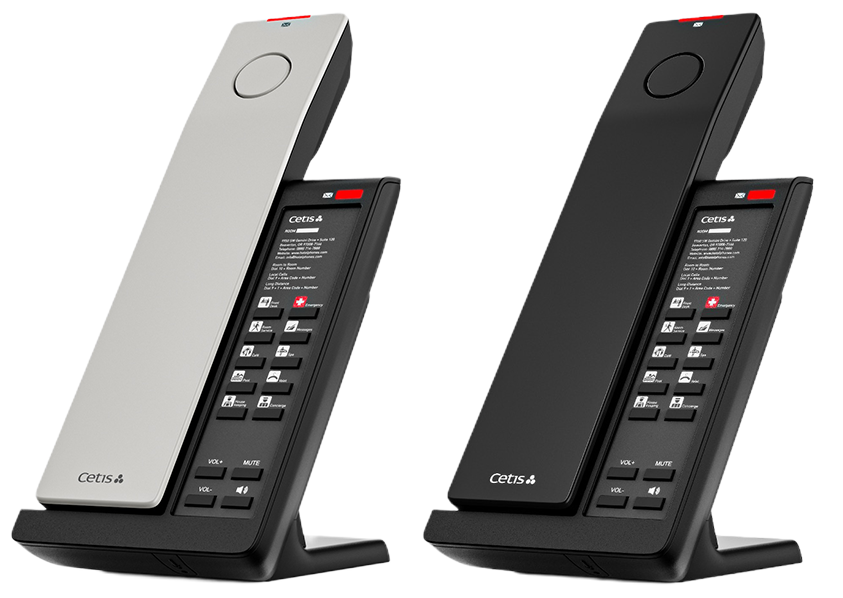
The phone that is trying to disappear
The 2026 V-Series is Cetis's current answer to a shrinking visual role. It stands 7.4 inches tall on a 3.5-by-4.5-inch footprint, with the dial pad hidden beneath the handset. It supports Power over Ethernet, HD voice, up to 10 programmable service keys, hearing-aid compatibility and swappable color accents. The matte finish resists fingerprints and scratches. Black and white are standard; custom colors become straightforward at orders of 500 or more.
This is not an attempt to make guests fall in love with a landline. It is an attempt to make a necessary endpoint occupy less space and attract fewer complaints. The design concedes the cultural reality - guests bring their own communication device - while preserving the hotel's operational reality.
Cetis is also widening the account. Its newer appliance line brings kettles, coffee makers and other in-room equipment into the same hospitality channel, while TOPS Printing handles customized communications materials. A 2026 promotion offered discounts on appliance orders of 25 or more and added incentives for buying across categories. The logic is familiar: if a distributor already knows the property, its brand standards and renovation calendar, the next object in the room should cost less to sell.
What another operator can copy
The Cetis playbook is not “find an obsolete object and believe harder.” It is a sequence of specific moves that fit a fragmented, standards-heavy B2B market.
- Watch the workaround. Refurbished-phone purchases proved hotels had a budget and an unmet price point.
- Pre-sell the wedge. Scitec secured volume before committing fully to the first Aegis release.
- Trade control for reach. Direct sales taught the market; channel partners made the model global.
- Preserve old investments. The D Series kept the Diamond faceplate geometry so upgrades discarded less.
- Make support part of the SKU. Programming, faceplates, certifications, spares and documentation reduce project risk.
- Acquire coverage, not sameness. Three brands kept distinct positions while sharing ownership and infrastructure.
It works when buyers manage fleets, failure is costly, standards persist, replacement demand repeats and local partners add installation or procurement value. It is weaker when customers can switch with no operational cost, software eliminates the physical endpoint, buying is concentrated in a few accounts, or distributors cannot earn enough margin to carry inventory. A channel-only model also puts distance between the manufacturer and the user; without disciplined feedback, yesterday's standard can quietly become tomorrow's shelf stock.
Cetis competes with VTech Hospitality, Bittel, AEI Communications and other specialist phone makers, plus the less visible alternative of mobile messaging, apps and in-room tablets. Its defense is not that the room phone will regain cultural importance. The defense is that hotels still prize a known device, a known faceplate and a known replacement path.
The hotel phone survives because it does a modest job under unglamorous conditions. Cetis has organized its company the same way: a broad catalog, a warehouse, a distributor network and enough engineering patience to reject the handset that will fail in room 417. The object may be ignored. The system around it cannot be.