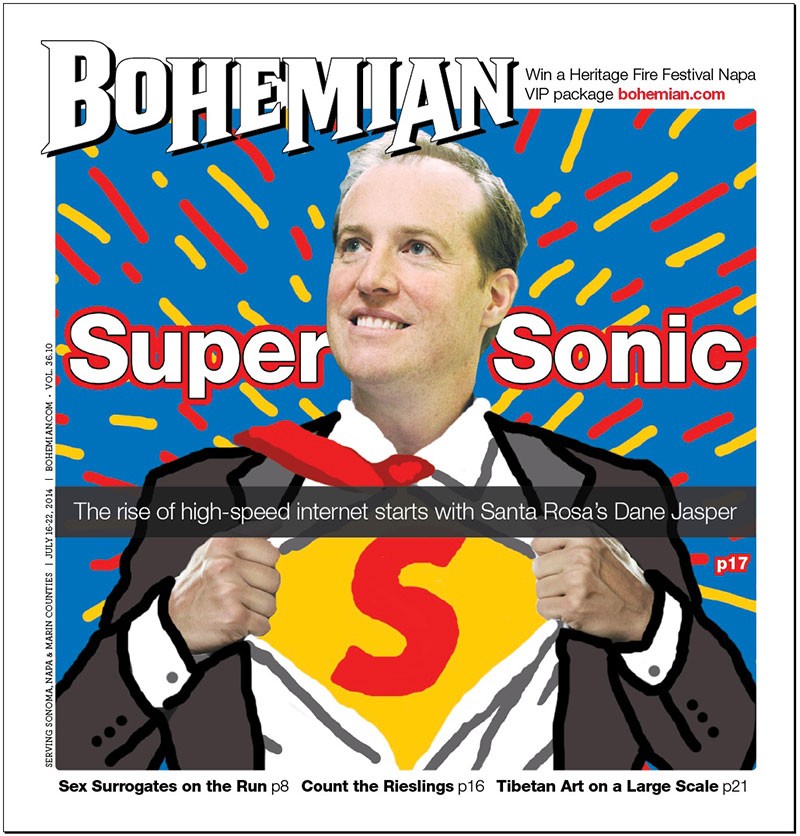
Before Dane Jasper had a company, he had a complaint to investigate. Someone using the network at Santa Rosa Junior College was being rude online. Jasper and his colleague Scott Doty looked into it and discovered something more commercially interesting than bad manners: access intended for the college community was being sold to outsiders. People wanted the internet badly enough to obtain it through somebody else’s account.
For a network technician, that was a problem. For a prospective founder, it was evidence. In 1994, Jasper and Doty started the business that became Sonic. Its early name, Sonoma Interconnect, sounded like a useful local service, which is what it was. The grand historical significance could wait. First, somebody had to get the modems working.
Jasper would spend decades dealing with the awkward position that discovery gave him. An internet provider stands between people and an enormous world it did not create. It collects a recurring payment for opening the door. How much authority should come with the key? His answer would emerge through decisions about networks, customer records, competition and the people who answered the telephone.
A business plan small enough to work
The original ambition was wonderfully modest. Sonic’s own early company history described a plan to finance a 56-kilobit connection to a founder’s home, with 100 customers helping to pay. The business plan went on a yellow pad. Setup fees would cover the initial costs; monthly payments would cover the connection, dial-up lines, electricity and a post office box. The founders were budgeting for a working service, rather than an imagined empire.
That account says they reached the goal within three months. The useful lesson is in the scale of the question. Could enough people share the cost of access to make it affordable? A tiny provider needed a workable answer immediately. The internet might eventually change shopping, employment and courtship, but the telephone bill arrived on a considerably shorter schedule.
Jasper’s professional formation happened around computers people actually needed help using. His work at the junior college included connecting machines and supporting its network. The relationship with Doty grew there, around the practical business of getting people online. Sonic carried that service background into a commercial setting. A connection was something to install, explain and keep running.
The company outgrew its first arrangement, but the early arithmetic helps explain why Jasper remains an interesting founder. His subject is access. The celebrated applications live elsewhere; his work concerns whether someone can reach them, at what price, and under whose conditions. It is a career built around the part of the internet people tend to notice only when it stops working.
Four versions of the same promise
Sonic’s technical history did not follow a straight line from a room full of modems to fiber. Jasper described four major phases: dial-up, DSL, becoming a competitive local exchange carrier, and building fiber. Each required the company to learn a different way of delivering the thing customers still called their internet connection.
The carrier step came in 2006. By 2015, Jasper’s court declaration described service in 125 California cities and board roles with competitive telecommunications associations. His work had acquired a second vocabulary: regulation, access and the conditions under which a smaller carrier could operate. Running a network meant understanding the rules surrounding other people’s infrastructure as well as the equipment on your own.
In December 2011, Sonic announced an ambition to bring gigabit fiber to much of San Francisco. That was a proposal, with substantial costs and regulatory obstacles ahead, rather than a finished map. Jasper acknowledged the scale of the undertaking. It is worth preserving that distinction: a founder’s announcement can be made in an afternoon; a city’s connections have to be built address by address.
Sonic dates its move into fiber construction to 2012. During Jasper’s tenure, the company progressed to offering speeds up to 10 gigabits in 2021. These are milestones in the service’s evolution, rather than a guarantee about any reader’s house. Availability is local, even when the internet itself feels borderless. The map still matters.
- 1994Dial-up access
- ThenDSL service
- 2006Competitive carrier
- 2012Fiber construction
Sonic’s evolution, as described by Jasper and the company’s history.
The records he chose to erase
In an August 2011 blog post, Jasper set out a concrete privacy policy: Sonic retained most IP allocation logs for two weeks, then deleted them because it no longer needed them. These records associated an assigned internet address with a subscriber. He carefully distinguished them from a record of the websites a customer visited.
The distinction matters to his story. Privacy can sound like an attitude, expressed at a microphone and quietly forgotten in a database. Here it became a retention period. Jasper argued that keeping unnecessary records created opportunities for abuse. He also explained that legitimate investigations already had a mechanism for requesting preservation of particular data. His position concerned indiscriminate accumulation.
That same year, Sonic challenged a government order seeking account information connected to WikiLeaks associate Jacob Appelbaum. The company lost the challenge and had to provide the requested information. Jasper described the expense plainly: “rather expensive, but we felt it was the right thing to do.” The outcome gives the episode its weight. The bill was real; victory was not assured.
In 2013, the Electronic Frontier Foundation gave Sonic all six stars in its Who Has Your Back? report. The categories included notifying users, publishing transparency information and defending privacy in court and Congress. It was a company result, achieved under Jasper’s leadership. The score measured specific practices. It also gave outsiders a way to assess a promise that would otherwise be difficult to inspect.
“We don’t own the internet.”Dane Jasper, 2017
Most IP allocation logs: the retention period Jasper described in August 2011.
An extra wire changes the argument
Jasper’s advocacy for an open internet also had a competitive logic. A small provider cannot bargain with large online services on the same terms as a national carrier. He has argued that allowing powerful access companies to extract payments from those services can put smaller competitors at a disadvantage. Customer rights and the economics of running Sonic were connected.
In a 2017 interview, he described the company’s goal as adding a competitive alternative rather than accepting that households should be served by only one or two carriers. Fiber was the means of making that alternative tangible. Symmetric connections gave uploading the same attention as downloading; uncapped service let customers use the connection they had purchased. Those were product choices with an argument inside them.
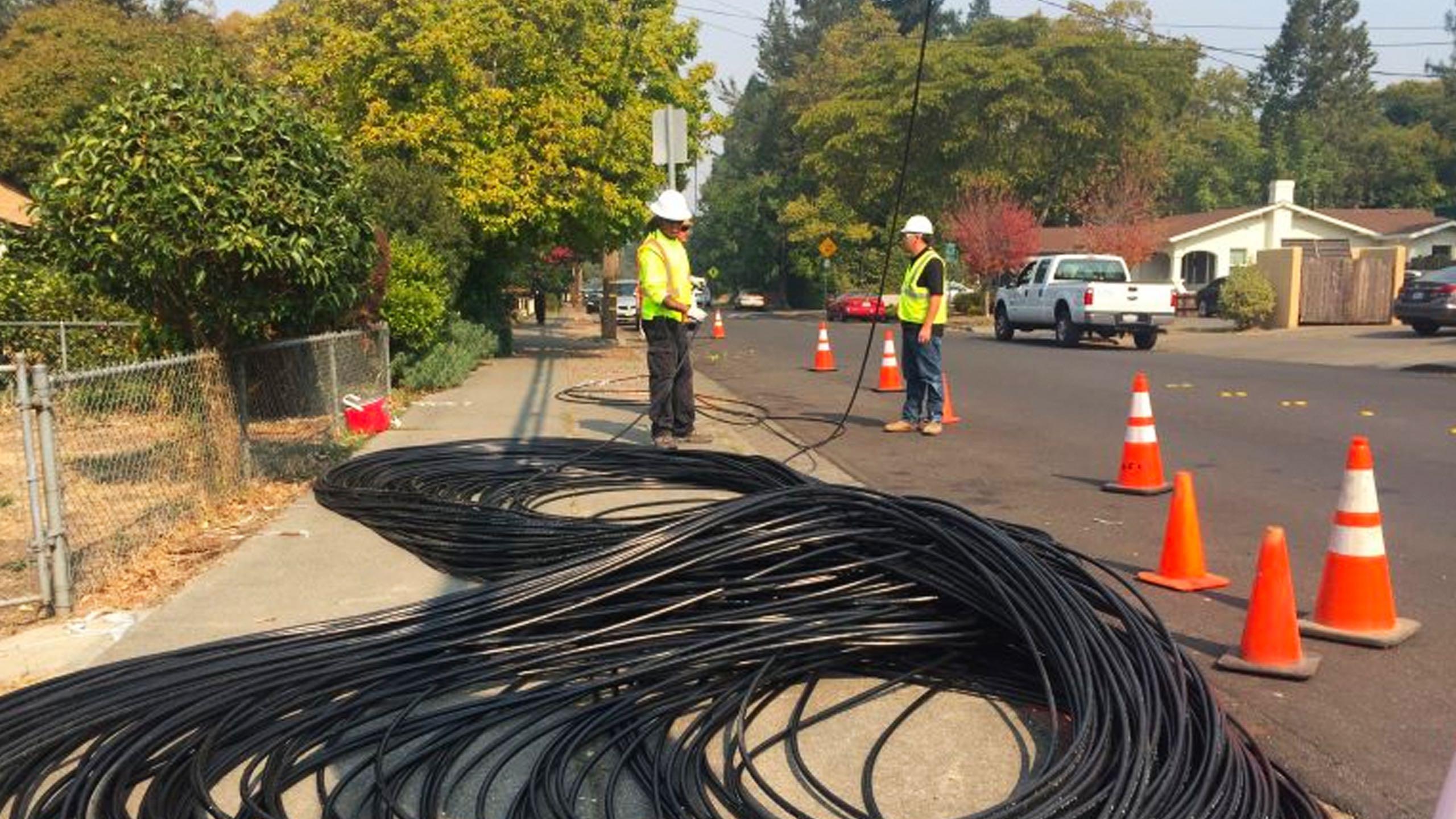
By 2022, that argument was arriving in Healdsburg, where Jasper was also a resident. Sonic’s deployment exposed a curious obstacle: neighborhoods with overhead utility poles could be easier to reach than newer developments with buried utilities. Underground conduits had been installed for the existing providers, without spare room for an additional network. A tidy streetscape could conceal a rather untidy problem for competition.
This is where the founder’s public opinions meet construction. Consumer choice needs space for another cable, permission to attach it, and someone willing to build it. Jasper’s account of Healdsburg made the practical constraints visible. The promise of another provider can be exciting; the work involves poles and conduit. Progress sometimes arrives wearing a safety vest.
The weekend the crew volunteered
In October 2017, fires destroyed a fiber feed serving businesses in Fountaingrove. Jasper wrote an open letter to Sonic’s 423 employees about the response. The outside plant team had been asked to work Saturday to restore service early the following week. They volunteered to work Sunday too, aiming to get businesses back online for Monday morning.
The effort involved three miles of new optical plant and Sonic’s first aerial construction performed by its own team. Elsewhere, employees helped colleagues find places to stay, cooked at shelters and assembled a phone system for a volunteer center. Jasper emphasized that these efforts had happened without his direction. He was describing initiative distributed across the company.
There is a revealing restraint in that letter. The founder could have positioned himself at the center of the response. Instead, he named work done by installers, network staff and other teams, then thanked them. The episode gives substance to the encouraging leadership described by former colleague Eli Marlin. People trusted to solve ordinary problems were making decisions when ordinary operations had fallen apart.
A domain, a farewell, a different chair
Even Sonic’s name needed maintenance. For two decades, the company used Sonic.net because Sonic.com belonged to another business. The eventual acquisition of the matching domain allowed a shorter brand. Jasper’s explanation was practical: the old address had fit the conventions of early network providers, while the company and its customers had moved into a different era.
A smaller farewell arrived in May 2024. Jasper wrote a final message marking the retirement of Sonic’s Linux shell platform. Text-based remote access had once let customers use email, discussion groups and chat through a machine with a much faster connection than their own. By then, he wrote, only about 100 committed users still logged in. The platform was due to close at the end of June.
It was an unusually specific piece of founder nostalgia. He remembered what the service had made possible, while explaining why the company would stop maintaining it. The internet’s early culture was worth recording; an aging platform still demanded work. A business that survived successive technical changes could acknowledge affection without letting affection make every operating decision.
Jasper is now Sonic’s co-founder and a board member, having served as CEO. Nathan Patrick, previously the company’s chief technology officer, leads the business. The change of role places Jasper’s earlier choices in a longer frame. The person who helped start the network remains connected to its governance while someone else takes responsibility for the daily operation.
Sonic’s current history records expansion to a national footprint in 2025, with availability to more than 685,000 homes and businesses. That number describes the company’s reach, not a tally of Jasper’s personal customers or a claim that every address has subscribed. His contribution is easier to see in the continuity: a local experiment in paying for access became an organization capable of building beyond its original region.
The rude college user, the yellow pad, the two-week retention period and the farewell to a shell server belong to the same life in networks. Jasper’s distinctive habit has been to examine what a provider actually needs to do, and what it ought to leave alone. The customer pays for a way into the world. Making that way useful has occupied him for three decades. Deciding how little else to take has been part of the job.
Follow the wires
More from Jasper, and more on the work behind Sonic.