The Co-op That Wired the Backroads Before Big Telecom Bothered to Look
For seventy-plus years a member-owned co-op in Abbeville has been laying fiber down roads the big carriers ignored. When Hurricane Helene knocked the region offline, its offices became the place people went to charge a phone and find a signal.
In 1952, a stretch of Abbeville County, South Carolina had a problem that no phone company wanted to solve: the farms were too far apart, the households too few, and the return on a mile of copper too thin. So the people who lived there did the unglamorous thing. They pooled their money, chartered a cooperative, and strung the line themselves. That co-op still exists. It is now called West Carolina, it runs more than 7,500 miles of fiber-optic cable, and it reaches roughly 100,000 addresses across two states.
The story of West Carolina is really the story of a business model - the member-owned cooperative - applied to a problem the market kept declining. National carriers build where density pays. Venture-backed ISPs raise money on the promise of scale. A co-op does neither. It answers to the customers because the customers are the owners, and it reinvests in the ground it already covers. That single structural fact explains almost everything interesting about the company.
01 / WHAT IT DOESInternet, TV, phone, security - one local number
West Carolina sells the full stack of home and business connectivity: symmetrical fiber internet up to gigabit-class, TV and streaming, phone, home security and automation, and managed IT for businesses. The pitch is not that any single product is revolutionary. It is that all of it arrives on one bill, over one fiber network, backed by a local number a human answers. In rural markets where the alternative has often been a slow DSL line or nothing at all, that bundle is the product.
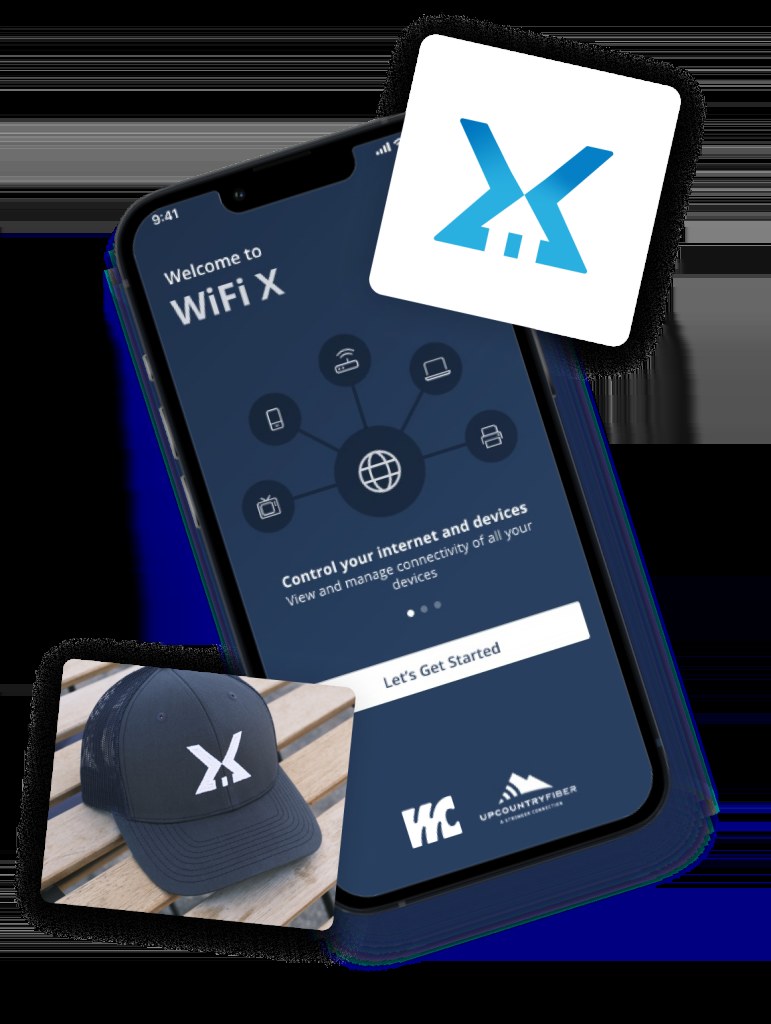
The company is a Certified Gig-Capable Provider and a nationally recognized Smart Rural Community, both designations from NTCA - The Rural Broadband Association. Its consumer WiFi product, WiFi X, adds an app layer on top of the fiber: whole-home coverage, parental controls, outdoor WiFi extension, and a WiFi backup service for when the main line goes down.

02 / THE REBRANDDeleting the two words that built you
On July 22, 2024, the company did something most legacy brands are too nervous to try. WCTEL - the cooperative - and WCFIBER - its expansion arm - united under a single name: West Carolina. In the process they cut the two words that had defined the business for seven decades, "Telephone" and "Fiber." The decision followed research, customer focus groups, and employee interviews. The logic was simple: a customer in a newly wired Georgia neighborhood did not know or care whether they were being served by the co-op or a subsidiary, and three names for one operator only created confusion.
The legal structures stayed separate. The cooperative is still a cooperative; WCFIBER is still the vehicle for expansion outside the original footprint. What changed was the storefront. It is a small case study in knowing which part of your identity is load-bearing and which part is just habit.
03 / WHO IT SERVESThe map big carriers left blank
West Carolina's footprint runs across rural South Carolina - Abbeville, McCormick, Anderson, Greenwood and Newberry counties - and reaches into Columbia County, Georgia. These are not markets anyone else was racing to serve. That is the point. The customers are homes, farms, small businesses, schools, and health facilities in places where the practical broadband choice was historically satellite or nothing.
04 / THE JOINT VENTUREAn electric co-op's poles, a phone co-op's fiber
The most quietly clever thing West Carolina has done is Upcountry Fiber. Launched around 2020 as a partnership with Blue Ridge Electric Cooperative, it solves the hardest part of rural buildout - the cost of getting fiber across long distances - by combining two utilities that already exist. Blue Ridge supplies the poles and existing infrastructure. West Carolina, through WCFIBER, hangs the fiber and connects each home. The partners unveiled a $150 million plan to build a data backbone into some of the Upstate's least-connected communities, and the venture now serves more than 22,000 customers.

The steal-this idea
Two rural utilities that could have competed instead split the bill. One already owned the poles; the other knew fiber. Where you see redundant infrastructure in a low-margin market, there may be a joint venture hiding in plain sight.
05 / WHEN THE LIGHTS WENT OUTHelene, and what a co-op does in a crisis
Infrastructure is invisible until it fails. When Hurricane Helene tore through the Upstate, West Carolina's response is the part of the story that best explains its structure. The company opened its offices as public hubs where residents could charge devices, get online, and reach family. It worked to keep Self Regional Healthcare and Anderson County Emergency Services connected so that emergency care could continue. NTCA cited that response when it named West Carolina a 2025 Smart Rural Community Showcase Award winner.
A company answerable to distant shareholders treats a disaster as a cost line. A cooperative answerable to its members treats it as the members taking care of the members. The incentives are simply pointed in a different direction.
06 / THE MODELWhy the boring structure wins here
West Carolina reports roughly $34 million in annual revenue with about 180 employees. Those are not hyperscale numbers, and they are not supposed to be. Rural broadband is usually described as a money pit precisely because the venture-and-shareholder model demands returns that low-density markets cannot produce fast enough. The cooperative removes that pressure. Revenue goes back into the network and the community rather than out to investors, and patience becomes an asset instead of a liability.
Where does it fit in the market? Nominally, West Carolina competes with AT&T, Spectrum, satellite providers like Starlink and Viasat, and fixed wireless. In practice, across much of its footprint it competes with the absence of any wired option - and it is the only operator that showed up. Being reported as one of the larger fiber providers in the country while headquartered in a South Carolina town of a few thousand people is the whole thesis in one sentence.
07 / TIMELINESeventy years, one line at a time
08 / WHAT YOU CAN DO WITH ITThe practical part
For a household, West Carolina is a way to get symmetrical gigabit-class internet, TV and streaming, a managed home network, and monitored home security from a single local provider - useful if you work remotely, school from home, or simply want an upload speed that matches the download. For a business, it is fiber internet plus hosted services, security integration, and managed IT without hiring an in-house team. For a community, it is the difference between a hospital that stays online in a storm and one that does not.