The person choosing your next internet provider may be the neighbor who also votes on landscaping. Hotwire Communications has made that ordinary fact of community life central to its business. It sells fiber connections to homeowners’ associations, condominium boards and property operators, bundling a collection of households into one commercial relationship. The sales pitch runs through the meeting room before the cable reaches the living room.
That approach puts Hotwire at an interesting intersection: part consumer utility, part property amenity, part infrastructure investment. Its Fision brand supplies internet, television, voice and security services. Residents want their connection to work. Boards want installation without a revolt. Investors want customers who will still be paying several years from now. Hotwire has built a business around trying to satisfy all three.
A neighborhood is a customer
The distinction begins with who signs. In a conventional household purchase, a subscriber chooses a plan. In Hotwire’s community model, an association negotiates service covering the property. The company’s residential offering promises symmetrical internet speeds, no data caps and bundles that can include IPTV and digital phone service. Availability and the package residents receive depend on the community arrangement.
Fitch’s May 2023 financing analysis offers a revealing historical snapshot. Its collateral pool covered 174,301 households, with association contracts generally starting at ten years. The association was liable for the agreement; individuals could buy upgrades. That is a subset of Hotwire’s business at that time, not today’s subscriber total. For an infrastructure operator, the attraction is straightforward: recurring payments attached to a physical network.
A simplified view of Hotwire’s bulk residential model. Individual property terms vary.
Residents therefore have two decisions to understand: what their community has already bought and what an optional upgrade adds. A headline speed alone will not answer either question. Someone comparing offers should first establish the included service, equipment, support responsibilities and total recurring charges. Otherwise, comparing two monthly prices can become an exercise in comparing different products.
The founder’s other network: people
Hotwire’s own history dates its launch to 2002, serving multifamily apartment communities. Fiber-to-the-home construction followed in 2003; installations in single-family communities began in 2009. The company’s development followed the places people lived, then widened into other kinds of properties. Co-founders Kristin Johnson and Michael Karp built a telecommunications operator whose customer relationship often begins one level above the individual user.

Johnson’s account of the culture is specific about autonomy. On Hotwire’s careers page, she says her first two hires remained with the company and influenced later hiring decisions. Her instruction is to find people who believe in the mission, then “get out of the way and let them do what they do best.” That is the employer’s description of its workplace, but it also explains the service promise Hotwire wants customers to recognize.
The external recognition includes an EY Entrepreneur Of The Year Florida award for Johnson in 2021. The award announcement describes her original ambition as combining technology with concierge-style service. In broadband, that pairing creates an everyday test: whether the pleasant sales conversation survives the first installation question or support call. The culture becomes visible where the network meets the customer.
First, explain what happens to the lawn
Hotwire’s own guidance to HOA boards spends considerable time on construction. It describes kickoff meetings, property walks, resident communication and a launch account manager during the first month after signing. The promised relationship is unusually tangible. Someone must explain where digging will happen, how installation will proceed and who stays available after launch.
“a decision based on their entire community for a ten-year contract.”Chuck Stauffer, Hotwire’s chief customer success officer, on what HOA boards are choosing
That makes landscaping a broadband issue. Hotwire tells boards to ask about restoration, permits, weather delays and communication throughout the agreement. The practical lesson is worth copying: give the transition an owner before construction starts. A launch contact cannot eliminate a delay, but residents should know who can explain it. For a board, that responsibility belongs in the evaluation alongside the advertised speed.
Houston provides a concrete picture of this service strategy. April 2025 coverage described more than 130 Hotwire employees in Texas and a Houston warehouse expanded to 24,000 square feet. The report said Hotwire used its own technicians and customer service staff. Local presence gives substance to a service pitch, although customers still have to judge what happens at their particular property.
One fiber network, several kinds of building
Hotwire’s product range follows the customer’s premises. Businesses can buy dedicated connectivity, managed Wi-Fi, television, voice and security services. The company also offers colocation, supplying space, power and bandwidth for customer equipment. Its business page names Brickell City Centre among properties served and describes assigned account management and ongoing network support.
For student housing, the language gets delightfully literal: an Ethernet port at every pillow. The wired offering advertises up to one gigabit per bed, with managed Wi-Fi extending through rooms and common areas. Legacy Suites in Tallahassee appears among its listed properties. The appeal is easy to understand on move-in day: the connection is part of the accommodation, rather than one more chore between unpacking and finding the nearest supermarket.
Hotels have different headaches. Hotwire offers guest Wi-Fi, in-room television and managed phone systems with property-management integration. Its hospitality page lists Fontainebleau and Carillon in Miami Beach, plus East Miami and SLS Brickell. Voice features include wake-up calls and activating or deactivating room phones at check-in and checkout. That is a reminder that a telecom bundle can include decidedly unglamorous work.
These services help place Hotwire in the market. It competes for the operator’s relationship as well as the resident’s connection. In Houston, alternatives identified in local coverage include AT&T Fiber, Tachus, Blue Stream and Ezee Fiber. Fiber itself is not an exclusive ingredient. Hotwire’s argument rests on the combination of infrastructure, a community agreement and the people supporting the property.
The 50G headline has a quieter point
In December 2024, Nokia announced that Hotwire had tested 25G and 50G passive optical network technology on its live Florida fiber network. The trial used Nokia’s Lightspan MF platform and ran 10G, 25G and 50G services simultaneously. These are access-network technology generations; the demonstration should not be read as a promise that every resident can order a 50-gigabit plan.
Three generations. Existing fiber.
The trial demonstrated coexistence and an upgrade path, not universal retail availability.The commercially interesting detail is reuse. Nokia said Hotwire could progress from XGS-PON to newer generations using the same access node and fiber cables. That gives existing construction a longer useful role as electronics and demand change. For a customer, though, the right plan still depends on the equipment and activities inside the building. A network milestone is useful evidence of capability, not a shopping instruction.
Growth comes with a construction bill
Hotwire’s history records a 2016 headquarters move to Fort Lauderdale, accompanied by more than $27 million in local investment and 375 new jobs. By 2018, the company says it was offering residential 10 Gbps service. The milestones pair technical capability with physical expansion: offices, network facilities and staff had to grow along with the product.
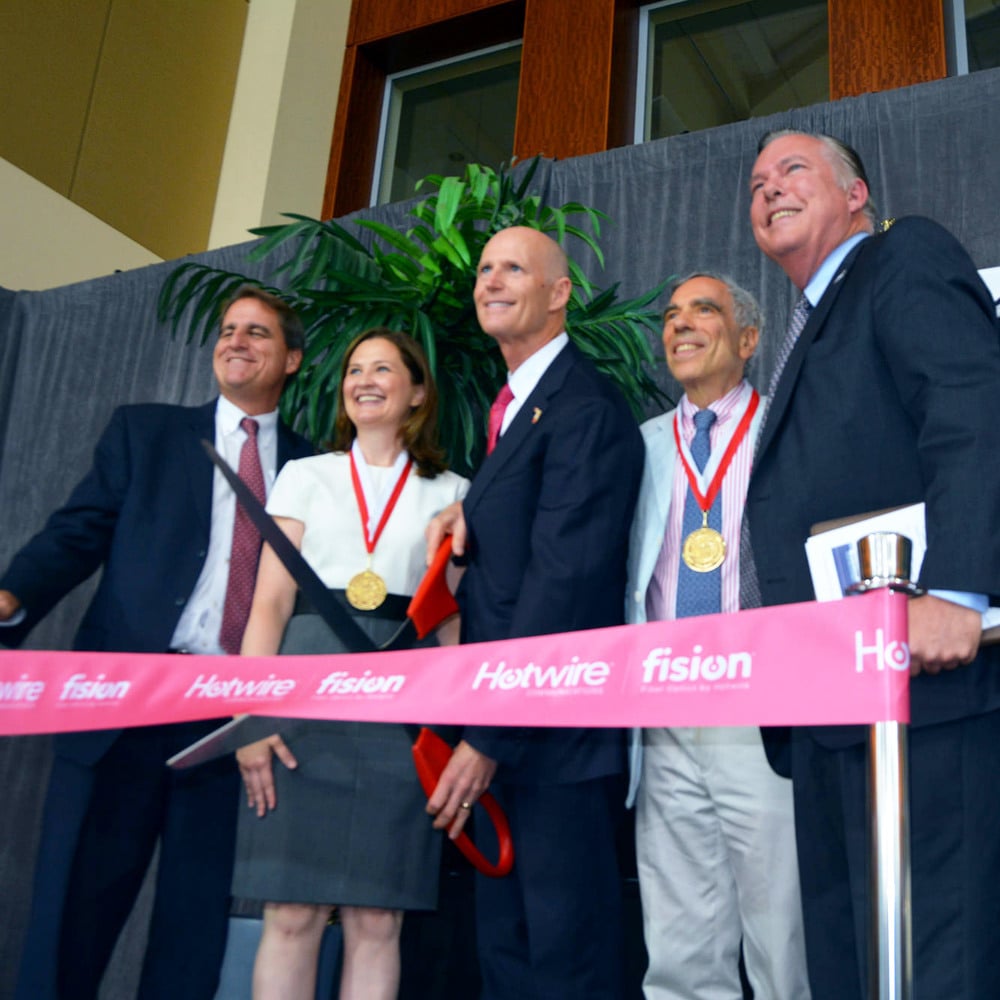
In April 2025, Orlando coverage put another price on expansion: an announced $50 million investment and 60 jobs across a seven-county service area. Initial named properties included Baldwin Park, Millenia Park Apartments and Balmoral Resort. Those figures describe a plan, not proof that every dollar had been spent or every connection completed. They nevertheless show the scale of the work behind a regional launch.
Outside capital has helped fund the broader ambition. Blackstone announced an investment alongside Hotwire’s founders in April 2021. Its legal adviser said the financial terms were undisclosed. Johnson framed the partnership as a way to scale during a period when digital services had become more central to daily life. The public explanation was expansion, with fiber infrastructure and customer service remaining the core proposition.
The deal price needs two labels
By June 2025, Reuters was reporting a Brookfield transaction valuing Hotwire at roughly $7 billion including debt. Hotwire subsequently announced Brookfield Infrastructure as an investor acquiring Blackstone’s stake. Its statement identified network densification, geographic expansion and further fiber-to-the-home development as priorities for the new partnership.
Reported transaction value
Including debt · June 2025
Consortium acquisition consideration
Brookfield filing · September 2025
Brookfield’s quarterly filing supplies the completion date: September 3, 2025. It records consortium consideration of $3.9 billion, with Brookfield Infrastructure’s own share approximately $0.8 billion. These amounts describe different measures from the reported enterprise valuation. None should be mistaken for a venture funding round or a household’s service price. The transaction placed Hotwire within another infrastructure investor’s portfolio, after four years of Blackstone backing.
A funding application hit the ownership rules
The expansion story also contains a documented setback. In December 2021, the FCC denied Hotwire’s request for an ownership-change waiver and rejected its pending Rural Digital Opportunity Fund application. The company argued that existing management retained day-to-day control after the Blackstone transaction. The agency found the ownership change substantial enough to trigger the application rules.
The original auction win covered $5.15 million over ten years and 3,233 Florida locations; Hotwire had already withdrawn 997 locations before the final denial. This was a failed funding application. It illustrates a practical constraint on infrastructure growth: the ownership arrangement and the funding process must fit together. A stronger balance sheet does not, by itself, resolve an application requirement.
Hotwire’s broader lesson is to organize demand around a place, make the installation somebody’s responsibility and keep supporting that place after the crews leave. The approach is most persuasive when a community wants a shared arrangement and can assess a long commitment. It is less convenient for someone seeking a freely interchangeable month-to-month purchase. The fiber may reach the home, but the decision starts with the people responsible for the whole property.