A photograph becomes a very different object when you are responsible for the machine that prints it. The customer wants a picture. The store needs a working printer. Somewhere behind that ordinary transaction sit replacement parts, support tickets, shipping labels, software, and a person who knows what to do when the machine stops. Multiply the problem across thousands of stores and you begin to understand Velocity, A Managed Solutions Company.
- One provider for networks, support, repairs, and rollouts.
- Built for businesses with many physical locations.
- A second business sells advertising across connected screens.
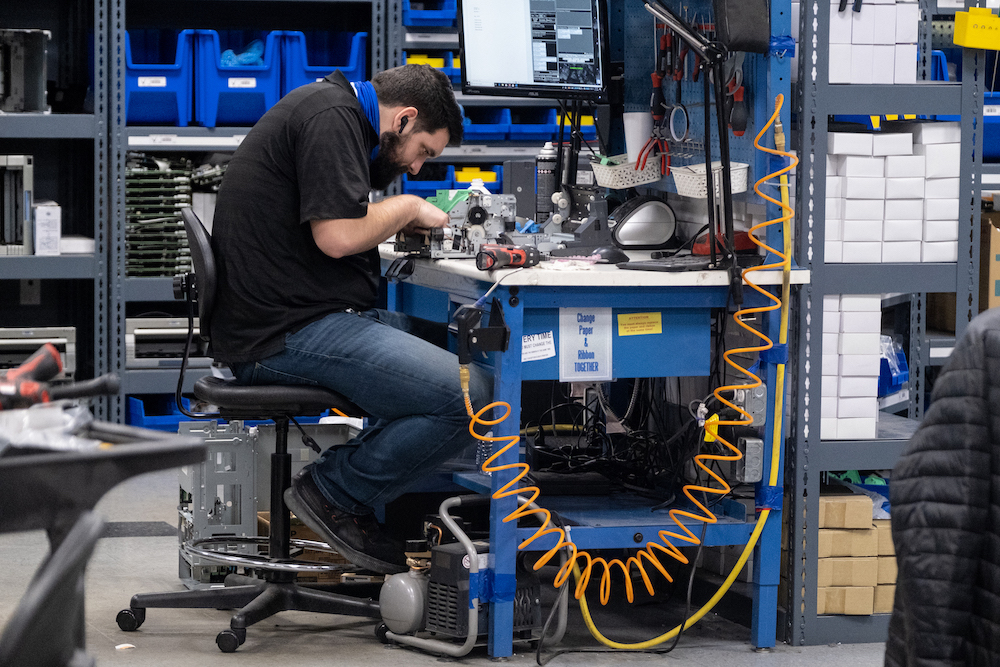
Its February 2026 case study of an unnamed pharmacy retailer gives the idea some weight. Velocity says it installed 3,500 photo labs, built a dedicated support team, and created a specialized printer-repair department. The account covers 8,309 active locations and 57,639 supported devices, with an average of 1,713 devices repaired monthly. These are company-reported figures. They describe a business whose essential unit of work is keeping someone else's equipment useful.
That is a useful way into a company with an unruly catalog. Velocity sells connectivity, voice services, managed Wi-Fi, technical support, equipment repair, expense management, and digital signage. Its customers include retailers, hotel operators, healthcare organizations, and entertainment businesses. The common denominator is geography: many locations, many devices, and many opportunities for a small failure to become an expensive distraction.
Twenty-seven vendors walk into a hotel
Greg Kiley founded Velocity in 2005 selling long-distance telephone service. The company's history records its first enterprise customer in 2006, a retailer with more than 5,000 locations in 2008, and an Extended Stay Hotels agreement in 2009. Along the way, the job expanded. Connecting a business brought Velocity close to everything that depended on the connection.
Consider its published account of a hotel chain with more than 600 locations. The trouble was a crowded supplier list, strained technology spending, and accumulated technical debt. Velocity says it reduced roughly 27 vendors to three, including itself, while refreshing internet circuits, Wi-Fi, television, phones, and back-office services. The case study reports 20% savings over the first five years. It describes a 650-location estate supporting 72,000 rooms at the time of publication.
The striking detail is the vendor count. Consolidation can change who has to coordinate a repair, reconcile an invoice, or explain a delayed upgrade. That is the practical promise here. A hotel operator buys an arrangement in which fewer organizations have to agree before somebody can get to work. The savings figure is evidence from one account, rather than a forecast for every hotel.
over the first five years
The network has hands
Velocity occupies an interesting stretch of the market between a telecommunications carrier, a managed IT provider, and a deployment contractor. It operates as a competitive local exchange carrier licensed in all 50 states. Its October 2025 announcement describes more than 450 carrier agreements and a proprietary network backbone spanning 21 redundant data centers. Those relationships let it assemble connectivity across a dispersed estate.
But connectivity is only one layer. The company advertises a nationwide network of 5,500 field technicians and U.S.-based support available every hour of the year. A technician network is different from employee headcount; Velocity separately reports more than 500 employees. Its repair depot, warehousing, project management, and installation services bring physical work into the same commercial relationship as network monitoring.
The software gives customers a view into that machinery. V-SELECT tracks locations, equipment, connections, trouble tickets, bandwidth, and invoices. GEM, its Global Expense Management platform, adds auditing, expense allocation, and payment handling. A customer can make one monthly payment while Velocity handles the underlying bills. The business combines ongoing managed services and connectivity with deployment, equipment, software, and support work.
The product list follows the awkward edges of an actual property. Hosted PBX and VoIP cover business calling. DataRemote's POTS IN A BOX connects existing analog endpoints through managed replacement infrastructure. Starlink, which Velocity became authorized to resell in 2024, adds another connectivity option for remote sites, backup links, and temporary deployments. Each extends the range of problems that can stay with one provider.
The company’s stated purpose“Connect. Communicate. Captivate.”
Velocity leadership page
Then the screen became a business
There is a second story hiding inside the first. Once a company can install, connect, update, and repair screens across many locations, it has some of the plumbing for an advertising network. Velocity established its digital signage and media division in 2019. Its subsequent acquisitions included Impax Media and CTI Solutions in 2020, followed by EYE Corp Media in 2021.
The media offering includes hardware, content management, installation, support, and advertising sales. A retailer can use screens for its own messages; an advertiser can buy access to audiences across venues. In February 2025, Velocity announced an exclusive sales agreement covering approximately 10,000 Loop Media venues. It said the addition took its advertising sales network beyond 50,000 venues, twice its scale a year earlier. Those venues should not be confused with Velocity-owned properties.
Expansion also produced an exit. Velocity acquired controlling interests in cinema businesses PaperAirplane and Velocity Cinema Solutions in 2020. Their management teams asked to regain control in spring 2022, and deals completed that December returned both businesses to founder ownership. Announcing the divestitures in January 2023, Velocity said they would sharpen its focus on signage sales, support, and out-of-home media networks. The public explanation describes a change in ownership and focus, rather than establishing that either venture failed.

Buy the handoff, measure the result
For a prospective customer, the useful comparison is with the existing combination of carriers, local technicians, IT providers, and billing tools. Ask what happens between those suppliers when a site goes down. Velocity's distinction is the breadth of responsibility it can take across those handoffs. Whether that breadth is worth buying depends on the estate and the contract.
A sensible evaluation starts with a few representative locations. Compare current spending with a proposal covering installation, equipment, connectivity, support, and replacement work. Set response expectations and decide which performance reports matter. Velocity's own hospitality buyer's guide recommends comparing equivalent services and examining total ownership cost. The published hotel savings are a useful prompt to investigate, not a price list.
The lesson readers can copy is straightforward: map ownership of the entire service, including the dull moments after launch. A small business with a simple network may have little coordination to remove. A larger operator may still prefer separate specialists or an internal team. Consolidation earns its place when fewer handoffs produce measurable improvements. The printer still has to print.
Keep following the wires
Explore Velocity’s website, its services, news and blog, and case studies. Follow the company on LinkedIn and Facebook, or watch the headquarters tour and visit its YouTube channel.