Before CentralReach was a health-tech company, it was an irritation. A practicing behavior analyst in a Florida clinic was spending too much of her day on paper billing, clinical data collection and reports, and too little with clients. The first product decision was not grand. It was practical: put the work in one place, make the records usable and give the clinician some hours back.
That narrow fix became an unusually broad piece of vertical software. Today CentralReach connects the front desk, the therapy room, the billing office, the school team and, increasingly, the payor. A provider can schedule staff, check authorizations, collect behavior data, write session notes, manage learning programs, submit claims, train technicians, show progress to families and inspect performance without stitching together a small parade of generic tools.
The market rewarded the accumulation. In March 2025, Roper Technologies agreed to acquire CentralReach from Insight Partners for a net purchase price of roughly $1.65 billion, including a $200 million tax benefit. The deal closed the following month. Roper said more than 200,000 professionals used the software and forecast sustainable organic revenue and EBITDA growth above 20 percent. That is a startling endpoint for a company whose original enemy was the binder.
01 · The productA clinic’s back office, compressed
CentralReach calls itself an autism and intellectual and developmental disabilities care platform. In ordinary language, it is the machinery around care. Its core electronic medical record and practice-management system holds client information, calendars, payroll inputs, authorizations, clinical programs, notes and claims. CR Mobile brings schedules and data collection into homes and community settings, including offline work. CR Institute handles onboarding, RBT preparation and continuing education. CR BillMax takes on managed billing. The education business adds IEP-aligned data collection, curricula and progress reporting for schools.
This breadth matters because ABA care is a relay race. A session is scheduled against a clinician’s credentials and a client’s authorized hours. The technician records data. A supervisor reviews progress and documentation. The note supports a claim. The claim must satisfy a payor’s particular rules. Payroll and utilization reports depend on the same event. Each broken handoff adds delay, rework or lost revenue. CentralReach’s real product is the removal of those handoffs.
“More time for care, less time in the system.”CentralReach’s useful test for automation
02 · The customersComplexity is the customer
The customer is not simply “a therapist.” It can be a two-person ABA practice, a provider with clinics across several states, a multidisciplinary group combining behavior analysis with speech and occupational therapy, or a public school district. Daily users include behavior technicians, BCBAs, schedulers, billers, administrators and educators. Caregivers see portals and progress. Payors are becoming a more explicit part of the network.
Scale sharpens the problem. Stride Autism Centers, which had 16 locations across three states when it discussed the platform, pointed to the value of keeping scheduling, billing, clinical work, assessments and messaging in one interface. NorthPoint Pediatric Behavior Therapy used the managed billing service because its founder knew the clinical side and did not want to become an amateur revenue-cycle expert. In its published case study, NorthPoint reported a 98.6 percent paid rate in its first six months and recovered up to five non-billable hours a week.
Old Bridge Township School District offers the more revealing adoption story. Its earlier data-collection software felt cumbersome. Staff fell back to paper, which was familiar but made longitudinal progress hard to see. The district’s mind changed when CentralReach could connect with its Frontline Education IEP workflow and introduce features gradually. The district said the price was comparable with alternatives while the feature set was stronger. The lesson is almost comically untechnical: a product wins only when the person holding the clipboard will actually use it.
03 · The AI chapterAutomation with a billing address
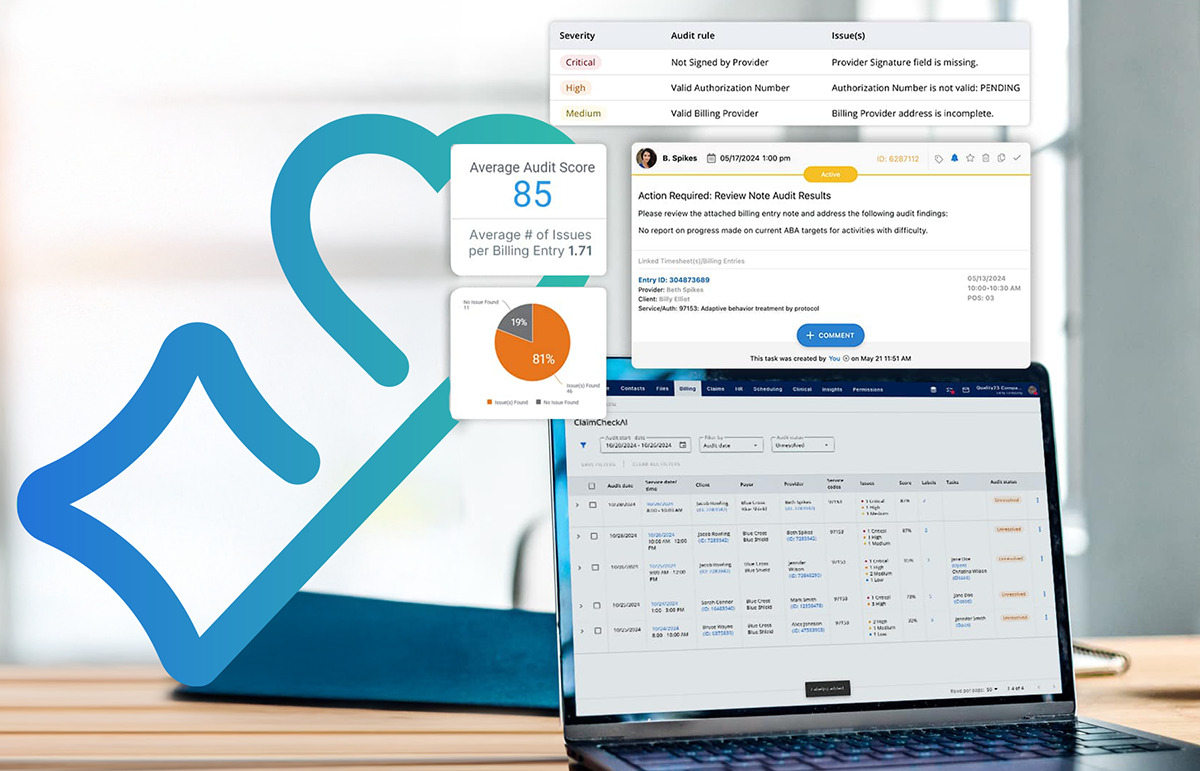
CentralReach’s AI push is strongest where it can be measured. ClaimCheckAI audits claims before submission against payor-specific rules. The company says customers can reduce audit time, improve clean-claim scores and bill sooner. NoteDraftAI creates a first draft of a clinical note; NoteGuardAI checks documentation quality and compliance. ScheduleAI treats scheduling as a constraint problem involving availability, credentials, service needs, travel and authorizations.
The larger bet is cari, an AI layer spread across the platform rather than parked in a separate chatbot. CentralReach says it was trained on more than a billion domain data points with review from more than 40 behavior analysts. That specificity is the advantage. A generic model can write a pleasant paragraph. A domain system must know whether the note, service code, authorization and claim agree.
In August 2025, CentralReach bought AI.Measures and SpectrumAi. AI.Measures brought assessment science. SpectrumAi brought predictive analytics, timestamped video review and an outcomes-based contracting model already used with major employers and payors. Intriguingly, AI.Measures had first been a preferred partner. CentralReach got to observe the product in the wild before buying it. For founders, that is a partnership strategy worth stealing: integrate first, acquire after the customer value is visible.
Where the model works
- Many roles touch the same client record
- Billing rules create expensive errors
- Growth multiplies scheduling constraints
- Training and compliance recur constantly
Where it can fail
- A small practice needs only a calendar and notes
- Migration and training lack an internal owner
- Users resist a dense, configurable interface
- The organization cannot justify modular enterprise cost
04 · The businessThe bundle is the moat - and the warning label
CentralReach makes money like a vertical SaaS company: recurring software subscriptions, modules, implementation and services. Managed billing and education add adjacent revenue. Pricing is generally consultative rather than plainly posted, which suits enterprise sales but frustrates buyers trying to compare systems without a meeting. Public customer discussions also show the usual all-in-one tension: larger organizations value the capabilities while some smaller users complain about price, complexity and the difficulty of switching.
Its other asset is domain credibility. The leadership roster includes clinicians and researchers alongside conventional software executives, and a scientific advisory board reviews the direction of the product. The company says its roughly 400-person team includes BCBAs, speech and occupational therapy professionals, engineers and customer-success staff. That mix matters in a field where a technically tidy feature can be clinically useless, or where a clever automation can create a compliance problem three desks away.
CentralReach also invests in the labor pool around its product. CR Institute offers technician preparation, onboarding and continuing education, addressing the chronic work of hiring and retaining trained staff. During the pandemic, the company opened its continuing-education library to the ABA community at no charge so disrupted clinicians could keep certifications current. Internally, it describes a culture of caring, with a volunteer day, charitable matching and neurodiverse hiring. Those programs are not proof that every employee experience is rosy. They do show a coherent business instinct: strengthen the people who make the software useful, not just the software itself.
That tension explains how CentralReach differs from competitors such as Rethink Behavioral Health, Motivity, AlohaABA, Passage Health and WebABA. It is not always the simplest option. It is trying to be the deepest connected option across clinical and administrative work, special education, training and outcomes. Against a stack of a generic EHR, calendar, billing service, LMS and spreadsheets, integration is the pitch. Against a lighter ABA tool, breadth is both the advantage and the tax.
The strategy also explains Roper’s interest. Roper favors specialized businesses with durable customer relationships and room to compound. CentralReach sits in a regulated niche, handles mission-critical records and money, and becomes more useful as it connects more jobs. The acquisition price did not buy one spectacular feature. It bought thousands of unglamorous decisions about how autism and IDD care actually moves.
Start with the specialist’s ugliest repeated task. Connect it to the next task and then to the money. Add intelligence only after the workflow produces trusted data.
05 · The verdictA good fit has more than one headache
The CentralReach playbook is clear. Find a narrow profession underserved by horizontal software. Build beside practitioners. Solve a task that happens every day. Expand into the work immediately before and after it. Tie operations to revenue. When enough clean domain data accumulates, automate the clerical decisions and leave clinical judgment visible to humans.
It will not work everywhere. An uncomplicated solo practice may be better served by a cheaper, lighter system. A provider without time for implementation can turn configurability into chaos. An organization expecting AI to substitute for supervision, ethical review or clinical judgment is asking the wrong product question. And an all-in-one platform earns trust only if integrations, uptime, support and data portability keep pace with its growing footprint.
But under the right conditions - several locations, many staff, complicated authorizations, recurring claims and a need to prove outcomes - the pieces reinforce one another. The schedule informs the session, the session informs the note, the note supports the claim and the accumulated record can show whether care worked. CentralReach began by rescuing a clinician from paper. Its next test is harder: making a giant operational system feel as helpful as that first small escape.