Carter Wigell’s early cloud career had a distinctly earthbound accessory: a telephone. He joined Salesforce in early 2001, when the company still had fewer than 100 employees. Before the consulting firms, investment rounds and AI arguments, there were customers to persuade. A promising idea needed someone willing to explain it, then explain it again.
Today he runs Thunder, the Salesforce consulting company he founded in 2020. His route there includes a consultancy sold to Cloud Sherpas, an innovation network conceived around MySpace social events and a spell at WeWork that prompted a rather good casting suggestion. He has spent years around new technology. He remains interested in the stubborn business of getting people to use it.
The view from the 1-800 line
Salesforce’s official account of his beginnings places Wigell among its first 100 employees. He spent almost a decade there, learning under Marc Benioff. That gives his present work an unusually long perspective: he knew the company when adopting cloud software still required an explanation, rather than a procurement committee’s password.
He remembers answering the 1-800-no-software line and developing pitches with colleagues. Prospects needed reassurance about putting their information in the cloud. The work involved trying scripts, offering trials and turning curiosity into customers. There was a product to sell, but also a habit to change.
Years later, he would discuss those beginnings in a Talent Hub conversation about the evolution of Salesforce consulting. Its subjects included talent, acquisitions and the decision to start a firm inside the ecosystem. Those are recurring concerns in his career: who can do the work, how an organization grows and what happens when it changes hands.
A consultancy with something to sell
In 2009, Wigell co-founded CloudTrigger. Its proposition sat close to the customer’s practical problem: implementing and customizing cloud CRM. A subscription could supply the software. Someone still had to make it fit the business.
By the time Cloud Sherpas announced the acquisition in December 2012, CloudTrigger had customers including AOL, USA Today and Riverbed. Its expertise included Salesforce Service Cloud and customer-service operations. It had also created G2Maps, a geographic mapping and visualization application on Salesforce’s AppExchange. This was consulting with a product-making streak.
The acquisition expanded Cloud Sherpas’ presence in the western United States and added customer-service and call-center expertise. Terms were not disclosed. For Wigell, who was CloudTrigger’s president, it was one chapter in a longer sequence of cloud businesses joining larger organizations. Cloud Sherpas itself was acquired by Accenture in 2015.
The idea that followed him out of the party
Another venture began with a different kind of customer observation. In 2008, after moving from San Francisco to Los Angeles, Wigell spent time with his friend Aber Whitcomb, MySpace’s co-founder and chief technology officer. At social events, people kept approaching Whitcomb with ideas they wanted to discuss.
Wigell saw an access problem. People with a promising thought needed advice, introductions and practical help; knowing someone in the room could make an enormous difference. He traced Ideator’s origins to that experience when announcing his move into its CEO role in January 2016.
The idea was an online network through which people could develop ventures and reach useful resources. It carried a recognizable lesson from his Salesforce years: a service becomes more interesting when more people can reach it.
Ideator later joined the first Salesforce Incubator cohort. The five-month program helped the team find an opportunity in higher education through Salesforce’s education team and Heroku Connect. By the cohort’s conclusion, the program’s account said Ideator had raised $1.5 million. The business of widening access was itself benefiting from some well-placed introductions.
Bruce Willis gets the part
Then came WeWork. Wigell led functions spanning commercial technology, enterprise services and global account management. It took him outside the Salesforce world and into a business with rather different demands.
Asked who should portray him in a WeWork film, he chose Bruce Willis. He compared the experience to Die Hard, and pointed out the convenient resemblance supplied by their shaved heads. The casting department, at least, would have had one easy afternoon.
The joke offers a welcome interruption to the orderly language of executive biographies. Careers are usually arranged as if each role calmly prepared the next. Wigell’s own account allows for a more hectic middle act. He eventually returned to the Salesforce world with Thunder.
The return, with unfinished business
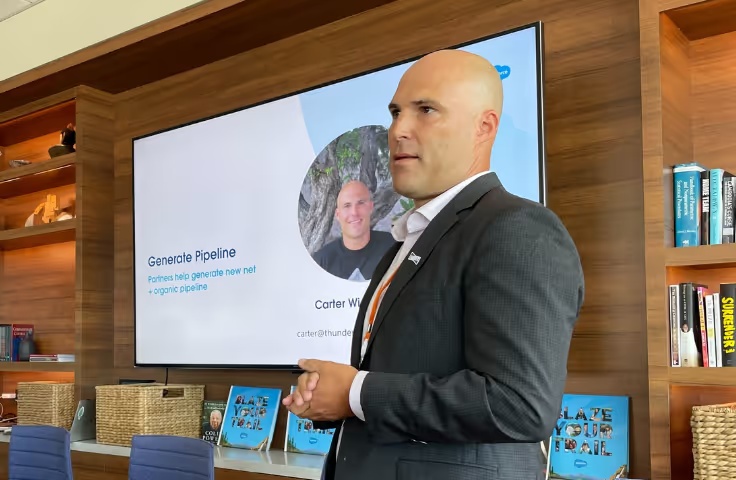
Thunder began in 2020. Its work covers Salesforce strategy, implementation and managed services, giving Wigell another company through which to work on the consequences of a software purchase. The relationship continues after launch: customers need their systems to keep pace with the business.
In August 2023, Thunder announced $16 million in Series A investment, led by Recognize with participation from Salesforce Ventures. The planned uses included expanding the global team and investing in intellectual property, accelerators and new programs. It was company financing for a services business preparing to grow.
“We have some real unfinished business in this current and future market to help fulfill the promise of CRM, Data and AI.”
Carter Wigell · August 2023
Washington Harbour Partners invested in December 2024. Its announcement described further investment in data, AI and cloud practices, alongside Thunder’s Amplify managed service. Washington Harbour would also join the board. The growth plan included building reusable tools to reduce the cost, risk and complexity of deployments.
These announcements place Thunder within a network of investors and platform relationships. They also make its commercial position clear. Wigell is building a business around Salesforce’s continued usefulness. His opinions about enterprise software come with that commitment attached.
Forty audits, one awkward question
One episode makes the daily work more tangible. Before a consultancy can price a project confidently, it needs to understand the customer’s existing setup. Before a customer grants access, it wants to trust the consultancy. Each side would prefer the other to go first.
Wigell turned to his Salesforce connections, including Rob Acker, the former Salesforce.org CEO who now leads Hubbl. Thunder adopted Hubbl’s diagnostic Scan Requests to examine potential customers’ Salesforce environments without requiring shared credentials or new user accounts.
In the account of that work, Wigell reported forty audits in a month and a seven-figure professional-services contract. The useful detail is the sequence: inspect the system, uncover specific problems, then discuss the work. It gave a conversation about trust something both parties could actually examine.
The same preference for concrete work appears in his description of a Yahoo project. Thunder built an Agentforce-powered tool for requests for proposals, helping sellers summarize incoming material, draw on previous pursuits and populate CRM records. He presented it as a change to a working process. The claims concern a particular deployment, rather than a guarantee for every buyer.
What he wants the software to do
Wigell’s writing becomes more specific when it reaches the decisions companies tend to leave inside their processes. In a February 2026 essay, he drew on conversations with Meredith Schmidt, Salesforce’s revenue executive and a Thunder advisor, to discuss revenue transformation.
The questions reach beyond faster quotes. What does the company sell? How does it package and price it? Where does sales hand work to finance? Which approvals exist because they serve a purpose, and which merely enjoy the protection of age? A new system can preserve an old inconvenience with remarkable fidelity.
His February update on Thunder Federal took the same interest in execution into government work. He credited Maurine Fanguy with building the practice and reported that its team had more than doubled that year. He also listed contract vehicles intended to make it easier for agencies to engage Thunder. Access, delivery and the mechanics of getting started were again close together.
In his contact-center commentary, the telephone returns in a different form. Wigell argues for connecting voice, customer records and AI more closely. He says Thunder has completed more than 100 Service Cloud Voice implementations powered by Amazon Connect. His concern is what the person handling an interaction can actually see and do, with the customer’s context available.
The unfashionable question: what does it cost?
By September 2026, Wigell was addressing a fashionable proposal: replacing established enterprise software with applications built around AI. His September 29 essay asks buyers to consider the economics before deciding the existing platform has become obsolete.
His position favors combining AI with established systems. Data, governance, workflows and maintenance remain part of the bill. A compelling demonstration leaves those obligations waiting politely outside the room. They will eventually expect to be seated.
It is an argument from someone with a clear stake in the answer. It is also consistent with a career spent working through what adoption requires. Wigell has sold software, built consulting services, tried to widen access to entrepreneurial help and returned to the systems customers already own.
There is a smaller, more personal test of that operating philosophy. In a public reflection on taking a vacation, he said he trusted Thunder’s leadership to make major hiring and other decisions while he was away. A company built around helping customers work better also needs to function when its founder leaves the room.
The early telephone pitches and the present AI discussions are separated by decades of technical change. Wigell keeps returning to the moment afterward: a customer has agreed to try something. Now people have to make it work.