A honeymoon is an ambitious place to hold a business meeting. In 2013, Anshul Jain visited Switzerland on his honeymoon and met Balesh Lakshminarayanan, his friend from business school. In a hotel in Lucerne, Jain opened his laptop. They looked at the numbers. The conversation helped turn a company that already existed into a commitment that would consume their working lives.
The holiday acquired a business agenda. Jain would serve as its founding CEO, building a Salesforce consultancy with Balesh before Youngsoft acquired a majority stake in 2019. Today, as co-founder and CEO of ApexNeural, he is working through another change in enterprise technology. AI has entered the conversation. The need to make a business function has stayed.
A friendship with a balance sheet
Jain and Balesh belonged to TAPMI’s class of 2010. Their partnership grew out of an existing friendship and experience in consulting. Before the full-time leap, Jain had worked at Infosys and Intergraph. ABSYZ dates its founding to 2011, so the Swiss meeting belongs to the story of committing to the venture, rather than inventing it over a holiday breakfast.
The distinction gives the episode its interest. A registered company and a working livelihood are different responsibilities. Balesh’s recollection describes two friends deciding to leave employment and put their own savings behind the business. A salary is remarkably persuasive once it stops arriving.
The firm’s own history places its beginnings in a two-bedroom apartment in the Hyderabad suburbs. That is a useful scale at which to imagine the undertaking: a small place, a specialist service, and customers who would have to trust the people delivering it. The apartment supplies a setting. The decisions about what to sell supplied a business.
The CEO in the answer queue
There is another early portrait of Jain, assembled from small public exchanges. In September 2013, a Salesforce user asked why a weighted sales-pipeline calculation produced unreliable totals. Jain replied within minutes, asking for the probability percentages attached to the sales stages. It was a modest diagnostic question, directed at the actual problem.
The exchange catches something a job title tends to conceal. A consultancy needs people who can look closely at the awkward detail another person has been staring at all afternoon. Here was Jain, posting under the ABSYZ name, doing precisely that. Before the deal announcements and office openings, there was a report whose totals needed explaining.
In October, another user asked about controlling access to notes and attachments. Jain explained the relationship with the parent record and suggested using Chatter Files. The reply was marked as the accepted answer. It shows him working inside the platform’s constraints, offering a route through a specific difficulty. This was the texture of his work: permissions, records and practical consequences.
Later that month, he answered a question about preparing for the developer certification by pointing the questioner toward study resources. The range is revealing without requiring a grand theory of his character. He was helping people understand reports, manage access and learn the platform. Those are concrete acts, preserved in the unglamorous filing cabinet of an online community.
“This could not have been achieved without the brilliant team we have on board.”
Anshul Jain, on ABSYZ’s expansion in 2017
A flight before a safety cushion
The founders also had to put themselves where customers gathered. In 2014 they travelled to the United States for Dreamforce. Balesh has since recalled the trip as two founders arriving with a small team behind them and a large amount of confidence. Conference travel has an excellent talent for turning confidence into receipts.
His later account makes the trip sound refreshingly direct: go to San Francisco and meet people. It belongs to an early business that needed relationships as much as technical competence. The customers were elsewhere. The founders went looking. There is no need to dress that up as an elaborate strategy to understand the effort involved.
Jain’s commercial proposition was specialization. In a 2016 account of the company, he described a bootstrapped business whose revenue had grown from $2,000 to $500,000 over four years. ABSYZ concentrated on Salesforce services, with work spanning implementation, customization, integration and support. The claim was that a focused team could combine experienced delivery with the flexibility of a smaller supplier.
That choice gave the company something specific to sell. Clients needed a system configured, connected and used properly. The service continued after the initial implementation through training and support. A consultancy has to live with the practical afterlife of its advice, when the presentation is over and someone must use the software on Monday morning.
The team becomes the business
Around the same period, the founders were recruiting people who would learn the trade. Balesh has recalled visiting engineering colleges with Jain in search of young talent. His account places campus hiring in 2015 at institutions including VIT, GITAM and Cochin University of Science and Technology. The business was creating opportunities for people whose Salesforce careers were still ahead of them.
He later described seeing early recruits leading teams, building products and progressing through the wider technology industry. That is his recollection, and it adds a human dimension to the usual growth chart. An employee count records how many people a company has hired. It says rather less about what those people learn to do, or where that learning takes them.
Recognition arrived in 2016, when ABSYZ received the Best Consulting Startup Award at the Indian Startup Entrepreneurship and Disruptive Innovation Awards. TAPMI celebrated the achievement of its two alumni. It was an award for the company, shared by a team, and a satisfying entry in the history of a business-school friendship.
By January 2017, ABSYZ was opening an office in Bangalore alongside its Hyderabad development operation. Its expansion announcement reported that it had become a Salesforce Gold partner in 2016. Jain credited the team. The same announcement reported employee attrition of 2% for that year, a company figure that makes his emphasis on the people more substantial than a ceremonial thank-you.
A sale that opened another door
In January 2019, Youngsoft announced the purchase of a majority stake in ABSYZ. Its announcement put the consultancy at more than 130 employees, with 159 Salesforce certifications and more than 100 completed Salesforce projects. Those figures describe the business at the transaction, a useful snapshot of what the founders and their colleagues had built.
Jain, identified then as director and CEO, explained the attraction in terms of customers. ABSYZ had grown in Asia and Europe; the Youngsoft relationship would broaden its access to the United States. His explanation was commercial and plain. A business that could deliver the work wanted a stronger route to the people who might buy it.
“This acquisition by Youngsoft will afford access to customers throughout the U.S.”
Anshul Jain, January 2019
The transaction makes a natural chapter ending, though the company continued. ABSYZ’s present leadership page lists Shubham Khilauria as CEO. Jain’s place in its history is as co-founder and founding CEO, while his current executive work sits at ApexNeural. Keeping the roles in their proper time gives both chapters room to be understood.
The workflow survives the technology
ApexNeural was incorporated in September 2024, with Jain and Arghya Basu as directors. Its leadership page identifies Jain as co-founder and CEO. The company combines client projects, its own products and investment or co-building activity. Its public portfolio includes recruitment automation and digital business tools. It is a broader collection of work than the focused Salesforce consultancy of his first founding chapter.
Jain’s own explanation of the transition starts with an older discipline. In a September 2025 post, he recalled drawing a swim-lane diagram during an early Six Sigma project. The diagram maps responsibilities and the movement of work. He connected that experience to the processes he built at ABSYZ and, later, to his use of AI at ApexNeural.
Read across his career, the continuity is practical. The earlier community questions concerned how a system behaved. The consultancy concerned how an organization could use a platform. His current writing asks how AI should fit into the work of an enterprise. The technology has changed considerably; he keeps returning to the steps people need to complete.
In March 2026, Jain wrote about seven enterprise AI agents being built across clients. He emphasized redesigning operations and providing a deliberate handoff to people for exceptions. These are his descriptions of the work. They also explain the problem he wants to address: a demonstration can be impressive while the surrounding organization still needs careful attention.
His example of human involvement is especially useful. Refunds, exchanges and escalations require judgment and context. A person taking over a case needs enough information to act. Anyone who has explained the same problem to three successive customer-service representatives will recognize the appeal. The handoff deserves as much thought as the automated answer.
There is a pleasing line from the laptop in Lucerne to this concern with workflows. Numbers helped two friends make a decision; systems helped them build a company; another technology now offers another set of possibilities. Jain’s career has acquired larger organizations and newer terminology along the way. The interesting work still happens where an idea meets somebody’s ordinary working day.
Follow the next chapter
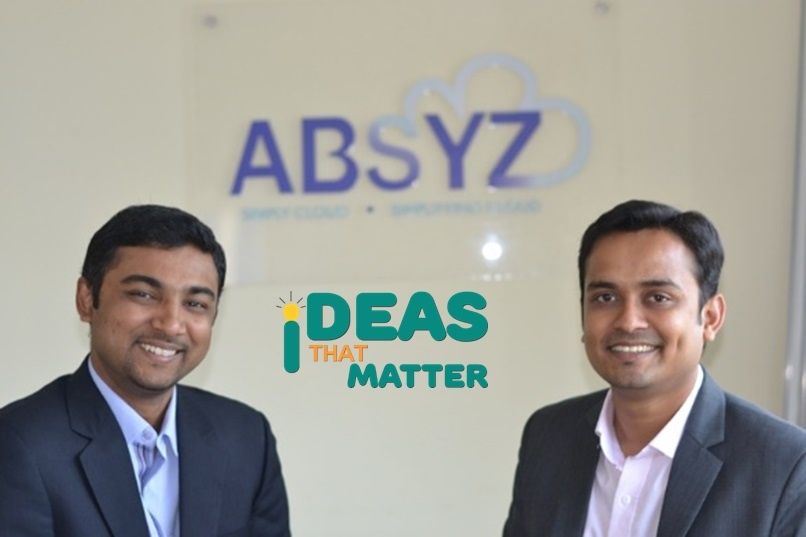
Photograph: ABSYZ co-founders, via AsiaBizToday.