A doctorate is a considerable thing to pack. It is also an incomplete set of instructions for starting a company in a country where you know nobody. In 2016, Carolina Reis Oliveira left Brazil for Silicon Valley to build OneSkin. She brought years of research experience. Learning how to turn that experience into a business would require another kind of schooling, with fewer agreed answers and rather more people offering them.
She has described arriving with basic English and little preparation for entrepreneurship. The opportunity was IndieBio, an accelerator built to help scientists establish companies. A scientist could enter with an idea and find herself having to explain a market, a business model, and a reason for someone else to invest. All three questions concern the same project. They demand different vocabularies.
That transition is the interesting part of Oliveira’s story. The eventual CEO title makes the journey look orderly from a distance. Up close, there are false starts, changes of direction, partners to evaluate, and a growing ability to tell helpful advice from a demand that should be questioned. A laboratory can teach careful observation. A company supplies a fresh assortment of things worth observing.
Brazil before the pitch deck
Oliveira’s route through science began well before OneSkin. Her educational record runs from biochemistry at the Federal University of Viçosa to postgraduate study at the Federal University of Minas Gerais, with a doctoral exchange at Rutgers University. Her doctorate is described by OneSkin as immunology; her research background includes stem cell biology and tissue engineering. These are years of specialist training behind a role that now also requires commercial decisions.
Entrepreneurship was familiar from home. Her father and brother had started ventures, and she watched her brother build a reforestation business while still near the beginning of his career. The appeal was seeing an idea become something that operated in the world. Biology and chemistry interested her as a child; in high school, genetic engineering gave that interest a sharper focus. She also loved dancing, although she did not regard it as a serious professional plan.
Her first venture in Brazil did not work out. The experience nevertheless helped open the route to the United States. That sequence deserves its place in the story: a business can fail to become the thing its founders hoped for and still change what they are able to attempt next. Oliveira’s move followed an earlier attempt to put research to use outside academia. The ambition already existed; the setting and available support changed.
OneSkin was co-founded in 2016. Its founding team brings together Oliveira, Alessandra Zonari, Mariana Boroni, and Juliana Carvalho, four women with doctoral training. The company’s account of its beginnings places their connection in research in Brazil. By the time customers encountered the brand, there was already a shared professional history behind it. The packaging arrived much later than the relationships.
- 2016Brazil to Silicon Valley
OneSkin co-founded · IndieBio - 2024A wider founder network
Endeavor selection with Alessandra Zonari - 2025A new growth partner
$20m Prelude investment announced - 2026The international conversation
Listed on the Berkeley Haas forum program
The business model was allowed to change
Early OneSkin looked different from the consumer brand it became. Oliveira initially imagined providing a testing service for companies already selling cosmetics. A service business seemed a way to reduce the risk of an unfamiliar venture. It also offered a legible answer to the first commercial question: who would pay for the work? Existing companies were an obvious place to begin.
Then conversations with investors changed the question. If the team owned its own research platform, why confine itself to evaluating other companies’ work? Developing proprietary products would involve another level of ambition and responsibility. Oliveira recalled the Silicon Valley environment encouraging her to think beyond a problem in the Brazilian market. The potential audience became international. The laboratory capability stayed central, while the business built around it changed.
Changing a business model is often given a tidy name, pivot, which makes it sound like a movement executed gracefully on one foot. In practice, it means reconsidering who the customer is and what the company promises to deliver. Oliveira’s early account shows a founder learning that a useful capability can support several businesses. Choosing among them is a decision that scientific training alone cannot settle.
OneSkin now keeps research and development in-house. That arrangement gives Oliveira’s career an unusual continuity: the CEO grew out of the same scientific work that remains part of the company. She did not have to abandon her original discipline to acquire a new one. She did have to learn how to make colleagues, investors, and customers understand the value of what the team was building.
Choosing the people across the table
For Oliveira, partner selection became an education of its own. She has acknowledged an early mistake in recruiting a co-founder under an accelerator deadline. The choice was hurried, and the partnership did not work. Her retrospective lesson was to push back on the timetable and take longer to find the right person. Urgency had acquired more authority than it deserved.
The point is broader than one appointment. A deadline can tell a founder when a decision is wanted. It cannot establish whether the decision is sound. Oliveira’s account contains an uncomfortable admission that makes her later confidence more credible: she had once treated a quick answer as the price of keeping an opportunity. Experience taught her that accepting the wrong condition can carry its own cost.
By August 2025, the circumstances around a new partner were markedly different. OneSkin announced a $20 million investment from Prelude Growth Partners, completed the previous month. The company said it had not been seeking new capital. The transaction replaced an early seed-stage investor with a partner intended to support its next phase. It was a decision about the people involved as well as the money.
Oliveira later described working with Alicia Sontag and the Prelude team for almost a year before formalizing the partnership. She emphasized their familiarity with consumer brands and the value they had already contributed. That period of working together supplied something an accelerated introduction cannot: time to watch how prospective partners behave. It makes an instructive companion to her earlier mistake.
Prelude Growth Partners’ investment, announced August 2025. Oliveira said the teams had worked together for almost a year before making the partnership official.
A CEO with room for the beach
There is a danger in profiling a scientist who runs a company: every personal detail can be made to perform unpaid work as a business metaphor. A favorite food becomes a management philosophy. A beach becomes a strategy. Oliveira offers plenty of material that is better left pleasantly ordinary. She likes Brazilian cheese bread, makes banana pancakes, and has named bikinis among her favorite clothes because she loves the beach.
She has also admitted to being late enough that friends once called her “the bride.” It is a fine nickname, economical and merciless in the manner of friends who have waited for you. Her stated dislike of perfection fits comfortably beside it. The person directing a technically demanding company can still acknowledge the parts of everyday life that refuse to run on schedule.
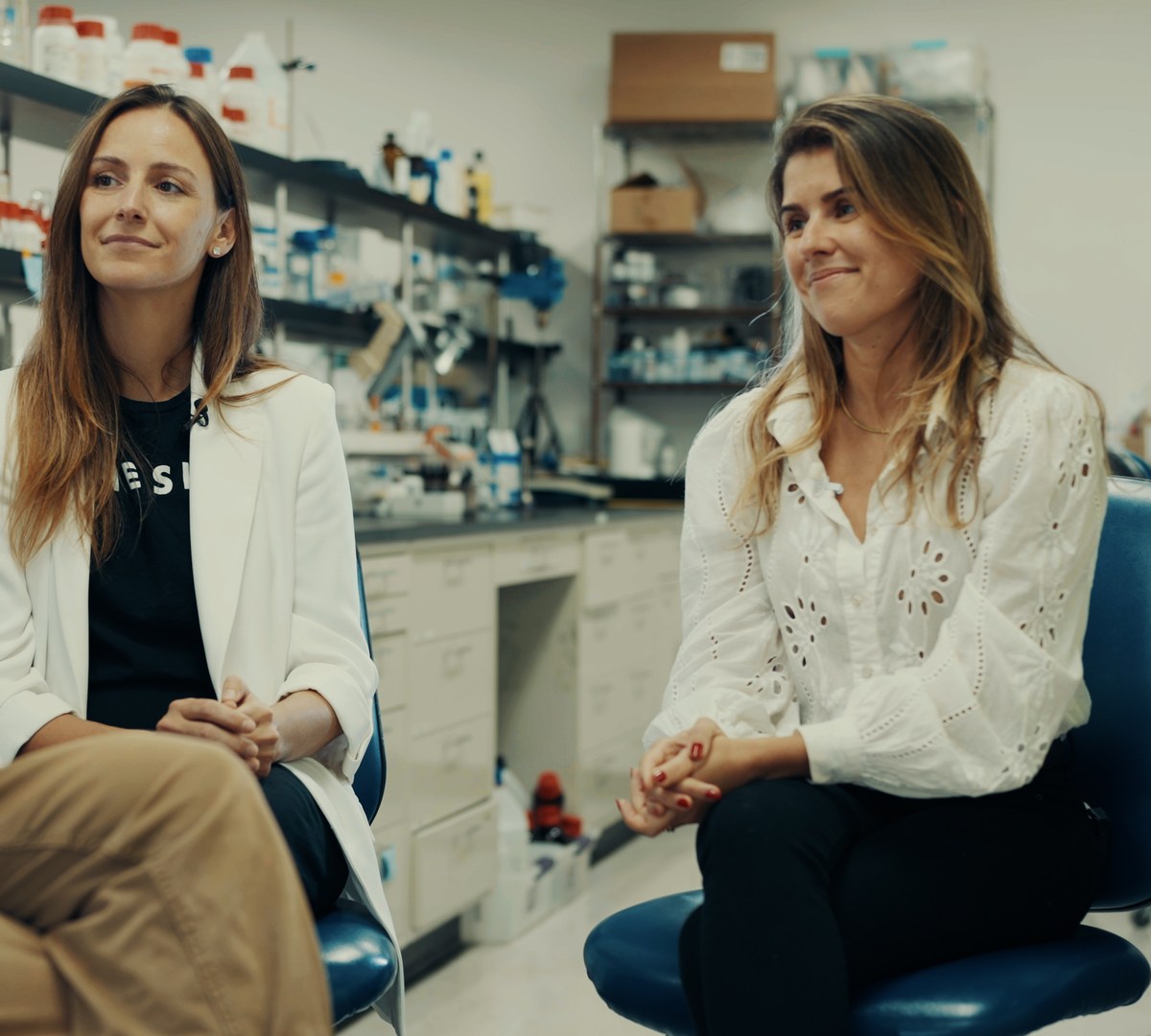
More recently, she has spoken about moving from the city to Sausalito. Proximity to nature and a stronger sense of community were part of the appeal. Her account of life there includes trails, time on the water, and getting to know more people. The photograph of Oliveira and Zonari in the OneSkin laboratory belongs to the same visit in which they discussed this change of setting. Their working partnership has a life around it.
Her public description of a company retreat is similarly social. She valued the exchanges and personal connections with colleagues. A team spends much of its time assigning tasks and producing results; a retreat allows people to encounter one another outside those usual transactions. Oliveira’s response gives some substance to her stated pleasure in bringing people together around a shared purpose.
The education continues
Recognition has followed the company’s development. Oliveira and Zonari were selected as Endeavor Entrepreneurs in 2024. The network brings them into a wider community of founders, extending the circle that began with researchers in Brazil and grew through IndieBio. It is another form of company-building infrastructure: people with experience that a founder can draw on as the questions change.
In February 2026, organizers of the LatAm Business Forum at Berkeley Haas listed Oliveira on a panel about scaling Latin American companies internationally. Later in the year, Beauty Connect’s Los Angeles program listed her for an October 29 discussion of education, user-generated content, community, and conversion. As of October 11, that appearance is still ahead. The vocabulary of the agenda says something about the range of her present job.
The founder who arrived through a scientific accelerator now has reason to discuss how customers learn about a brand. A consumer business requires explanation at many levels: within the team, across the investor table, and in the public conversation. Each audience has its own questions. The CEO has to keep the company recognizable as she answers them.
Looking back on her beginnings, Oliveira wished she had understood that she was enough. That sentence carries more weight after the failed venture, the move, and the decisions about partners. It leaves room for expertise from other people without handing them ownership of her judgment. Her education as a founder has involved learning whom to bring along, when to change the plan, and when to trust the person who made it.
“I wish I knew I am enough.”
Carolina Reis Oliveira
Follow the conversation
More from Carolina, her company, and the conversations around her work.