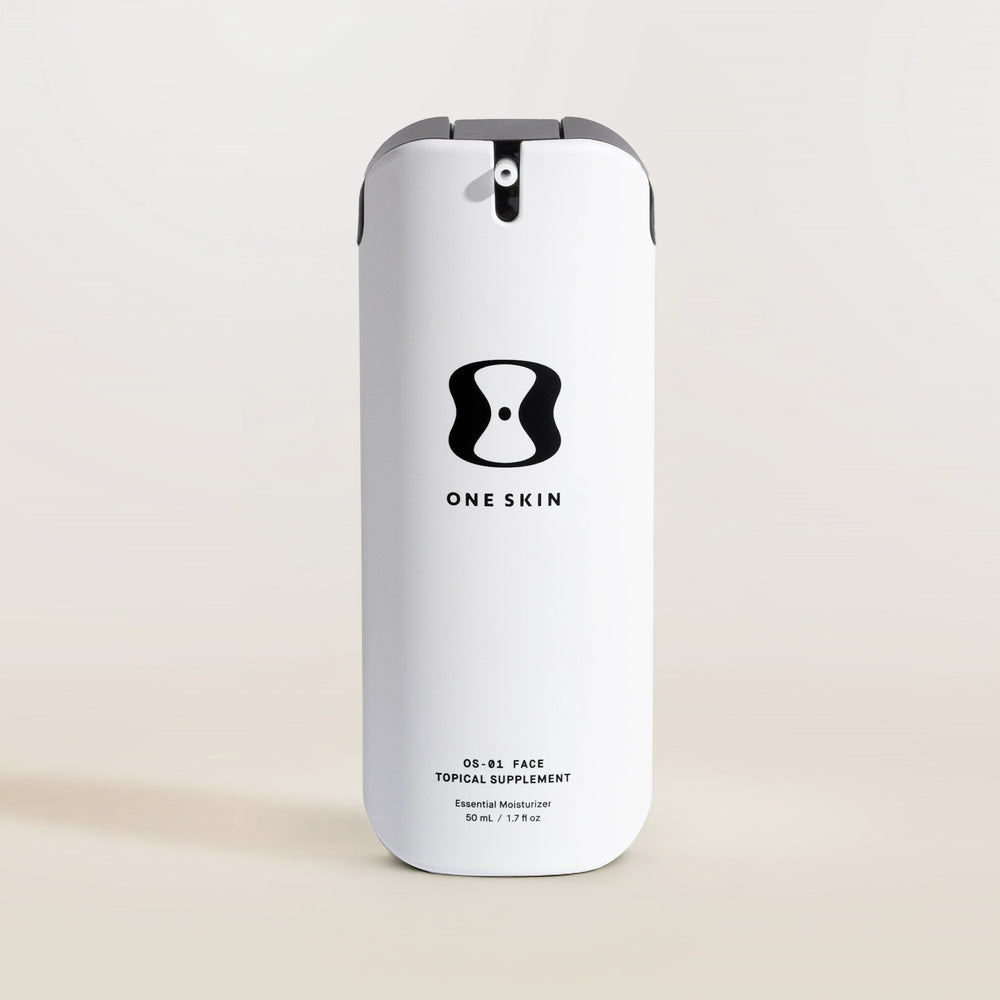
OneSkin is a San Francisco biotech company that sells face cream. Those two things - "biotech" and "face cream" - do not usually appear in the same sentence, and the friction between them is basically the whole story. The company was founded in 2016 by four Brazilian women who all have PhDs and who all met in a doctorate lab, which is not the traditional origin story for a brand you find on a Shopify checkout page. They were interested in longevity science, the study of why bodies wear out, and they arrived at a slightly contrarian conclusion: the most measurable, most visible, most underrated organ to work on is the one you can see in the mirror.
The pitch, stripped of marketing, goes like this. Skin ages in part because of "senescent cells." These are cells that have stopped dividing but refuse to die politely. Instead they hang around, metabolically active, leaking inflammatory signals that degrade collagen and quietly sabotage the tissue around them. The industry's affectionate term for them is "zombie cells," which is both accurate and, you have to admit, good copy. If you could persuade those cells to behave less like zombies and more like functioning young cells, you would in principle be treating a cause of aging rather than spackling over an effect.
So OneSkin went looking for a molecule that could do that. This is the part that separates it from a company that merely says "clinically proven" in a serif font. Starting around 2016, the team ran a computational screen across a library of more than 900 candidate peptides - short chains of amino acids - looking for ones with "senotherapeutic" properties. Out of that haystack they pulled two needles, which they named OS-01 and OS-02. OS-01 became the flagship. The company describes it as a peptide that modulates senescent cells and, in its own studies, reduces markers of skin's biological age. The appropriately skeptical reader will note that "biological age of skin" is a metric the company is heavily invested in making you care about. The appropriately fair reader will note that OneSkin has actually published its work in peer-reviewed venues and holds a portfolio of patents - roughly 17 at last count - which is not something most cosmetics brands can say, or would ever bother to try.
There is a nice detail in how they test it. Rather than animals, OneSkin uses lab-grown human 3D skin models - little engineered pucks of actual human skin tissue. This is partly an ethics decision and partly, more quietly, a data decision: human skin behaves like human skin, and a mouse's back does not. It is a good example of a recurring OneSkin move, where the virtuous choice and the rigorous choice happen to be the same choice, and the company gets to bank both.
Then there is the naming. OneSkin does not sell "moisturizer." It sells a "topical supplement." At first this reads like the sort of euphemism that exists to dodge a regulator, and maybe partly it is. But it is also a genuine claim about category. A moisturizer is judged on whether your face feels soft this afternoon. A supplement is judged on whether something is better months from now. By renaming the shelf it sits on, OneSkin is quietly changing the question you are supposed to ask about it - from "do I look dewy" to "is this organ aging well." Whether or not you buy the product, you have to respect the jujitsu.
The product line has expanded in the predictable, sensible way a single hero ingredient tends to expand. There is OS-01 FACE, the original. There is OS-01 EYE, which packs the highest concentration of the peptide for the thin skin around the eyes and is the subject of a 2025 clinical paper on periorbital aging. There is OS-01 BODY, a lotion that the company's research links to reduced inflammation and a stronger skin barrier. There is a mineral SPF called SHIELD and a cleanser called PREP. It is, structurally, one molecule wearing five outfits, which is exactly what you want if the molecule is your moat.
It is worth asking the blunt consumer question buried under all this: what does the stuff actually do for you? The honest answer is the modest one. You put it on twice a day, and OneSkin's own studies report that participants saw improvements in skin smoothness, radiance, firmness and the appearance of fine lines over roughly 12 weeks - the window the company keeps pointing to as where its effects become visible. That is a claim about incremental, cumulative change, not a magic overnight reversal, and to OneSkin's credit the marketing mostly resists the overnight-miracle grammar the category is famous for. The practical value proposition is simple: it is a daily routine for people who would rather their skin-care decisions be governed by published data than by an influencer's lighting.
Who buys it tells you something too. OneSkin's natural customer is science-literate and "pro-aging" rather than anti-aging - someone comfortable with the idea that they are managing an organ over decades rather than chasing a red-carpet look on Friday. The company sells direct through its own storefront and through Amazon, on both one-time and subscription terms, which is the standard modern playbook for a brand that wants repeat purchases and a direct line to its most loyal users. Exact customer counts are not public, but the repeat-and-subscribe model, plus a steady drumbeat of long-form user reviews documenting six- and twelve-month before-and-afters, suggests a base that treats the product more like a supplement regimen than an impulse buy - which is, of course, exactly the behavior the "topical supplement" framing was engineered to produce.
The competitive set is a moving target, which is part of why the category naming matters. On one flank are the established science-forward lines - the SkinCeuticals and Augustinus Baders of the world - that already own the "clinical" shelf and have far bigger distribution. On the other are newer longevity and senotherapeutic startups trying to plant flags in the same "skin as longevity organ" territory OneSkin is cultivating. And behind both looms the entire sprawling anti-aging market, most of which competes on brand and feel rather than mechanism. OneSkin's wager is that owning a specific, patented, published molecule is a more durable position than owning a mood. It is a reasonable wager. It is also an expensive one, which is where the funding comes in.
The money has followed the story. OneSkin has raised roughly $60 million to date. In November 2024 it closed a Series A round bringing the brand to a $20 million milestone, with a cap table that is itself a little essay: Selva Ventures and PLUS Capital, the strategically interesting Unilever Ventures (the venture arm of a company that knows a thing or two about selling soap), returning early backers SOSV and Meta Planet, plus a celebrity-and-operator garnish of model-designer Camila Alves McConaughey and tech entrepreneur Kevin Rose. Then in August 2025 the growth-equity firm Prelude Growth Partners put in another $20 million, in a deal the company framed as swapping out an early seed investor for a partner better suited to scaling. That is a polite way of describing cap-table spring cleaning, and it is the kind of thing companies do when they think the next phase is about distribution rather than discovery.
What OneSkin is really selling to those investors is not a cream. It is a category: "skin longevity." If that phrase catches on the way "clean beauty" did, the company that coined the vocabulary and owns the peptide behind it is in a very good seat. If it does not, OneSkin still has a differentiated product with published data, which is a perfectly respectable fallback for a beauty brand and a slightly precarious one for a biotech. The interesting tension in the business is exactly that it is trying to be both at once.
The founders lean into the science because the science is the point. Carolina Reis Oliveira, the CEO, has a doctorate in immunology and moved from Brazil to Silicon Valley to build this. Alessandra Zonari, the chief scientific officer, did her doctorate in skin regeneration and tissue engineering and is credited on the patents and papers behind OS-01. Mariana Boroni brought the bioinformatics and genomics - the computational muscle that made screening 900 peptides tractable in the first place. Juliana Carvalho rounds out the founding four. The company they built is small, around 63 people, and unusually credentialed for its shelf. In an industry that runs on fast launches and faster claims, OneSkin's competitive advantage is a slightly boring one: it did the unglamorous, decade-long work first, and it can show you the receipts. Boring, in this case, is the strategy.