Consider the student who gets an algebra problem wrong. A grade book records the error. A teacher wants to know where the reasoning slipped. Was it the equation, the operation, the meaning of the variable? The distance between those questions is where Carnegie Learning has spent much of its working life.
- Adaptive math coaching that responds to individual skills, with live information for teachers.
- A school-and-district business spanning curriculum, software, tutoring, and professional learning.
- The evidence has conditions: RAND’s positive high-school result emerged in year two.
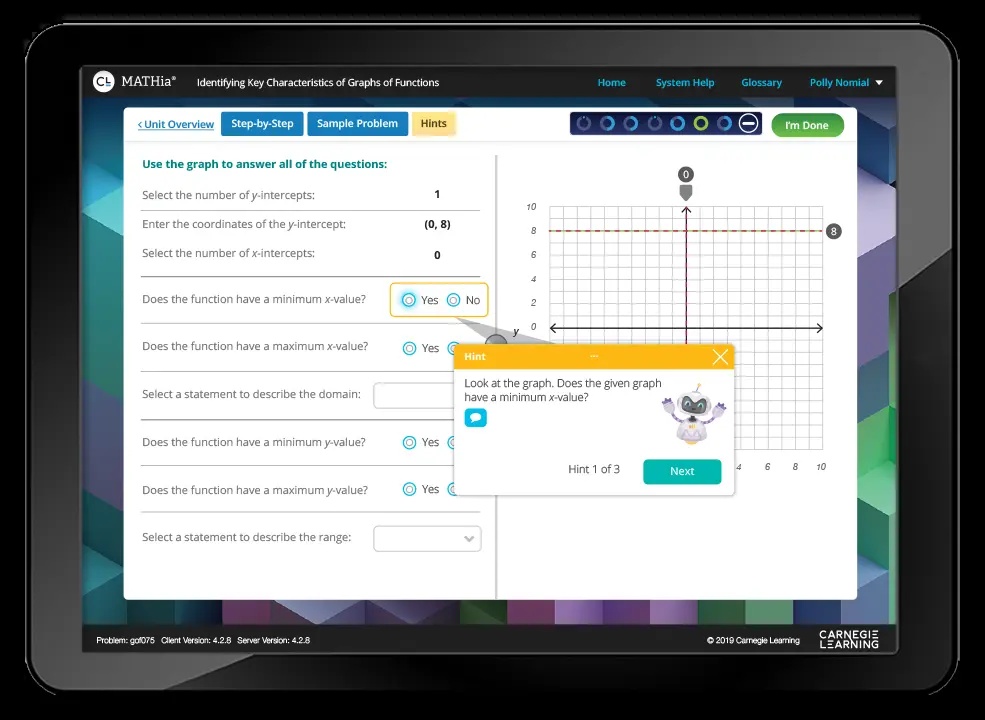
Its MATHia software gives students feedback while they work, adapting at the level of individual skills. For teachers, reports turn those interactions into a picture of progress. The proposition is practical: a classroom contains many different misunderstandings, and one adult cannot catch all of them at once.
Today, Carnegie Learning sells K-12 mathematics, literacy, world-language materials, tutoring, and professional learning. The company reports reaching more than 5.5 million students and educators across all 50 states and Canada. That reach is impressive. The more interesting question is what happens after a school signs up.
02Before AI became a sales pitch
In October 1998, Carnegie Mellon University announced a company to commercialize cognitive tutors already used in schools. The underlying work combined psychology and computer science. John Anderson’s research helped provide the foundation; Steve Ritter, Ken Koedinger, and educator William Hadley were among the company’s co-founders.
The original announcement described a system that diagnosed difficulties as students worked through problems. It also insisted on a classroom that included the teacher. One wonderfully specific detail: the new chief executive, Robert Longo, had worked at both Apple and NeXT. Selling computers to education and understanding how children learn were already meeting in the same room.
The researchers’ own account supplies a useful change of mind. Early geometry tutors addressed proof, but school adoption demanded attention to the wider curriculum. Working with teachers and administrators helped move the effort toward complete courses. A clever program needed somewhere to live in the school day.
03The second year changed the result
Then came a demanding test. RAND evaluated Cognitive Tutor Algebra I across 147 schools in seven states. Schools were assigned to the Carnegie curriculum or their existing approach. This tested a package of classroom teaching, printed activities, and software under ordinary school conditions.
The first year produced no statistically significant advantage. In year two, the high-school result was positive: an effect equivalent to moving from the 50th to the 58th percentile. The middle-school estimate was also positive, but statistically inconclusive. Those distinctions belong beside every enthusiastic retelling of the study.
Why the delay? RAND explored explanations without establishing a definitive cause. Reports of teachers adapting the curriculum offered a possible clue. My reading: buyers should budget for implementation and watch what changes in teaching. The evidence gives patience a place in procurement; it does not make patience a guarantee.
Eight percentile places.
A meaningful distinction.
04A purchase with a timetable attached
The financial comparison is equally instructive. RAND’s historical cost analysis estimated about $97 per student for Cognitive Tutor Algebra I against about $28 for comparison curricula. The accounting included materials, technology, support, and training. These are study-era estimates, not a price list for today’s MATHia.
Carnegie Learning’s business combines school and district software licensing, print curriculum, and services. A district can adopt a core program or buy supplemental instruction and support. Its product pages direct interested buyers toward demonstrations and sales conversations. The school must judge the whole implementation, including devices, scheduling, and staff time.
Look at LiveLab, the teacher’s live facilitation tool. It distinguishes students who are working, idle, offline, or in need of attention. Idle means signed in without activity for five minutes. That modest detail captures the design problem: opening a laptop and learning algebra are separate events.
The license is only part of the bill.
05The portfolio grew beyond algebra
The math offering now spans ClearMath Elementary, game-based MATHia Adventure, secondary curricula, MATHia, and interactive video instruction through MATHstream. The pieces serve different jobs: introducing ideas, discussing them, practicing independently, and finding the place where understanding runs out. They give schools several ways to combine print and digital teaching.
Expansion changed the business. A 2018 merger brought EMC School and Mondo Publishing into the picture. In 2020, Madison Dearborn Partners made a strategic growth investment, and Carnegie Learning acquired Scientific Learning, known for Fast ForWord. Zorbit’s Math followed in 2021. Literacy and languages became substantial parts of the company’s offer.
The latest addition is Ethiqly, acquired on October 9, 2026. Its writing platform supports brainstorming, drafting, and revision while giving teachers insight into students’ work. Chief executive Barry Malkin explained the attraction: “Technology should not do the thinking for students”. That is a demanding product brief in an age of instant essays.
“Technology should not do the thinking for students”
Barry Malkin · CEO · October 2026
06What a school can borrow
Carnegie Learning occupies a crowded space between curriculum publishing, adaptive practice, and instructional services. Curriculum Associates’ i-Ready is one alternative for personalized math instruction. Carnegie’s distinctive combination is its cognitive-tutoring lineage, classroom materials, and teacher support. The useful comparison is a school’s instructional needs, rather than a contest over who says “AI” most often.
There is a concrete example of the support side in North Carolina. In December 2023, the state education department announced a roughly $7.9 million federal grant for a project using Carnegie’s Patterns professional learning. With WestEd, it planned to involve 300 upper-elementary educators. This was education-project funding, rather than a venture round for Carnegie.
The next research question reaches beyond math. A five-year federal EIR project announced in March 2026 will evaluate Lenses on Literature in approximately 120 middle schools, with WestEd and partners in Kentucky, Maine, and Florida. It is a planned evaluation of the full curriculum, not a result already earned.
A school can copy the underlying habit: examine the steps, connect practice to classroom instruction, and give teachers time to respond. Where devices are unreliable, software time displaces discussion, or training is an afterthought, the fit becomes weaker. Buying a tutor cannot settle those choices. The next step still belongs to the people in the room.
Open the classroom door
Explore the tools, see the product, and follow what comes next.