The Dispatch
A software company that runs on submarine discipline
Most hardware engineers - the people building rockets, drones, reactors, and robots - still stitch their working days together out of MATLAB, Python, Jupyter notebooks, and Grafana. Tools that were never built to talk to each other, holding up systems where a missed anomaly is not a bug report but a failed mission. Cameron McCord looked at that arrangement and decided it was closer to a scandal than a standard.
Nominal, the company he co-founded in 2022 with Bryce Strauss and Jason Hoch, is the fix. It is a connected software suite for testing and validating mission-critical hardware - the invisible layer that ingests high-frequency sensor data, correlates it, surfaces the thing that is about to go wrong, and lets engineers collaborate in the cloud instead of emailing spreadsheets. In early 2026, three years in, Nominal crossed a $1 billion valuation after raising more than $155 million in roughly ten months. Four of the five largest US defense contractors are customers. So are Anduril, Shield AI, and the US Air Force.
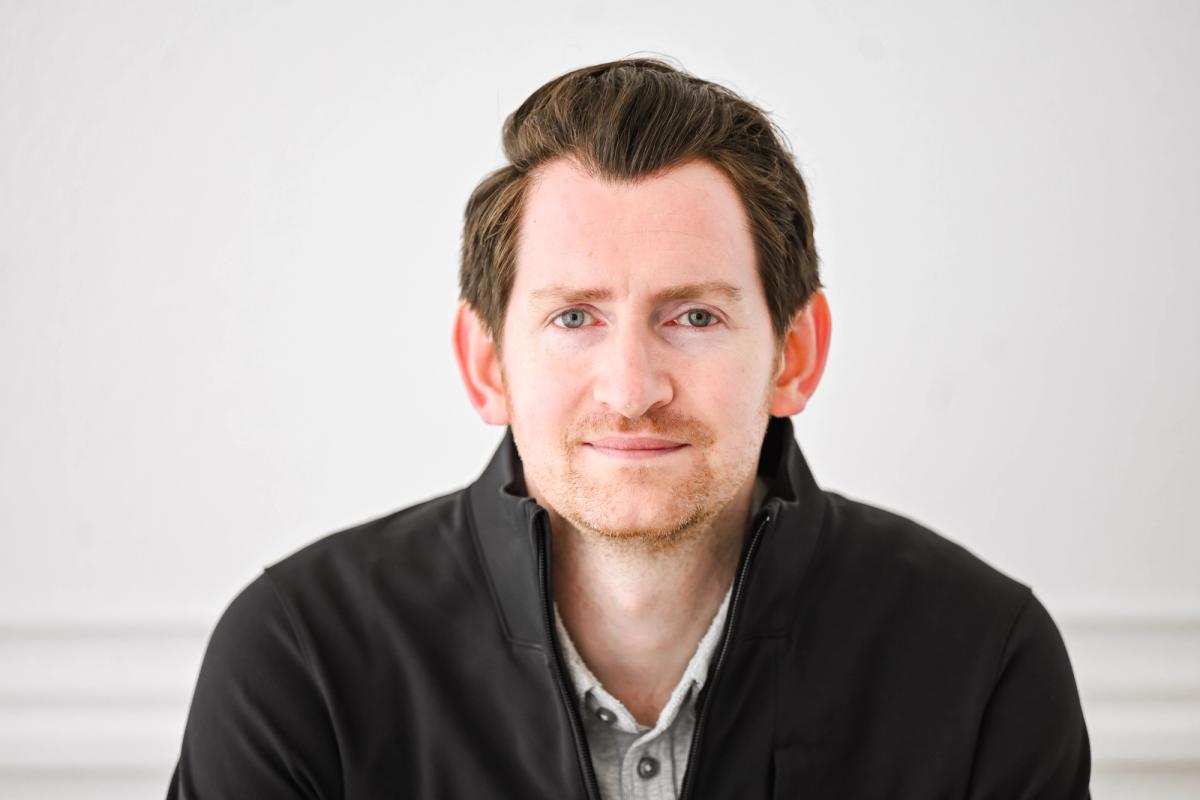
McCord is the CEO. He is also the person who personally interviews every single employee - a habit that has quietly colonized his weekends as headcount climbed past a hundred and ten. He is not doing it because he distrusts his managers. He is doing it because he learned, in a place with no windows, what happens when you put the wrong person in a small room and everyone's life depends on the right one.
You earn the right to stand the night watch.
- On the hires he actually wants
The night watch
Every US Navy submarine officer starts the same way: down in the engineering spaces, operating a nuclear reactor for a year or two. Only after that apprenticeship do you earn what McCord calls the right to stand the night watch - the trust to command the vessel while the captain sleeps. It is the entire promotion system compressed into a single phrase. Are you a safe pair of hands? Can you make the correct call, alone, in the dark, without waking anyone up?
He spent five years in that world and logged 484 days underwater. He describes the environment, unromantically, as "52 and fluorescent" - cold, artificially lit, and utterly transparent. On a submarine there is nowhere to hide; your crew watches you brush your teeth. That, he argues, is precisely why earnest leadership beats performed leadership. Pretend to be someone you are not and the people twelve inches away will notice by Tuesday.
The lessons compounded. Direct conflict resolution, because there is no room to postpone a disagreement. Two-way communication loops, where an order is repeated back and confirmed before anyone acts. A critique culture built on "five whys" root-cause analysis. He imported all of it, more or less intact, into a Series B startup.
Nominal's fundraising sprint
Approximate capital raised, cumulative · source: TechCrunch, company
A founder, assembled on purpose
McCord did not stumble into Nominal. He built the founder first. Growing up in Springfield, Virginia, he read physics books and argued them with his father, and idolized an uncle who wore a Navy admiral's stars. He went to Thomas Jefferson High School for Science and Technology, then to MIT, where he double-majored in physics and nuclear engineering, played varsity soccer, joined a fraternity, and - in 2012 - was named a Truman Scholar. As a student he interned with the Nuclear Regulatory Commission on post-Fukushima reactor simulations, went to a nuclear conference in Moscow, and trained for a month with the South Korean Navy.
Then came the submarine years, and then Capitol Hill, where he served as a Navy Congressional liaison out of an office in the Rayburn building - learning how billion-dollar defense budgets actually get negotiated. Then Anduril, when it was still around eighty people, where he built early counter-drone systems and, by his own account, got "promoted" six times simply by moving at the speed of opportunity in a deliberately flat organization. Then Head of Defense at Saildrone. Then investor and operator at Lux Capital, where he watched founders up close and learned the mechanics of raising money before he ever needed to. Advisory work at Applied Intuition along the way.
Public sector, private sector, government, venture, startup, big institution. He treated each as a stepping stone rather than an accident, and the through-line was consistent: the hardest, highest-impact problems are multidisciplinary, and you can only see them clearly if you have stood in several rooms.
The journey of a company is you have to find product-market fit every three months.
- On staying agile
Intentional ambiguity, and the Monte Carlo in his head
From Anduril he borrowed a phrase he still uses: intentional ambiguity. The idea is counterintuitive - you deliberately under-structure the organization so that high-caliber operators are forced to self-organize toward outcomes rather than wait for a chart to tell them what to do. Paired with the Navy's directness, it produces a company that is both loose and exacting.
Colleagues describe McCord as calm and even-keeled, the person who lowers the temperature in a high-stakes meeting. The calm is partly manufactured. He is, by his own description, a Monte Carlo simulator - someone who runs the scenarios over and over in his head before a big moment, and who works with executive coaches to keep that machinery from running him. Saturday mornings are reserved not for tactical catch-up but for deep thinking. "Being comfortable in your own head," he says, "is the biggest gift I can give to Nominal."
His interview method carries a submariner's suspicion of smooth surfaces. He wants to see how a candidate handles friction, so he sometimes engineers a little - a late start, a staged IT hiccup - and watches. He is hunting for the same two things every time: low ego and killer performance. Quiet operators. Safe hands. People who can stand the night watch.
Taking testing from 2002 to the future
McCord frames Nominal's near-term job in almost deflationary terms. The hardware-testing world, he says, has been stuck somewhere around 2002; the first mission is simply to drag it forward to 2019 with modern automation and data practices, and only then to push into AI. It is a rare founder who publicly caps his own hype.
His longer bet is contrarian in an era of automation maximalism. For the next few years, he argues, the value sits at the human-machine interface - understanding how engineers actually make judgments about physical systems - not in leapfrogging to full autonomy. Keep the human in the loop, reduce their workload with hardware-specific agents, and own the data asset and agent infrastructure underneath it all. If he is right, Nominal becomes the connective tissue for how the world tests and operates its most important machines. He has clearly run the simulation.