Issue No. 047 / The Investor
Bilal
Bilal
Zuberi
A chemist learned to read pitch decks. Then he led 65 deals, sat on 35 boards, and walked away from a $5 billion fund to start over with a smaller one.
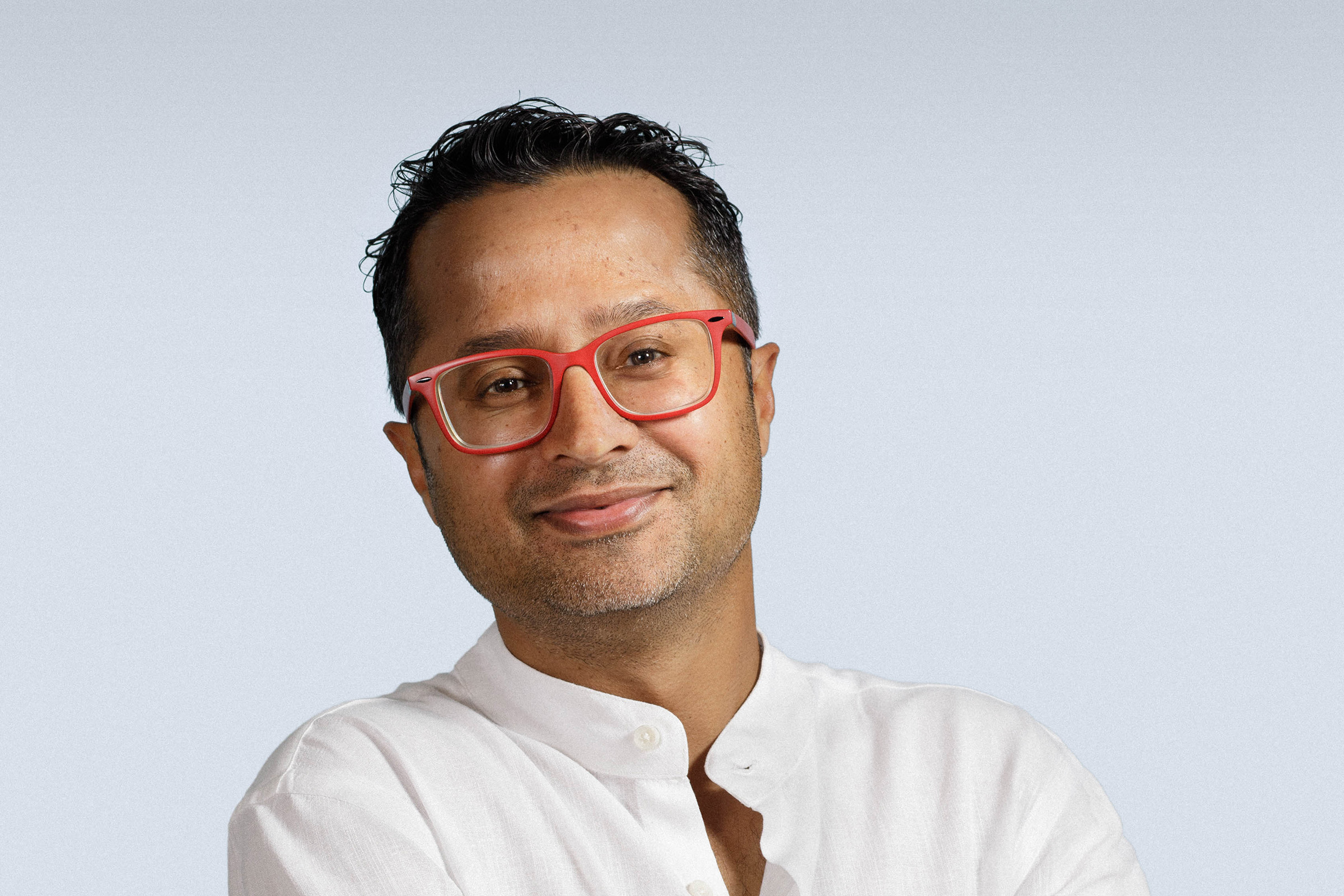
A chemist learned to read pitch decks. Then he led 65 deals, sat on 35 boards, and walked away from a $5 billion fund to start over with a smaller one.
Most venture capitalists collect logos. Bilal Zuberi collects problems - the kind that involve kilns, satellites, and unreasonable amounts of physics.
He runs Red Glass Ventures now. Menlo Park. Early stage. He writes the first or second check into companies where software has to meet something it can drop on its foot. Robotics. Autonomy. Manufacturing. Defense. Energy. Anything that, in his phrase, lets AI "touch atoms."
The fund is new. The thesis is old. For the last seventeen years - first at General Catalyst, then at Lux Capital - Zuberi has been writing checks into companies that engineers love and most VCs find too complicated to underwrite. Applied Intuition's vehicle software. Saildrone's ocean drones. Desktop Metal's printers. Evolv's weapons detectors. Nozomi's industrial cybersecurity. Ironclad's contract platform. OpenSpace's construction cameras. The list is long, and it skews toward things you can weigh.
You can read his name on Lux's old website and on a hundred press releases. What's harder to read is why a guy with a PhD in physical chemistry, who once shipped diesel exhaust filters out of a Massachusetts factory, kept showing up in those particular cap tables. The short answer is that he understands what a hard tech founder is actually trying to do, because he's been one.
Zuberi grew up middle-class in Karachi, Pakistan. He has said publicly that he credits US taxpayers for the scholarship that paid his way through graduate school. He landed at MIT in the late nineties, working in physical chemistry. His doctoral advisor was Mario Molina, who had won the 1995 Nobel Prize for figuring out how chlorofluorocarbons chew through the ozone layer.
Most newly minted MIT chemists go into a lab, or to a national lab, or to a university. Zuberi went to The Boston Consulting Group. A year of slide decks later he left BCG to co-found GEO2 Technologies, a Massachusetts startup making advanced ceramic substrates for catalytic converters. He spent four years there as VP of product development - which is to say, four years of dirty boots, supplier calls, and the specific kind of customer pain that involves diesel engines and EPA deadlines.
That operational scar tissue is the thing he keeps quietly cashing in.
In 2008 he moved to General Catalyst as a Principal. In 2013, Lux Capital - then a much smaller firm - announced him as Partner. He stayed twelve years. During that stretch Lux grew from a niche frontier-tech shop into a $5 billion-plus asset manager, and Zuberi led more than 65 deals and sat on 35-plus boards along the way.
The deals are what people notice. The pattern is what they should notice. Applied Intuition is software for vehicle development, but the vehicles are real. Saildrone is a fleet of autonomous sailboats that the US Navy actually uses. Evolv is a weapons-detection system installed in real stadiums. Desktop Metal is a 3D printer for actual metal parts. There is a through line: AI on top, atoms underneath. Years before "deep tech" became a panel topic, this was already his beat.
In December 2024 he posted, briefly: after more than a decade at Lux, he was starting a new chapter with the firm's blessing - partnering at the earliest stages with what he called "visionary founders." By spring 2025 the new firm had a name. Red Glass Ventures. Menlo Park. Early stage. AI x the physical world. He runs it himself.
Solo GPs are not a new thing. Solo GPs who came up at a flagship fund and are now writing checks at formation are slightly more unusual. Zuberi has spent his career on the cap tables of companies that take a decade to mature and a billion dollars to scale. He has now chosen, deliberately, to start at the smallest end of that pipeline.
It's worth taking him at his word. "Money is the cheapest thing that you give to capital," he has said. "What you really want to give them is your time, attention, network and resources." Twelve boards at once does not leave much room for any of those. One fund, much smaller checks, his own decisions - that does.
If you ask the people who work with him what they actually value, they don't usually mention the MIT diploma or the AUM. They mention the rolodex. Zuberi has spent two decades quietly becoming a connector between Silicon Valley and three communities that the Valley tends to mishandle - Pakistani founders, government customers, and dual-use deeptech operators. He has been on the Building the Base podcast hosted by Business Executives for National Security; he has been a regular voice at Deep Tech Week; he serves on advisory bodies including the Lemelson Foundation.
The bridge work is not branded. It just happens. A defense procurement officer needs to talk to a robotics CEO. A South Asian engineer is trying to figure out whether to take a fellowship or start something. A late-stage portfolio company suddenly needs a friend at the Pentagon. He picks up.
Zuberi writes. His Medium publication, BZ Notes, is a long-running collection of essays. On X, he posts as @bznotes - usually about portfolio milestones, defense tech policy, or whatever new physical thing has just stopped being theoretical and started being shippable. In a 2024 Axios interview about climate and energy he was blunt: with data centers, EVs, and a new domestic manufacturing build-out all pulling on the grid, the answer is to develop more power. Not less demand. More supply.
The same logic shows up in his investing. He does not bet on demand restraint. He bets on capacity - on the companies building the new machines, the new sensors, the new software for the new factories. "AI x the physical world" is a tidy phrase for a messy thesis, but the thesis itself has been consistent for years.
He is not loud. He is not a brand-first investor. There is no podcast empire, no TED stage tour, no book tour. He has a Medium and an X account and a calendar that is presumably very full. The work is the work. The reputation followed because the deals followed.
What's interesting about a Red Glass Ventures-shaped career arc is that it is voluntary. You don't leave a senior seat at a $5B fund by accident. You don't take a step back at 50 unless you want a different kind of problem. Zuberi appears to have wanted a different kind of problem - the kind where the first cap table conversation is also the first board meeting, and where the upside is enormous but only if the founder is right about something almost nobody else believes yet.
His record suggests he's comfortable with that. His new fund is a bet that he is more comfortable with it than the institutional machine ever allowed him to be.
Red Glass is new enough that its portfolio is just beginning to surface in public. Zuberi has hinted at investments adjacent to industrial autonomy and aerospace-grade software. The shape of the fund - small, early, concentrated - means each check will be visible. There is no hiding behind a giant late-stage book.
That is, perhaps, the whole point. The chemist still wants to be in the lab. He just built a smaller one.
A partial reading of his Lux-era cap tables
Zuberi's Twitter handle, @bznotes, is also the name of his Medium publication. He has been writing essays under that header for years - long before substacks became a venture cottage industry.
His PhD advisor at MIT, Mario Molina, won the Nobel for explaining how human-made chemicals destroy the ozone layer. Zuberi's first company, GEO2 Technologies, made ceramic filters to reduce diesel emissions. The atmospheric chemistry was not a coincidence.
He has invested across autonomous sailboats, courthouse weapons screens, industrial control cybersecurity, autonomous vehicle simulation, and metal 3D printing - in a single career. The unifying theme is not a sector. It is a posture.
He grew up in Karachi. He doesn't bury the detail. He talks about the scholarship that brought him to the United States and the obligation he feels to the system that paid for it.