When Byron Hewett arrived at SomaLogic, Larry Gold had a joke ready for him. Most incoming chief executives inherit a business plan, a set of accounts and perhaps a drawer that nobody wishes to explain. Hewett inherited 1,129 possibilities. Gold, the company’s founder, asked how often a person walked into a new company with that many products to take to market. It was an excellent welcome, and an unusually large homework assignment.
The number referred to the company’s protein-binding reagents, each with commercial potential individually and in combination. For a scientist, that abundance suggests experiments. For a commercial executive, it raises another collection of questions. Which opportunities should come first? Who will buy? What must the organization build to deliver? An inventory of possibilities can be a fine thing. It can also be a very expensive way to avoid choosing.
Hewett joined as chief executive in 2013, taking over from Gold, who remained chairman and an active adviser. Their arrangement paired the founder’s scientific work with an executive whose career had been spent developing markets and organizations. The problem was particular to SomaLogic. The underlying assignment was familiar to Hewett: help a company make the journey from technical promise to commercial activity.
A commercial education, before the corner office
Hewett’s formal education began on the business side. He earned a bachelor’s degree at the University of Virginia’s McIntire School of Commerce and a graduate management degree at Northwestern’s Kellogg school. Those credentials place him in a different professional lane from the research founders with whom he would later work. His contribution came through management, marketing and the practical business of bringing products to customers.
His earlier employers included Abbott, BioCircuits, Chiron, Bayer and Qiagen. At Qiagen, his responsibilities included sales and marketing and general management for North America. The sequence matters less as a parade of company names than as a record of the kinds of organizations he encountered. He had worked in established businesses before taking leadership roles at smaller companies, bringing experience of commercial operations into environments still constructing their own.
At Immunicon, he held operating responsibilities before becoming president and CEO. He later led BioBehavioral Diagnostics as chairman and chief executive. By the time SomaLogic recruited him, his commercial experience stretched beyond 25 years. He was arriving with a substantial working history, rather than learning the machinery of company leadership for the first time in Boulder.
His subsequent public biography describes him as a four-time CEO who has sold two companies and merged another. That compact description contains several distinct jobs: running an enterprise, finding a buyer, negotiating a combination and managing transitions. A corporate career is often presented as a ladder. Hewett’s looks more like a succession of assignments, each with a different point at which the organization needed an experienced hand.
The founder stays in the picture
The 2013 handover at SomaLogic was designed around continued cooperation. Gold had initiated the search for a new chief executive. He retained the chairmanship, while Hewett took on the CEO role and joined the board. The founder was still present; the responsibilities were changing. That is a useful distinction in a company whose identity remained closely tied to its original research.
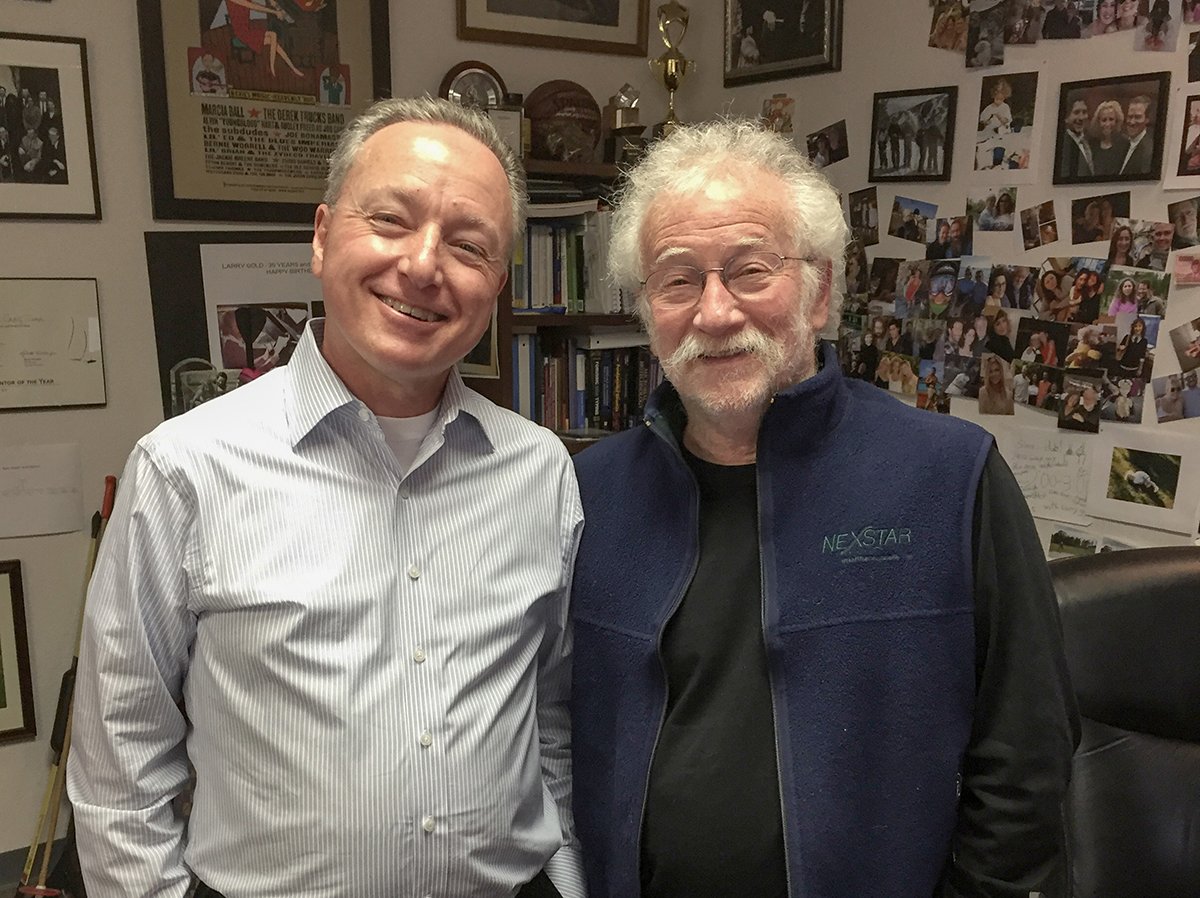
A photograph of the two from 2016 makes the relationship pleasantly ordinary. Hewett stands on the left, Gold on the right, surrounded by books, framed pictures and a generous population of family photographs. They are smiling. The room has the accumulated texture of somebody’s working life, rather than the immaculate emptiness of a showroom office. It is a fitting setting for a partnership between a founder and an incoming operator.
That year, Gold and Hewett were finalists in the Mountain Desert regional EY Entrepreneur Of The Year program. The shared recognition matters here: the commercial executive and the founder were named together. Company building rarely fits neatly into a photograph of one individual, however much the conventions of business coverage encourage it. This picture at least leaves room for two.
A catalogue becomes a set of relationships
By January 2016, SomaLogic had an agreement with Bristol-Myers Squibb providing expanded access to its reagents. The arrangement covered 1,310 reagents in the then-current public assay, as well as custom reagents developed specifically for the partner. The number had moved beyond the 1,129 in Gold’s greeting. More consequentially, an outside company had made a concrete arrangement to use the technology.
The agreement was a way to connect a technical capability with another organization’s research work. Hewett described the intention to integrate SomaLogic’s technology into that work through collaboration between the companies’ scientists. The commercial story lay in the relationship: access, customization and an agreement around use. A promising catalogue had become part of somebody else’s operating plans.
Oxford supplied another setting for that work. A January 2016 partnership kickoff agenda placed Gold, Hewett and other SomaLogic leaders alongside members of the university community. Hewett’s scheduled contribution concerned the partnership’s “Crucible” and the company’s commitment to innovation with Oxford. Other sessions addressed the technology and the agreements governing collaboration. Scientific ambitions and practical arrangements appeared on the same program.
In January 2017, SomaLogic announced an agreement to join iCarbonX’s Digital Life Alliance. The arrangement included plans for a China-based joint venture and an equity investment whose financial details were not disclosed. For Hewett’s commercial remit, this was a further expansion of the map: a Boulder company arranging a new route into China through a local partner. The agreements were different, but all required the company to work beyond its own walls.
The investor’s clock
An opportunity has a timetable. So does the money used to pursue it. Hewett had been explicit about the friction between those two clocks. In a discussion of Colorado company financing, he described investors needing to recover capital within a fund’s life while product development could take longer. His concern was structural: a company can be progressing on its own terms and still be awkwardly timed for its backers.
He also described Gold’s use of personal financing and strategic partners to retain influence over SomaLogic’s direction. The lesson was about control as much as cash. Funding arrangements help determine who gets to choose the next step, how long a company can keep working and when a transaction becomes attractive. Money arrives with a calendar attached, even when the calendar is tucked discreetly into the paperwork.
In March 2016, SomaLogic announced financing of up to $60.5 million from Visium through a combination of debt and equity. The phrasing deserves care: this was a financing arrangement of up to that amount, rather than a statement that the full sum had already been received. Hewett emphasized the customized structure and its fit with the company’s capital requirements and growth plans.
The headline figure was substantial, but the structure was part of the point. Debt and equity do different work in a company’s finances. The announcement put capital design alongside commercial development. It gave the research business another resource for its next stage, while leaving the detailed terms private. There is a certain lack of glamour to financing architecture. Companies tend to discover its charms when they need another year.
Leaving a company with something built
Hewett stepped down from SomaLogic in April 2017. Board member Alister Reynolds succeeded him. The company described the transition as a move into a new phase following its initial commercial growth. Hewett’s own assessment focused on the commercial program established alongside the research operation and the strategic planning undertaken during his tenure.
That is a revealing choice of emphasis. His account of the work centered on what the organization had developed: a commercial program and a foundation for further growth. Gold thanked him for his contribution and willingness to continue supporting the business. A leadership change can be read as a closing scene, but this one also described a handover of work already in place.
Hewett subsequently cofounded Brava Diagnostics and held a senior operating role at LightDeck Diagnostics. The titles varied between founder, chief executive and operating leader. The recurring setting was an organization needing commercial and managerial experience. His later move into fractional leadership extended that pattern, allowing the same background to be applied through a different form of engagement.
A commercial program is something the next leader can inherit.
Experience, available in more than one room
At General Inception, Hewett is listed among the life science tools team, and his role is fractional CEO. The title has a deliberately practical sound. It describes a way of making executive experience available without the conventional assumption that one person’s professional identity must belong entirely to a single company. His public work also includes board service and advice to younger businesses.
Nomic announced his board appointment in June 2023. Its cofounder and CEO, Milad Dagher, connected the appointment to commercialization and scaling. Hewett, for his part, described having followed the company for several years and welcomed the chance to help it grow. The appointment put him back near a familiar commercial challenge, this time through a board seat rather than the chief executive’s desk.
The company’s current board listing continues to include him. Meanwhile, his Colorado advisory work reaches across businesses including HepQuant, Darwin Biosciences, AOA Dx and ExOcular Dx. Those roles show the distribution of his experience across several organizations. They do not make every outcome his achievement. Advice and governance are collaborative work, and a board seat is a responsibility rather than a claim on everyone else’s accomplishments.
From one company’s strategy to Colorado’s
Hewett joined the Colorado BioScience Association board in 2020, when he was identified as Brava’s founder and CEO. By 2023, he was chairing its strategic planning committee. In March 2026, he became board chair, succeeding Ethan Mann, with Robin Harper Cowie becoming vice chair. The progression moved his work from company leadership toward a broader set of regional responsibilities.
He summed up part of that remit in a list: “advancing smart policies, strengthening access to capital, connecting our community, growing our talent, and ensuring Colorado remains competitive.” Each item has a company-level equivalent, but the scale has changed. Recruiting becomes a regional workforce question. Fundraising becomes access to capital. The relationships that help one company grow become connections across a community.
The route from Gold’s joke to that chairmanship is a useful way to read Hewett’s career. He arrived in Boulder facing an abundance of possible products. He now helps lead an association concerned with the conditions under which many companies can develop. The number of possibilities has grown; the need to organize around them remains.
It is tempting to end a business profile with a prediction. Hewett’s record offers something more concrete: commercial programs, partnerships, financing arrangements, leadership handovers and board responsibilities. The interesting work happens where people decide what to build next, with whom and on what terms. A thousand possibilities may make an excellent opening line. Giving an organization a way to pursue them takes considerably longer.