In 2013, Wavin was losing market share in Turkey. Local managers had an explanation: the factory was too far from customers, making transport expensive. Build closer, cut costs, lower prices. A new factory gave the problem a reassuringly solid shape.
- Business Models Inc. helps teams rethink how they create and earn value.
- Its projects put customer observation before expensive commitments.
- The tools are often free; applying them is the paid work.
Executive Richard van Delden hesitated. At a Dutch construction site, a contractor had explained a gap: plumbers recognized Wavin’s quality, but mechanical contractors choosing materials might not. With Business Models Inc., Wavin’s managers visited Turkish building sites. They saw installation mistakes undermining the finished result. Training became the proposition. The free Wavin Academy followed, with local research informing expansion elsewhere. In BMI’s account, the original diagnosis had missed who chose the product and what happened after delivery.

A canvas has an awkward talent
That episode explains the company better than a catalogue of innovation services. Founded by Patrick van der Pijl, BMI works where executives have a growth question but an incomplete account of the customer. It combines consulting, design, research and experiments. Its expertise concerns the links between a proposition, the people receiving it, the organization delivering it and the money supporting it.
A Business Model Canvas puts those links on one page. At Toyota Financial Services, mapping the existing business exposed different assumptions among leaders about fundamentals such as the customer. This is the canvas’s awkward talent: it makes disagreement visible before everyone nods through the same presentation.
Chief executive George Borst had asked for a two-and-a-half-day strategic conversation involving 55 leaders. Van der Pijl and innovation strategist Lisa Kay Solomon helped them develop four options, ranging from insurance improvements to more radical business changes. Participants role-played consumers, dealers and employees. A proposed model had to become imaginable from somebody else’s chair.
“I didn’t want us to stay at the 30,000-foot level.”George Borst, Toyota Financial Services
The output was a set of options to develop, rather than proof that each would succeed. That distinction matters. A well-run room can organize a decision. Customers, costs and execution still have their say afterward.
Let the customer interrupt
Cisco’s CHILL lab made that outside voice unusually frequent. Cisco joined Woodside, Ricoh and Rockwell Automation in a 48-hour exercise designed and facilitated by BMI. Five teams worked on manufacturing opportunities, building prototypes and bringing selected end users in every 90 minutes.
The company describes five resulting business models, prototypes and action plans. Those are workshop outputs, with a long commercial journey still ahead. The instructive detail is the interruption. Teams repeatedly had to expose their thinking to someone who might use the result.
For Microsoft Netherlands, the rhythm was two weeks. BMI’s account describes interviews, three audience segments and campaign experiments as Azure marketing moved toward direct customer communication. Developers responded better to specific Azure services than broad Azure stories. The next campaign could use that finding. Here, innovation looked like a calendar of small corrections.
These customers place BMI in the market for corporate growth and change. Its work also reaches startups, public institutions and social enterprises. The shared problem is an organization trying to move beyond its current model without treating a confident internal opinion as market evidence.
Give away the map, charge for the journey
BMI’s reputation travels through books and visual tools. Van der Pijl produced Business Model Generation; Alexander Osterwalder and Yves Pigneur wrote it. Wiley describes a book co-created with 470 practitioners from 45 countries. Getting the credits right also clarifies the business: BMI belongs to a wider community of methods, rather than owning every canvas it uses.
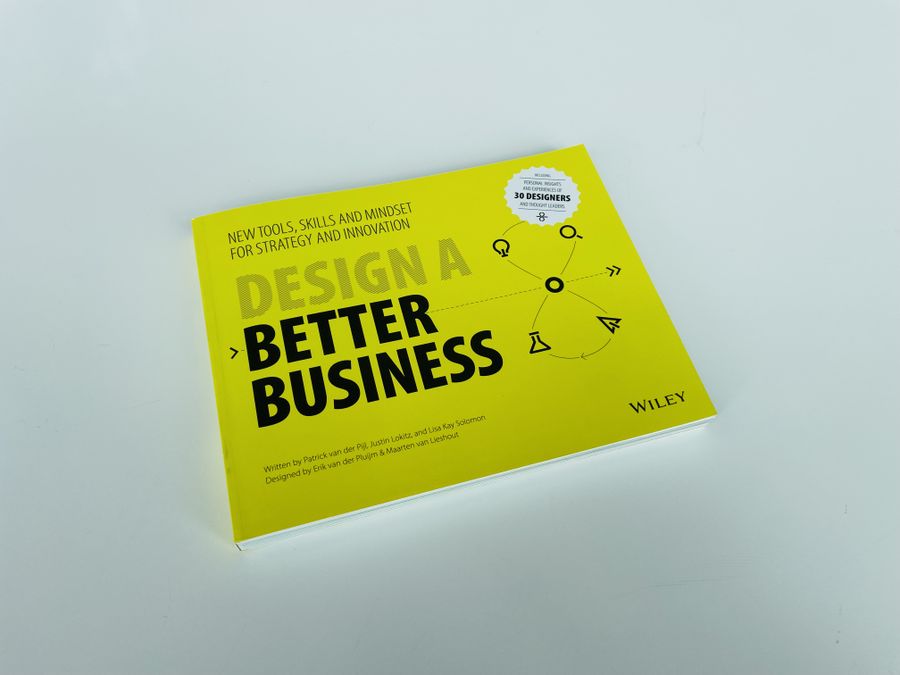
Design a Better Business followed in 2016, co-authored by van der Pijl, Solomon and Justin Lokitz. Business Model Shifts examines six transitions, including products to services and linear to circular models. Good Design Australia recognized BMI with its inaugural Design Pioneer Award, citing its contribution to making design thinking accessible.
The commercial arrangement is straightforward: publish useful thinking, then sell the work of applying it. Clients buy consulting, workshops, training and development. Current services include AI product development, prototyping, scenario planning and innovation organization design. A team can hire help finding an opportunity, testing a proposition or building the product.
Its stated distinction is capability transfer: work beside the client until the client can repeat the method. That positions BMI between conventional strategy advice, design agencies and internal innovation teams. Buyers should judge the promise by what their own people can actually do afterward.
Miro makes that transfer easier to share. BMI dates its official partnership to 2024; Miro lists it as a Premier partner. Templates and training put visual frameworks inside a workspace distributed teams can edit together. A board records the reasoning, provided somebody keeps the reasoning current.

The Monday test
The current Augmented Collaboration one-day training lists an open-cohort fee of €795 per person, excluding VAT. Participants work on a real challenge, use AI to question propositions and leave with ten artifacts and a 90-day installation plan. The price buys a structured day; the advertised plan places responsibility beyond it.
A reader can borrow the sequence: identify the person with the problem, observe their workflow, make the proposition tangible and test the assumption most likely to sink it. Agree beforehand who can authorize the next step. Protect time afterward to act on the result.
BMI’s own writing recommends stopping projects when customer demand, delivery capability or economics fail scrutiny. The approach needs access to customers, decision makers willing to reconsider and resources for follow-through. Without those conditions, even a beautifully organized workshop can leave everyone admiring a map while Monday’s work goes elsewhere.
Visit Business Models Inc. · Try the tools · Explore the projects · Read the journal