Before there was a digital doorway into Harput’s past, there was a web address. Burak Soylu bought biletdukkani.com in his third year of high school. He was already learning the travel trade through his father’s agency. The purchase was small enough to fit into a student’s life. The idea attached to it would eventually lead him into a rather different business: building software that helped people go places, including places that no longer existed as they once had.
Travel is a useful education for a technology founder. A customer wants something specific. A destination, a date, a price. The attractive promise has to survive the booking process. Soylu’s career began near that transaction, long before his public vocabulary filled with avatars, blockchain and digital worlds. His first documented digital investment had a shop in its name: Bilet Dükkanı, or ticket shop.
A shop before a software company
Soylu was born in Elazığ in 1988 and graduated in law from Istanbul Kültür University. By February 2020, he was explaining that he had obtained legal and notarial qualifications but had put the profession aside to continue in business. A law degree had supplied one possible itinerary. He took another.
He founded RoofStacks in 2015, beginning with tourism technology. The sequence matters. Experience in an existing trade came first; software followed. An agency provides plenty of opportunities to notice where a process becomes awkward. The company that grew from that background would eventually work across payments, games, streaming and extended reality, a considerably longer list than the one on a travel agent’s window.
In his early account of Bilet Dükkanı, the details were administrative: agencies, customer records, refunds and changes. He described a service intended to organise more of a journey and make booking work easier. There is a particular kind of ambition in taking such chores seriously. A successful refund rarely inspires a standing ovation. It does encourage the customer to return.
That practical business ran alongside a more playful question. A booking engine could take someone to a historic place. Could software let that visitor experience an earlier version of it?
Harput, with the clock turned back
GoArt gave that question a setting. Historic Harput, in Soylu’s home province of Elazığ, became an early location for its digital experiences. The connection makes the project more personal than a generic virtual destination. A founder working on the future had chosen somewhere close to his own beginnings to reconstruct the past.
In 2021, Soylu connected the project to his childhood habit of imagining how people had lived in places he visited. GoArt’s answer used augmented reality. Visitors could enter reconstructed historical settings through a mobile device, placing a digital experience alongside the world in front of them. The doorway belonged to software; the curiosity was recognisably older.
Development began in 2017, and the application became publicly available in 2021. The early team combined software, art and product work. Recreating a place calls for more than a programmer’s ability to make an object appear. Someone must decide what to show, how to move through it and what will persuade a visitor to keep looking.
There is a pleasing reversal here. Tourism usually sells a change of location. GoArt proposed a change of time. The phone, more often accused of distracting people from their surroundings, became the instrument for looking at those surroundings differently. The proposition depended on giving a visitor something worth seeing after the novelty of the doorway wore off.
“Roof Stacks, bir organizasyondan çok bir organizma gibi evriliyor.”
Burak Soylu, February 2020
“Roof Stacks evolves more like an organism than an organisation.” Translation.
The gallery needs a checkout
By 2023, Soylu’s public argument had moved well beyond historical sightseeing. He was describing commerce, digital ownership and the reasons people might spend time inside a virtual environment. He favoured mobile augmented reality as an accessible way in. The device was already in the user’s hand.
At a May industry panel, he appeared alongside İş Bankası’s Aydın Bozdemir and Trendyol’s Dündar Özdemir. The conversation put GoArt among organisations with established customers and familiar commercial tasks. One example was an art gallery developed through the Trendyol collaboration. Visitors could view work in a digital setting and follow a link to buy it.
The purchase link is a wonderfully unromantic detail. It gives the experience an ending beyond wandering around. The gallery could be imaginative; the transaction still needed somewhere to happen. This was a concrete version of Soylu’s broader pitch that immersive environments could connect brands and users.
His forecasts could be much more adventurous. In February 2023, he imagined wearable technology eventually letting shoppers feel the cold inside a refrigerator. That was a prediction about a possible future, rather than a description of an available GoArt feature. He also argued that fading casual interest in the metaverse left room for people willing to develop it. His position was one of continued commitment after the initial rush of attention.
- 01Enter the
digital gallery - 02Explore
the artwork - 03Follow a link
to purchase
A room full of people building other worlds
RoofStacks’ widening range of work made organisation a story of its own. Soylu brought technology and other businesses together under HAR Group, whose interests also include tourism, energy, construction and agriculture. His public roles include founder and chairman of the group, founder and CEO of RoofStacks and GoArt, and chair of DEİK’s Web3/Blockchain Committee.
The organisational chart contains a useful reminder: a founder can talk about several futures at once, but the people building them still need to agree on next week. In June 2025, management teams gathered in Sapanca under Soylu’s leadership. Strategy and leadership adviser Zeynep Kurmuş moderated sessions on shared goals, cooperation and the coming period’s plans.
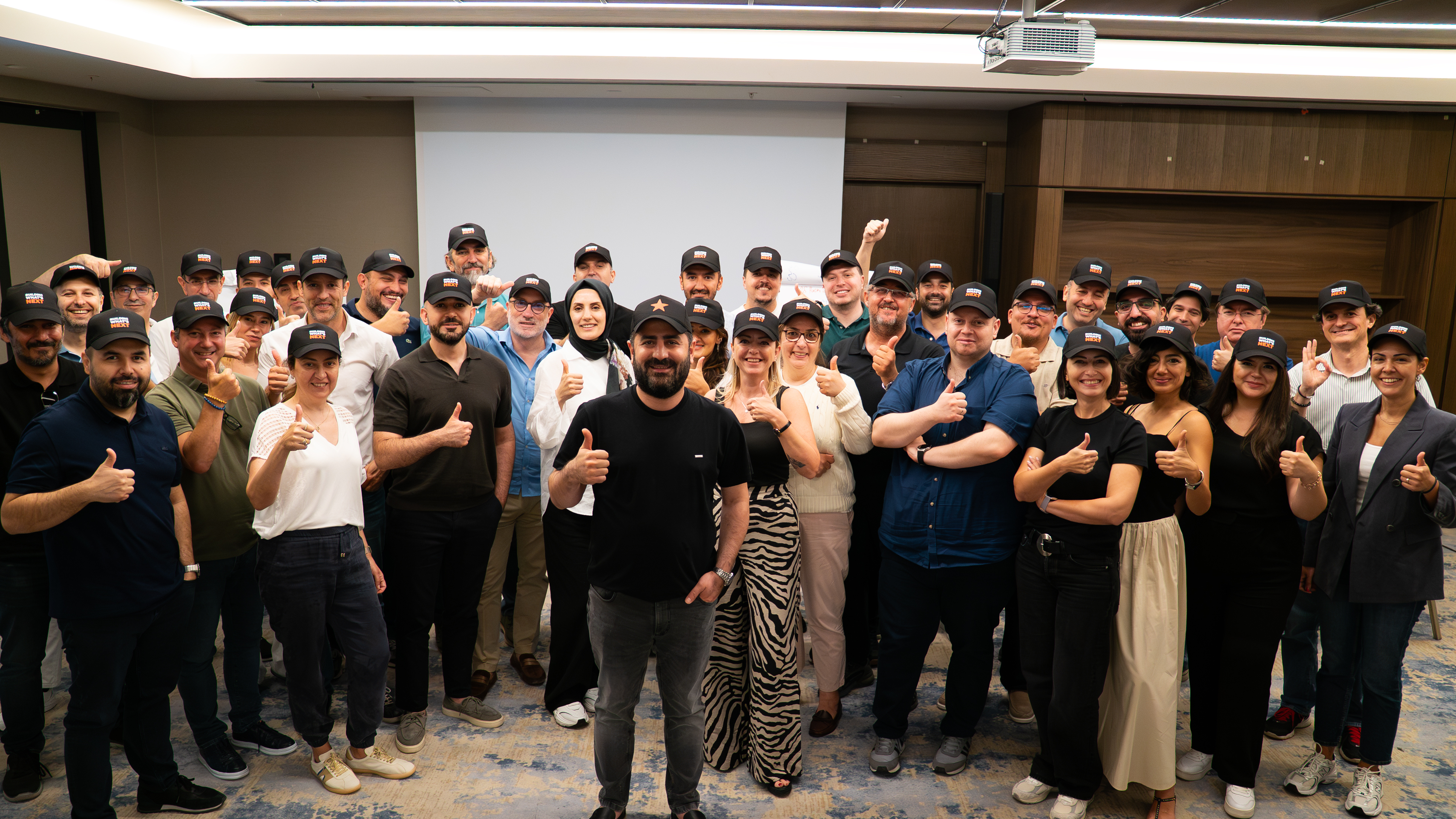
The photograph has matching caps and a generous supply of thumbs up. Its business context is less theatrical: reviewing strategies, working in groups and producing action plans. Digital worlds arrive in public as polished experiences. Behind them are the familiar negotiations of a company deciding which work to do together.
Soylu also founded HAR Institute, with an expressed purpose of supporting talent development within the group and meeting demand for qualified people in the wider sector. It adds an educational ambition to the product businesses. Recruiting and developing people are recurring tasks for a company whose work crosses several technical disciplines.
Back among the supermarket aisles
Another 2025 project brought the story back to everyday transactions. RoofStacks and Tarım Kredi Teknoloji announced a collaboration on a retail mobile application. The proposed features included store maps, product search, barcode scanning, voice search, saved favourites, campaign tracking and personalised notifications. It was being designed for iOS, Android and Huawei platforms.
These are small decisions from a shopper’s day. Where is the product? Can I find it again? Is there an offer? Soylu’s accompanying remarks connected customer satisfaction with faster operations and efficiency. The announced project supplied a practical setting for that argument. Its features were plans for development, rather than evidence of a completed rollout.
At the company’s April 2025 technology fair appearance, its agenda also included gaming, financial technology, streaming, cloud infrastructure and AR training. The breadth creates an interesting tension in Soylu’s career. He has kept extending the range of things the organisation might build, while each product still has to answer a specific person’s need.
A historic street and a supermarket aisle are unlikely neighbours. On a phone, both require someone to find their way. That connection helps explain the continuity between the early travel business and the later software portfolio without making every venture sound identical.
The difficult chapter in 2026
In January 2026, Soylu was detained and subsequently remanded in custody during an Istanbul investigation involving alleged illegal betting and money laundering. HAR Group denied wrongdoing, rejected claims about the group’s financial activities and said it was cooperating with the authorities. Those allegations belong to the legal chapter of his record; they are not established facts about his conduct.
He was released on February 10 after approximately 20 days in custody. His release did not, by itself, determine the merits of the allegations. In May, he was again making public visits in Elazığ, including to local newspapers.
The chapter changes the texture of a career usually presented through product launches and future plans. It sits beside the company’s ambitions and the work already undertaken. A profile of the founder has to hold those different parts of the record together, without allowing an allegation or an aspiration to pass for a result.
Return to the domain name, and the scale becomes human again. A teenager in the travel trade acquired an address for a business he wanted to build. Years later, his companies were working on ways to book a journey, enter a historical setting or search a shop. The destinations grew stranger. The task of giving someone a useful reason to arrive remained.
Follow the journeys
PROFILES, CONVERSATIONS & DATED COVERAGE
- Personal website
- RoofStacks
- X / Twitter
- 2020 conversation: travel, law and GoArt
- GoArt’s 2021 launch
- 2023 brands and metaverse panel
- 2025 retail collaboration
- HAR Group’s January 2026 statement
- February 2026 release coverage
- May 2026 follow-up
- Watch: Technology World conversation (Turkish)