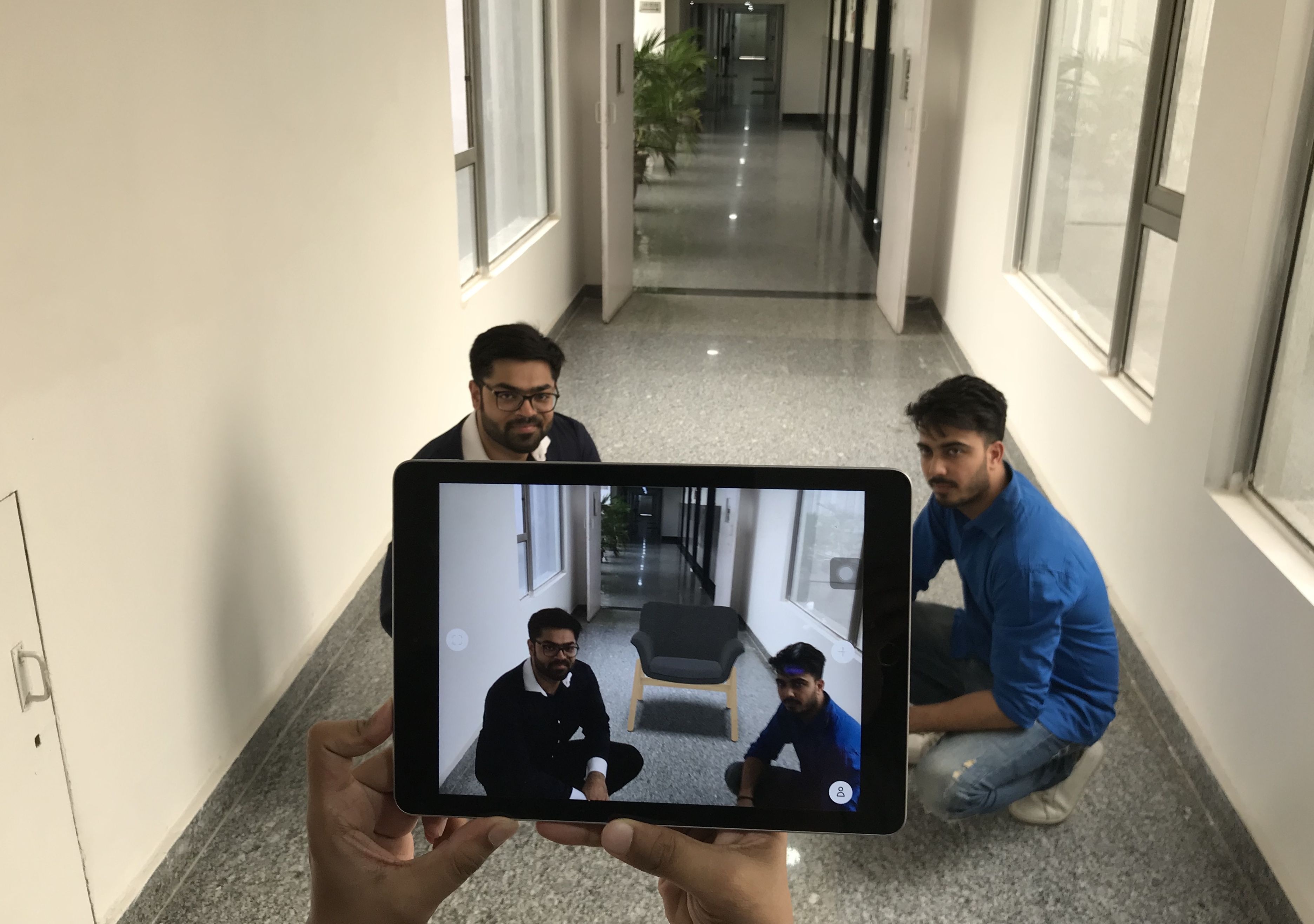
Kanav Singla is sitting in a corridor beside Mohit Malik. On the tablet held in front of them, there is a third occupant: a chair. Look past the screen and the chair disappears. The photograph, published in 2018, is a pleasingly modest introduction to a business that would later speak the language of virtual worlds. Two people, one tablet, some borrowed floor space. Even the imaginary furniture has to start somewhere.
The picture captures the question that has occupied much of Singla’s working life. How do you let somebody understand an object that is absent? A sofa they have never sat on. A vehicle whose particular combination of colours and options is unavailable. More recently, a mechanical part hidden inside a machine. The objects change. His business keeps returning to the gap between seeing something and knowing enough about it to act.
The placement queue he declined to join
At IIT Delhi, Singla studied civil engineering. As classmates prepared for campus placements, he opted out. He came from an entrepreneurial background and wanted to build a technology company with international reach. Conversations with ecommerce executives gave that ambition a target: buying online still left customers struggling to judge products properly. The catalogue had travelled onto a screen. Much of the useful information had stayed behind.
At an industry convention, he met Malik, who had worked at Accenture and was considering a job at Microsoft. They shared an interest in augmented reality. With their own savings and money from friends and family, they launched Adloid in 2016. The purpose was practical, however unfamiliar the technology sounded: give companies a way to let customers try and inspect products through a device they already possessed.
“I wanted to take them out of the books, and make real products.”
Kanav Singla, on AR and machine learning, 2018
In January 2018, Adloid won an investment commitment at IIT Bombay’s Ten Minute Million competition. The format made an efficient antidote to leisurely startup storytelling: founders pitched to investors in ten minutes. Adloid secured a ₹16 lakh commitment. For a young business trying to make a technical idea legible, the exercise had a certain symmetry. Show enough, quickly enough, for somebody else to make a decision.
First, explain the initials
Singla later recalled casually saying “XR” during a customer meeting and being stopped by a question about what it meant. Before selling the application, he had to explain the category. That anecdote offers a less glamorous picture of early technology entrepreneurship than the customary launch photograph. Sometimes the opening challenge is vocabulary. The customer has a business to run; the founder has brought an alphabet.
XR, or extended reality, covers technologies including augmented and virtual reality. Singla’s conference appearances became one way of translating that umbrella into concrete uses. At AWE USA in June 2022, he was scheduled to discuss both automotive and retail applications and the move from ecommerce to virtual commerce. Those subjects placed him in front of audiences concerned with how products are discovered and sold.
His work also crossed into the surrounding technology community. He served as vice-president of the VR AR Association’s Bangalore chapter and worked with SAP through SAP.iO as an XR consultant. These roles belong to the less photogenic infrastructure of a new market: connecting people, discussing applications, and helping a field develop enough shared understanding for a customer conversation to proceed beyond the initials.
A showroom with fewer walls
Adloid’s development followed the practical needs of its customers. During 2017 and 2018, it built a web-based AR viewer and a 3D configuration and comparison platform. It also created a home decor visualisation tool for Asian Paints. In 2019 came a commercial AR experience for Tata Motors, alongside work on rendering, compression and smartphone compatibility. By 2020, the company was building web-based virtual showroom technology for deployment across dealerships.
These are unromantic engineering concerns, which is precisely why they matter. A beautiful model that loads reluctantly on a customer’s phone has a limited future in sales. Each extra demand on the device asks the shopper for another small act of patience. Singla’s early ambition depended on making the experience usable under ordinary conditions, far from the carefully prepared demonstration.
In December 2021, Adloid announced a $4 million round and its rebranding as Metadome. The stated ambition expanded towards infrastructure for creators and brands to build immersive experiences. The new name gave the company room to imagine whole environments. Yet the automotive work supplied something more concrete than a destination in a virtual world: a product to inspect, a configuration to compare, a possible purchase.
MG Motor’s MGverse made that approach visible at Auto Expo 2023. The platform offered a digital version of the event’s MG pavilion, where visitors could explore through avatars and interact with others. Its Explore & Creator’s Centre had launched; other proposed zones were still to follow. For Singla, it was a way to carry a physical event beyond the people who could get through its doors.
The tension is useful. An avatar can make an experience entertaining, while a customer still wants answers about the car. The commercial argument depends on whether the extra interaction helps that person understand the product. A showroom can be built without walls. It still needs a reason for visitors to stay.
The customer gets a vote
By August 2024, Metadome had raised a further $6.5 million in a round led by Siana Capital and existing investor Chiratae Ventures, with participation from Alteria Capital, 3 to-1 Capital and Manish Choksi’s family office. The announced plans included expansion in the United States, Southeast Asia and the Middle East, and further work combining XR with AI. Singla described the problem as a fragmented experience between online and offline shopping.
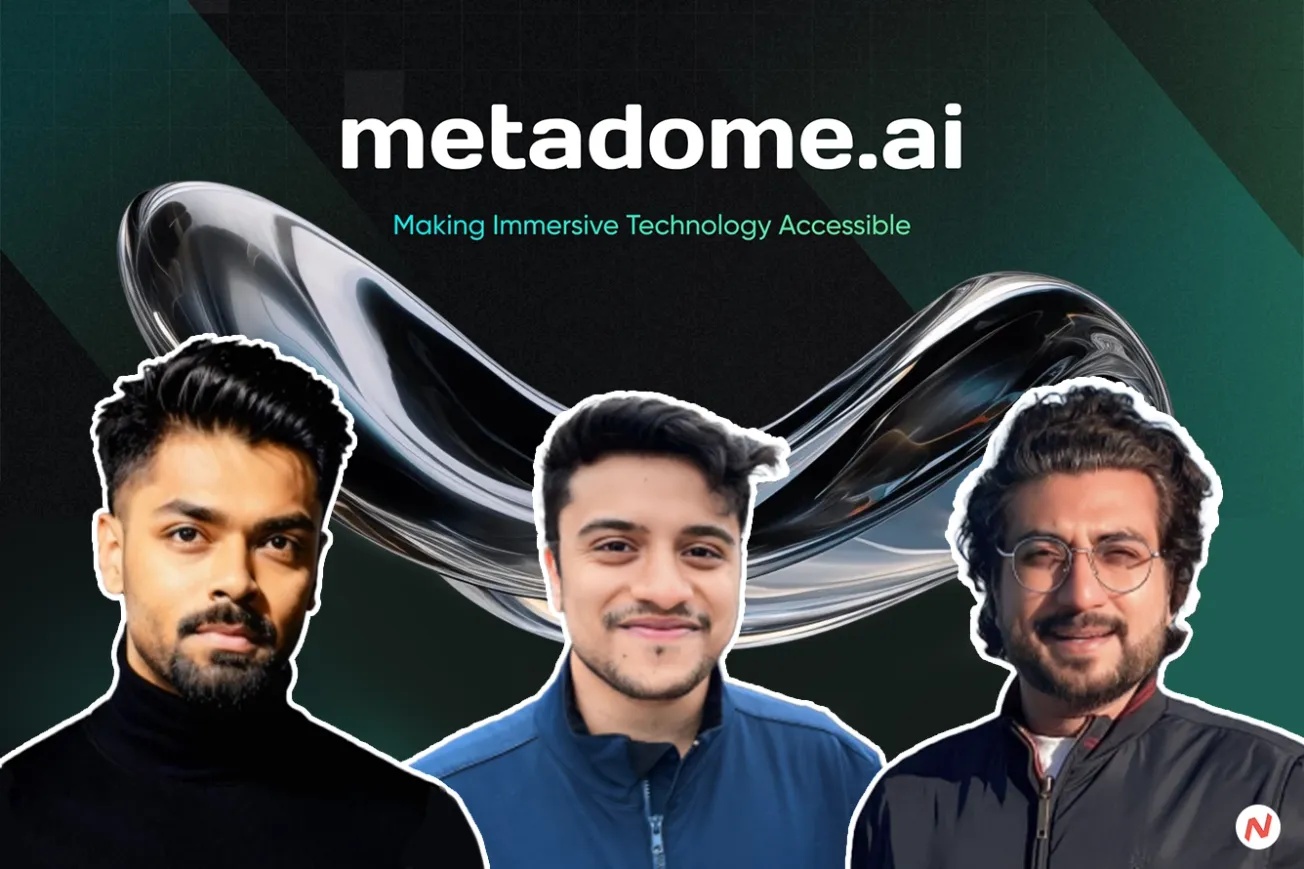
In his own announcement of the round, he emphasised staying close to customer needs. That stance also appears in a case study of Metadome’s North American market work with JJELLYFISH. The engagement began with customer discovery, tested three value propositions and examined the buyer’s journey. It generated 18 meetings with automotive leaders across five subsegments in 90 days. International ambition acquired a calendar, a target customer and a succession of conversations.
The explanatory work continued in a different setting. In 2024, Singla appeared on Metadome’s Into The Verse podcast with host Sagar Kalbande. One episode with Rahul Ranjan Srivastava explored XR’s development and business uses. Another, with Hippo Homes’ Akhil Meshram, considered home decor, visualisation and the buying journey. A discussion about dimensions and family agreement is a welcome reminder that purchasing furniture can involve more negotiation than the technology used to display it.
What he notices inside the office
Singla’s public reflections offer glimpses of how he thinks about the organisation behind the demonstrations. In a 2025 post, he described colleagues adopting AI through small experiments: debugging recurring problems, improving internal notes and building prototypes faster. He said meetings shortened and support responses improved. The detail he appeared to enjoy was that the experiments emerged from the team’s own curiosity.
Those observations are his account of internal change, rather than measured results published for comparison. They nevertheless show what catches his attention as a manager: people trying tools, discovering uses and sharing the effects. In another post about enterprise AI and recognition from Maruti Suzuki Innovation, he stressed value, trust, readiness and security. The themes bring his interest in unfamiliar technology back to the requirements of organisations expected to use it.
There is also a record of technical involvement. A US patent granted on January 6, 2026 names Singla alongside Karthik Kanaujia, Sidharth Suresh and Ashish Dasari as inventors. Assigned to Adloid Technologies, it concerns creating virtual spaces by turning a 360-degree image into a rendered 3D environment. The old corporate name survives in the paperwork, a small reminder that companies accumulate history even while changing their vocabulary.
The hole that must remain a hole
Metadome’s current work brings the problem of visual understanding into parts commerce and service. Its platform is presented as a way to turn existing drawings, photographs and manuals into interactive 3D, including models buyers can inspect and guidance technicians can follow. Here, the standard becomes less forgiving. An attractive representation is useful only if the information it carries survives the conversion.
A September 24, 2026 research release makes the difficulty tangible. Metadome describes a generated view of a mechanical component that closed important through-holes while retaining a convincing outline. A shape-similarity score still reached 0.89 out of 1. The company’s proposed evaluation checks individual features for what is present, missing or invented. It also acknowledges remaining positional errors between a recognisable component and one ready to manufacture.
“The physical world has no undo button.”
Kanav Singla, on the demands of industrial AI
Singla’s recent public argument focuses on precision in manufacturing, engineering and service. He has also advertised a founding engineering role in generative CAD and 3D for Metadome’s data and intelligence team. The ambition has moved further inside the object: beyond helping someone imagine ownership, towards helping them understand how something is assembled and maintained.
Return to the corridor photograph and the distance is easier to see. The chair on the tablet demonstrated a possibility. The mechanical part demands an answer. Singla has spent years asking screens to reveal more about the physical world. His next problem is wonderfully stubborn: every hole has to be where it belongs.