A bank account is an odd travelling companion. It knows where you bought dinner, which airline took you away and when the rent interrupted the fun. It rarely has much to say about any of it. Archie Ravishankar wanted a different arrangement. Having grown up in Australia and worked in investment, he began building Cogni around a question drawn from his own life: could a financial app keep up with someone who liked to travel and try things?
That question eventually led him from debit cards to digital assets. Along the way came discounted gift cards, disposable cards for subscriptions, a $23 million funding round and a wallet whose users controlled their own keys. The products changed. His recurring concern was the distance between what a financial service could technically do and what an ordinary customer could comfortably use.
A passport before a product
Ravishankar’s early career crossed more borders than the usual founder biography. His background included investment banking and infrastructure work in Hong Kong and Papua New Guinea. During his university years, he represented Australia as a youth ambassador to the United Nations. Invitations to represent Australia at the G20 Business Summits in Moscow in 2013 and Istanbul in 2015 followed.
These were places where finance met institutions, governments and physical projects. A construction business has to deal with the world as built; an investment decision has to survive the world as it behaves. The later banking app would live on a phone, but its founder’s professional surroundings had included rather more concrete.
He studied at Queensland University of Technology and Bond University, then worked in real estate and startup investment in Australia before establishing himself in New York. His ambitions for Cogni were international, too. In 2020, he discussed partnerships in Korea and conversations about Japan. He also described a more patient immediate task: provide clear banking services, hear from customers and build the surrounding offering gradually.
The combination is revealing. There was room in his plans for another continent, but also for the person trying to understand an account. Expansion is an attractive noun. Explaining a fee is a daily job.
The debit card gets some company
At Cogni’s 2020 launch, Ravishankar set out a phased approach. Banking would come first; commerce and lifestyle services would follow. The initial offering included accounts without routine fees or minimum balances, physical and virtual debit cards, peer-to-peer transfers and access to more than 55,000 ATMs. Single-use cards addressed an especially familiar irritation: a recurring charge that outlives the customer’s enthusiasm.
“Learning from our members is key as we continue to develop our offering,” he said.
The sentence is modest by launch-day standards. It also makes a promise that is harder to decorate than a product announcement. Customer feedback means letting people’s actual behaviour complicate the original plan. A founder can imagine a coherent financial life; the customer may simply want to stop paying for something they tried last Tuesday.
His public conversation about service extended beyond the app’s feature list. In a 2020 Payments Innovation appearance, he discussed serving younger and underserved customers and the relationship between account balances and customer treatment. Service mattered alongside access. Opening the door was only part of the work; what happened when someone needed help belonged in the same discussion.
“Learning from our members is key as we continue to develop our offering.”
Archie Ravishankar, Cogni launch, 2020
For a young customer, that is a more concrete proposition than a distant mortgage. It concerns the small exchanges that decide whether a product becomes part of a routine: a question answered, a purchase understood, a charge avoided. Ravishankar’s interest in lifestyle gave those exchanges a place in the business.
Twenty-three million dollars, and a new direction
In April 2022, Cogni announced a $23 million Series A co-led by Hanwha Asset Management and CaplinFO. Participants included Solana Ventures, Thirty Five Ventures and other investors. Ravishankar said the money would support technology, infrastructure, recruitment, new products and customer acquisition.
The ambition had widened to include crypto, NFTs, gaming and other Web3 services. Yet the everyday products were still there: discounted digital gift cards and transaction-based carbon estimates. A customer might come looking for a deal rather than a theory of the internet. That gave Ravishankar a practical starting point for introducing unfamiliar tools.
Capital raised by Cogni. Company funding, not a measure of its founder’s personal wealth.
Scale also supplied a reason to choose a direction. In April 2022, Ravishankar described Cogni’s users as numbering in the tens of thousands, with roughly 50 to 60 customers joining daily through word of mouth. Larger digital banking competitors counted users in millions. Another general-purpose banking app had considerable company.
His proposed wallet would make an unfamiliar activity available beside an established one. At the time, Cogni also discussed a savings product built on decentralized-finance infrastructure, while acknowledging unresolved compliance work. Those were plans. The distinction matters in a founder’s story: raising money purchases the chance to build, and the next announcement has to contain something people can actually open.
A wallet in familiar surroundings
The multi-chain wallet arrived in December 2022. Cogni’s announcement described a non-custodial product: users would retain control of the private keys associated with their digital assets. Its design included recovery options using multi-party computation. The company was taking on the awkward combination of user control and a usable customer experience.
Private keys are a rather demanding household possession. They do not care how many passwords someone already remembers. Putting their management inside a familiar app gives a designer useful context, but also considerable responsibility. A calm screen has to represent actions whose consequences extend beyond the screen.
In interviews around the launch, Ravishankar described a single interface containing ordinary transactions and on-chain activity. His ambition included more direct exchange connections and further NFT features. The appeal lay in proximity: the customer would encounter a new financial action in surroundings they already recognised.
Read as a career decision, the move followed his earlier interest in making money services fit the customer’s life. The setting had changed from bookings and debit cards to tokens and wallets. The design question remained recognisable. How much homework should a person have to do before the product lets them begin?
The rooftop and the address problem
In April 2023, Cogni hosted a rooftop gathering during NFT.NYC, with a panel exploring digital banking and crypto. Ravishankar appeared among the participants as the company showcased its wallet and Passport, a proposed connection between conventional identity checks and portable Web3 identity.
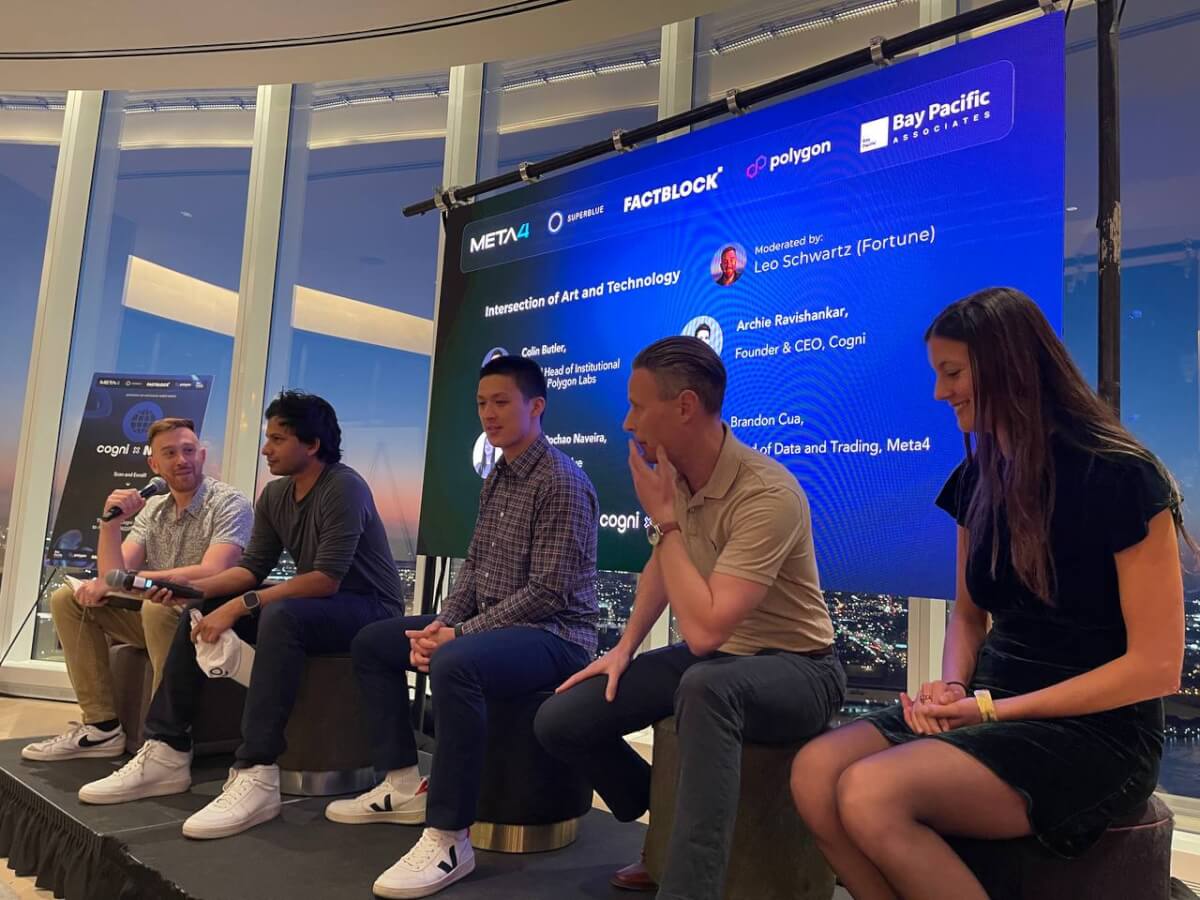
The setting suited the original brief. Art, technology, money and social life had ended up in one room. Passport dealt with a less photogenic part of that combination: proving who you were. Repeated identity checks can turn exploration into form-filling. Cogni’s idea was to make an existing verification useful across participating services.
Later that year, the company announced a partnership with Unstoppable Domains. Instead of requiring users to send crypto to a long wallet address, it offered human-readable domain addresses. Users could also purchase existing premium domains through the wallet’s connection feature. Some of the improvement was almost disarmingly plain: give people a destination they could recognise.
There is a useful personality clue in that choice, provided it is kept where the evidence supports it: in the product. Ravishankar repeatedly returned to the customer’s point of entry. A discounted gift card, a single-use card and a readable address solve different problems, but each reduces a small obstacle between intention and action. Grand ambitions often arrive dressed as buttons.
Convenience meets the rulebook
His public engagements also placed him beside people responsible for the rules. At OMFIF’s 2023 Digital Monetary Institute symposium, he joined a discussion of global crypto regulation with Hester Peirce, Susan Friedman and Moad Fahmi. The agenda addressed borderless transactions, the lessons of FTX and possible business models for a token economy.
Sharing a panel does not establish agreement. It does locate the conversation he was participating in. A consumer-facing wallet has to make sense to the person tapping “send” and to the institutions considering what that action means. The two audiences bring different questions to the same interface.
By June 2024, the FII PRIORITY programme in Rio de Janeiro listed him for a discussion about AI investment alongside investors and financial-sector participants. His public interests extended beyond the particular wallet. The common territory was how emerging technology entered the financial system, and who would build the businesses around it.
There is another institutional connection in his work: a board seat at C4ADS. The organisation’s biography describes his understanding of how illicit actors exploit legitimate systems as relevant to its financial-sector work. It adds a different perspective to the product story. Making a service easier to enter also raises questions about how it will be used.
The ordinary customer at the end of the journey
Cogni’s current website centres on self-custody, multiple chains, NFTs and access to decentralized applications. The product language has travelled some distance from the early debit-card pitch. It still asks a familiar question about control: what should a person be able to manage for themselves, and how should the app help?
The present wallet offering makes that tension visible. Private-key management sits beside backup features; digital assets from different networks sit within one interface. The tidy presentation carries a complicated set of underlying arrangements. For Ravishankar, the challenge suggested by his own product history is to make those arrangements understandable without stripping them of their meaning.
His route has run through Australian universities, investment work, international forums and a New York fintech. The most human thread is smaller than the itinerary. He wanted a financial product that had something useful to say about the way people spent their time. First came the card. Then came the wallet. The customer still has dinner to book.