Burak Arik had a chief executive’s title before he had a San Francisco address book. When he arrived in 2016 to build Maxitech, he was an engineer taking his first turn as CEO, in a new country, with few familiar people around him. The assignment came with expectations. The introductions would have to come later.
There is a useful inconvenience in that beginning. A title travels easily. The relationships that make it worth something require more baggage. Arik’s subsequent work has involved connecting people who need each other but do not necessarily know it yet: a bank and a startup, an enterprise problem and a young engineering team, a founder and a first customer.
He has also kept finding reasons to become a beginner himself. Years after taking charge of a company, he returned to business school. Away from work, he carries a camera. Both activities offer an occasional correction to the comforting idea that experience has already taught you everything.
Before the title, the apprenticeship
Arik graduated in computer engineering from Ege University in 2001 and completed his master’s degree in 2004. He credits that technical education with supporting a career spent both writing code and managing projects. His interest in the details survived his move into management.
In discussing his education, he invoked a Turkish saying about the impossibility of becoming a master in work where you have never been an apprentice. He applied it to leadership: knowing what a team does each day gives a manager useful advantages. Even in a role dominated by meetings, the technical background helped him talk to customers, startups and people at meetups.
That is a fairly modest claim, which makes it more persuasive. He does not ask an engineering degree to explain every decision. He describes it as a continuing aid to conversation. There is a difference between attending a technical meeting and being able to follow the part where the interesting problem begins.
Before Maxitech, he spent roughly a decade at Softtech working on İşbank projects. By 2020, his career encompassed 18 years in the sector. Silicon Valley became a new setting for accumulated experience, with the added complication that he now had to build the organization around it.
A city where the coffee queue talks Python
Arik’s account of working in San Francisco has the pleased attention of someone who recognizes his own interests in the surrounding noise. He remembered waiting at Starbucks and hearing someone behind him explain a Python problem. In another café, he encountered a technical interview. On the train, people carried on working and coding as though the office had simply acquired wheels.
He described a setting crowded with entrepreneurs, investors, accelerators, mentors and academics. Competition extended to the investors themselves. A promising startup could make the people providing capital hurry, too. For a software engineer interested in how technology becomes a business, the city offered a running conversation.
It is an affectionate portrait of a place with a distinctive public soundtrack. Some cities supply birdsong. This one supplies debugging advice with the coffee. Arik enjoyed the mixture of people drawn from around the world, and the proximity of technical curiosity to commercial ambition.
Maxitech had a specific reason to be there. Its early mission connected Silicon Valley technology with Turkey’s banking ecosystem. In September 2017, an interview about the company’s first year already framed that work as a bridge between the two places. The metaphor was geographic; the daily work involved choosing technologies worth bringing across.
The introduction has to survive a trial
One early example involved İşbank and Clinc, a conversational AI company. The bank wanted voice-enabled assistance across banking channels, but first needed to assess prospective vendors and establish whether their technology could work. Maxitech helped identify and evaluate the candidates.
The Clinc proof of concept delivered results within four weeks. The experiment then expanded to include Alexa, call centers and Pepper, the bank’s robotic concierge. A robot in a bank offers considerable photographic appeal. The more consequential detail was the process behind it: a customer problem, a technology assessment and a demonstration the bank could examine.
Arik said the bank wanted to integrate the technology after seeing the demonstration videos. The episode gives his connecting role a practical shape. Finding a promising company starts the conversation. Helping an institution understand what it can actually deploy moves the conversation toward a decision.
In 2021, he described another engagement, with H2O.ai, that Maxitech had initiated and led. İşbank would use its Driverless AI platform, while Softtech became a strategic partner in Turkey. The relationship joined the bank’s demand for predictive capabilities to a specialist software provider and a regional technology partner.
An explanatory sequence drawn from the banking collaborations.
Thirty thousand pages make a good question
By September 2024, a partnership with Instabase put the same approach to work on something less theatrical than a robot: customer money orders. İşbank received nearly 30,000 pages a day. Unstructured documents required manual classification and data entry, producing an operational problem with enough repetition to make improvement matter.
Maxitech identified Instabase and facilitated the partnership. The bank used its generative AI technology in the Commonfax workflow to classify documents, extract information and validate the data. Reported classification rates rose from 41.4 percent to 85 percent. Extraction rates increased from 22.5 percent to 75 percent.
Those figures describe two parts of one workflow. They give the conversation useful boundaries: a defined task, a starting rate, an improved rate. A bank does not process an abstract promise about the future. It processes the next page in a large pile.
For Arik, this was a concrete expression of the work Maxitech had come to do. The introduction crossed an ocean; the results appeared in an everyday operation. The paperwork provided the test.
Less of the pile left to people
When the customer says, “Later”
A matching business has an awkward dependency: the customer can decline the match. In June 2024, explaining Maxitech’s investment fund, Arik described months spent researching and shortlisting startup partners. If an enterprise chose not to pursue a project, the team moved on to the next pilot, however much promise it saw in the startup.
Investing created another option. Maxitech could work directly with the founders it wanted to support. The company’s enterprise connections could also help a startup test its product, hear feedback and find customers. The organization acquired a way to stay involved after an initial procurement decision.
Arik also expressed an ambition to make AI more accessible in emerging countries. His concern was a widening distance between places developing the technology and places positioned to benefit from adopting it. That aspiration fits the geography of his own job, with its regular passage between Silicon Valley and Turkish enterprises.
The CEO who had midterms
In 2023, Arik announced that he was a student again, after already surviving his first round of midterms. He had entered Wharton’s two-year program. His learning team included Matt Vail, Adam Wong, Kate Modic, Charles Wilfried Abedier and Aditi Soory. There were people to learn with, as well as faculty to learn from.
He thanked İşbank and Softtech leaders for supporting the decision, and his teams at Maxitech and Entrapeer for helping him balance the work. He also named Duygu Öktem Clark and Yiğit Ihlamur as people who had inspired him to apply. The announcement reads as a record of assistance: a personal decision made possible by other people’s willingness to accommodate it.
He completed the MBA in 2025. His graduation account counted 32 courses, more than 140 assignments, exams and case studies, and over 50 weekends away from family. He credited his wife, Nesrin, with holding things together, and described the strain of combining study, CEO responsibilities and two children.
He wanted stronger business skills alongside his technical background. The eventual lesson included accepting imperfection and relying on others. An executive had enrolled in an education that required him to hand work in.
“I’m a student again after so many years!”
Burak Arik, announcing his Wharton studies, 2023
The company begins to make its own tools
By April 2026, Arik described another turn in the business. Customers had asked how Maxitech did its work, pulling the organization toward consulting. That brought a constraint: delivery tied to headcount creates difficult choices about speed, cost and consistency.
Entrapeer offered a product response. Arik described AI-supported strategic work, deployment within an institution’s own environment, and a corporate memory that could accumulate rather than disappear between projects. Appearing with Eren Hükümdar on Bloomberg HT, he spoke as Entrapeer’s lead investor and discussed its next phase of growth.
The recurring subject was how useful knowledge travels. It can pass through a meeting, a consultant or a software product. Each form has different limits. In July 2026, Maxitech also announced an investment in Tasklet, extending its interest to agents that work across enterprise applications. His organization kept pursuing the practical question of how AI fits into daily work.
The camera comes along
Arik dates his photography to 2006, when he first held an SLR. Travel eventually gave the camera a recurring assignment. His interests range from northern lights in Norway to wildlife in Alaska and scenes in Istanbul. He has contributed editorial photography to Anadolu Agency.
The photographs accompanying his personal account put him in Japan with a camera in hand and in Kenya with the camera still at his side. They offer a welcome change of scene from enterprise software. A business trip may require a presentation. His packing arrangements leave room for another way of looking.
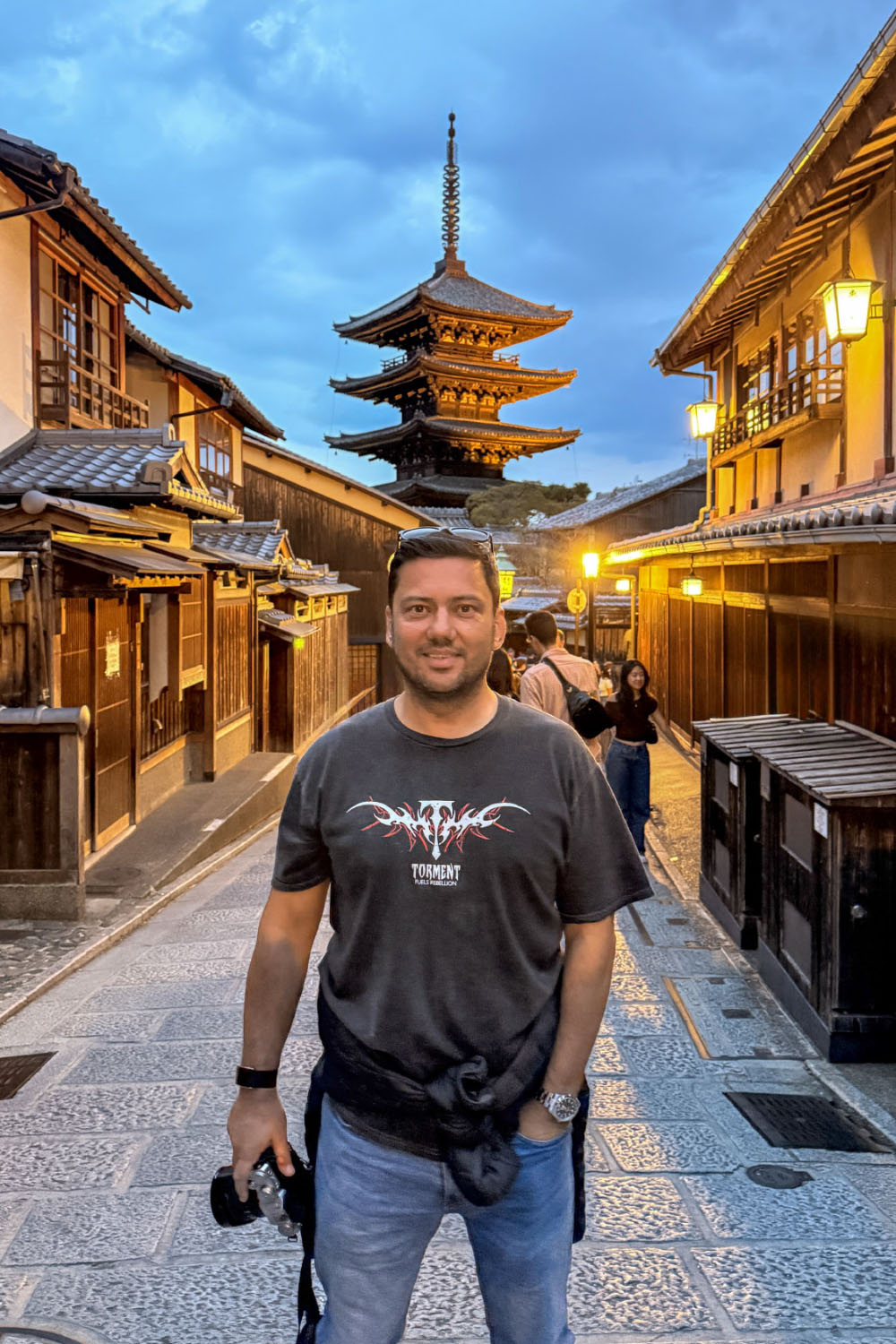
He built his photography website himself and treats it as somewhere to try technologies and ideas. The engineer remains occupied even when the subject is a landscape. A portfolio can be a place to show finished pictures and a place to keep experimenting.

His career now contains several kinds of introduction: founders to customers, technical training to business education, a traveler to an unfamiliar place. The common pleasure seems to lie in getting close enough to understand what is happening. Even with a CEO title, there is always another room to enter, another question to ask, another picture to take.