A paper notebook can hold an entire neighborhood economy. On one line, a shopkeeper records a packet of noodles. On another, a phone top-up. In the margin is a familiar name and a debt to be settled after payday. The system is quick, social and perfectly adapted to a business where the owner may also be the cashier, buyer, bookkeeper and collections department. It also has an obvious flaw: the notebook cannot calculate cash flow, send a reminder or prove a trading history to a lender.
BukuWarung began in Jakarta in 2019 by taking that notebook seriously. Co-founders Abhinay Peddisetty and Chinmay Chauhan had worked on merchant products in Southeast Asia and grew up around family-run businesses. Their first proposition was deliberately plain: a free Android ledger for tracking sales, expenses and customer credit. The app could turn those entries into reports and send polite payment reminders over WhatsApp, the channel where many merchants already spoke with customers.
That choice contains the company's central insight. Indonesia's micro, small and medium enterprises did not need a miniature version of corporate accounting software. They needed a better version of what they were already doing. Once BukuWarung occupied that daily habit, bookkeeping became the beginning of a larger financial relationship.
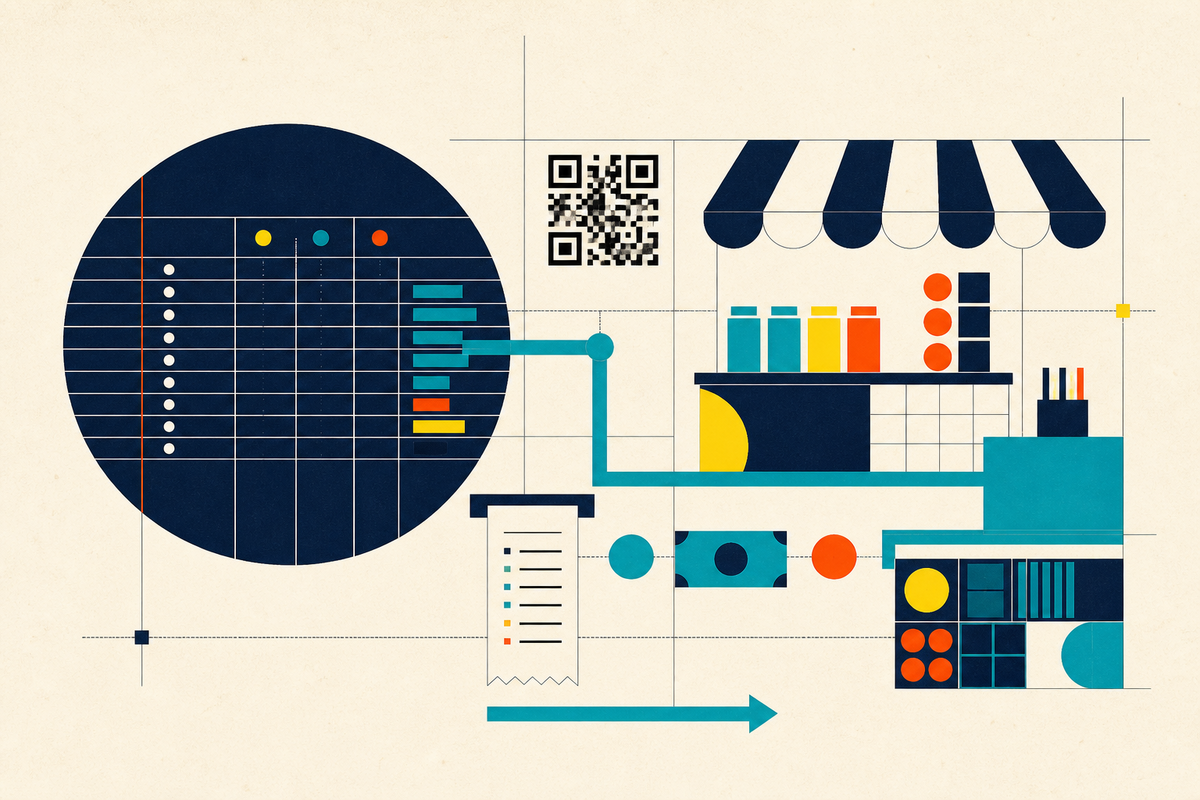
01 / The wedgeThe notebook was a distribution strategy
Bookkeeping software is usually sold as control. BukuWarung sold relief. A merchant could replace scattered paper entries, see who owed money and send a reminder without composing an awkward message. The product respected an important feature of informal commerce: credit is not only a balance-sheet item. It is a relationship between people who may see each other every day.
When the pandemic pushed more transactions online, the company attached payment links and digital collection to the ledger. The records said what should move; the payment layer helped move it. QRIS, Indonesia's interoperable QR standard, later gave a merchant one code that could accept participating bank and wallet payments. Transactions could settle into an account and appear in the record without another night of arithmetic.
Those are historical company-reported numbers, not a current count of active merchants. They still explain why investors paid attention. In June 2021, Valar Ventures and Goodwater Capital led a $60 million Series A. BukuWarung said it had raised $80 million in total; its valuation was not disclosed, though contemporary reporting placed it in an estimated range of $225 million to $250 million.
“The paper notebook was not the enemy. It was the product brief.”The idea hiding inside BukuWarung's first feature
02 / The stackOne app, several jobs behind the counter
The present suite is less a single piece of software than a set of merchant jobs arranged around money. Tagih & Bayar handles payment requests and business transfers. QRIS accepts cashless purchases. Digital bookkeeping tracks the store. Produk Digital turns the merchant into a seller of airtime, data packages, electricity tokens, game vouchers and bill payments. Solusi Modal Usaha routes eligible merchants toward working-capital offers from regulated partners.
Record
Sales, expenses, stock and customer debts become a searchable business history.
Collect
Payment links and QRIS reduce the distance between an entry and actual cash.
Pay
Transfers support supplier, payroll and other everyday business outflows.
Resell
PPOB products let a shop earn fees from digital goods and household bills.
Borrow
Licensed partners can offer working capital using a more legible trading record.
Serve
BukuAgen devices add transfers, withdrawals and balance checks at the counter.
The customer is often called Juragan in BukuWarung's product language, an everyday honorific for the boss or proprietor. The term matters. This is software addressed to an owner with agency, not to an abstract “unbanked segment.” A salon, laundry, food stall, mobile-credit counter, repair shop or grocery can enter through whichever job hurts most, then discover adjacent services.
03 / The economicsFree software, paid movement
BukuWarung's business model follows the flow of funds. A free ledger lowers the cost of acquiring merchants and generates useful context. Payments, QRIS, bill pay and digital-product transactions create repeat activity. Lending partners can pay for distribution or originated business, subject to regulation and underwriting. Dedicated EDC devices can be sold or rented, while agent transactions produce commissions and payment economics.
This is not classic subscription SaaS. It is closer to merchant infrastructure with software as its front door. The model also spreads regulatory responsibility across specialists. BukuWarung's public terms name payment gateways including DOKU, OY! Indonesia and BNI; lenders including KoinWorks and GandengTangan; identity services VIDA and Privy; and Artajasa for Mini ATM services. BukuWarung assembles the experience while licensed partners supply regulated components.
04 / The differenceDesigned for a shop, not a spreadsheet
Competitors approach the same merchant from several directions. BukuKas and other ledger apps began with accounting. Majoo, Moka and Pawoon emphasize point-of-sale operations. Mitra Bukalapak and bank-agent networks turn shops into service counters. Wallets and QRIS acquirers compete for payment acceptance. Lenders compete for qualified borrowers. BukuWarung's position sits across those categories.
Its difference is integration at the micro-merchant level, but the more defensible distinction is behavioral. Reports and reminders traveled through WhatsApp because that was where merchants already worked. The app was designed for modest Android devices. Products were phrased as concrete jobs: collect, pay, sell, record. Twilio later reported that expanded WhatsApp messaging tripled customer engagement. The number is a vendor case-study result, but the lesson is durable: distribution can be a conversation, not another dashboard.
The founders have argued that this market will not be winner-takes-all. That is plausible. A warung can accept several wallets, use more than one agent network and keep a separate ledger. BukuWarung wins only if bundling saves enough time or creates enough income to become the merchant's preferred operating layer.
05 / Data without theaterThe quiet work behind a simple screen
The cheerful interface conceals a demanding data problem. Payments must reconcile. Reports must agree. Partners and regulators need auditability. Google Cloud described BukuWarung using BigQuery, Looker and Firebase to standardize reporting across a team that had reached roughly 300 people. Its analysts reportedly spent 30 percent less time on ad hoc requests after the company pushed self-service analytics.
That infrastructure supports a sensitive ambition: using electronic payment and bookkeeping records to improve access to credit. A cash-based shop may be healthy but invisible to conventional underwriting. Digital transactions can make the business legible. They can also create a detailed portrait of a merchant's life. BukuWarung's opportunity therefore comes with an obligation to keep consent, security and partner accountability as understandable as the ledger itself.
06 / The counter returnsFrom app to Mini ATM
BukuAgen brings the story back into the physical shop. Its EDC Saku and Android devices let an agent support transfers, cash withdrawals, balance checks and PPOB transactions. The merchant can set service fees within the program's rules and earn transaction commissions. For a community where a bank branch may be inconvenient, the familiar shop counter becomes a financial access point.
The newest layer is BukuSimpan, a Bank Nobu-linked account available through BukuAgen. It is presented as a place to hold business funds, make transfers and support EDC cash transactions without moving between apps. The deposits sit with the partner bank, which is supervised by Indonesia's OJK and participates in the LPS deposit-guarantee system under applicable conditions. BukuWarung is not becoming a bank; it is moving closer to the account.
That product arc is almost circular. BukuWarung started by making the record of money digital. It then helped the money move, helped the merchant earn from moving other people's money, and connected the agent to an account where business funds could sit.
07 / The marketInfrastructure in ordinary clothes
Indonesia's MSMEs account for most employment and a majority of economic output, yet the category contains enormous variation. A tiny food stall and a growing retailer do not want the same software. The market rewards products that remain useful at low transaction values, work beyond central Jakarta and can be explained in one breath.
BukuWarung fits between small-business SaaS, payments, embedded finance and branchless banking. Its expertise is not a single algorithm. It is the packaging of complicated rails into familiar merchant actions, then distributing them through mobile software, WhatsApp, field relationships and hardware.
The harder chapter is no longer proving that merchants will download a ledger. It is proving that a broad suite can remain coherent, trusted and economically sustainable as the company adds partners and regulated services. BukuWarung's 2026 MiniATM Pro gathering in Bali focused on agent efficiency, customer service and risk management, less glamorous topics than explosive downloads and more revealing ones. The company is now tending an operating network.
For other builders, the stealable idea is precise: begin with a small, repeated pain that produces permission and data. Expand only along the jobs already visible in that behavior. BukuWarung did not ask a neighborhood shop to become a tech company. It put the back office in the proprietor's pocket, then let the counter grow around it.