The first thing to break is rarely the grand strategy. It is the handoff. A web order lands in one system but never reaches inventory. A lead becomes a contact and loses the field that explained why the person cared. A production schedule lives in Outlook, then gets printed for every workstation. Everyone can see the work. Nobody can see the same work.
BSP has made a business out of those seams. Founded in Quebec City in 2011 as Gestion Bureau Sans Papier - essentially “paperless office management” - the company sells, configures and connects Zoho applications for organizations that have outgrown a tidy spreadsheet but do not want the cost or rigidity of a conventional enterprise overhaul. Its repertoire spans CRM, finance, inventory, analytics, marketing, project management, HR, custom development and training. The technology matters. The translation matters more.
That makes BSP a familiar kind of firm: part consultant, part reseller, part systems integrator. The less familiar move came after years of bespoke work. BSP began converting repeatable customer solutions into vertical products. Averro, its flagship, packages operations modules for industries including manufacturing, logistics, retail and professional services. Capto connects bookkeeping with Zoho. ZeFranchise centralizes the mechanics of running a franchise network. The consultancy did not discover a product in a brainstorming retreat. It found one in the accumulated debris of client projects.
The jobMake the applications behave like one company
Zoho’s appeal is breadth: sales, books, inventory, campaigns, support, projects, people and analytics can live in one ecosystem. Breadth also creates a configuration problem. Software does not know that a cabinet maker’s deposit schedule affects production, that a pool installation depends on sourcing and transport, or that a nursery order contains thousands of plant varieties. BSP interviews the people who do know, maps their process, configures standard applications where possible and uses Zoho Creator or custom code where the off-the-shelf shape stops fitting.
Its customers are typically small and midsize organizations with enterprise-flavored complexity: manufacturers, pool retailers, nurseries, training organizations, professional-services firms and health-technology vendors. Named clients include Armoires AD+, Piscine Hippocampe, Cogiscan, Visbody Canada and CASIOPE. They are not buying a prettier address book. They are buying fewer duplicate entries, cleaner handoffs, current inventory, visible work and a system their teams can actually use.
What failed firstThe software stack became a relay race with dropped batons
Piscine Hippocampe offers the cleanest anatomy of the problem. The family-owned pool company was coordinating manufacturing, retail, installation and service through a mix of Excel, Acomba and Servex. The online store added another fracture: Shopify orders did not reliably update stock. Payments required manual adjustment. Sales information arrived late. Every isolated tool could perform a task; the combination produced mismatches, delays and re-entry.
BSP built a custom ERP on Zoho Creator, then linked order processing through Zoho Flow, customer intake through Forms, finance through Books and customer records through CRM. The company reported saving five to ten hours per week, alongside real-time stock updates and fewer manual errors. This is not a cinematic turnaround. It is better: one or two reclaimed workdays, every week, indefinitely.
Armoires AD+ began with similarly ordinary failure. Planning was manual. Staff copied and pasted information, used Outlook calendars for scheduling, printed plans for workstations and tracked follow-ups in spreadsheets. BSP implemented Zoho CRM and connected the surrounding process. The sales team adopted the system within four months. In a separate implementation, a mobile Creator app gave technicians and installers live information, while purchasing, inventory and production were pulled into the same operational picture.
“A product opportunity often looks like the third client asking you to rebuild the same boring thing.”YesPress analysis of BSP’s operating pattern
The turning pointA developer shortage changed where BSP built; repetition changed what it built
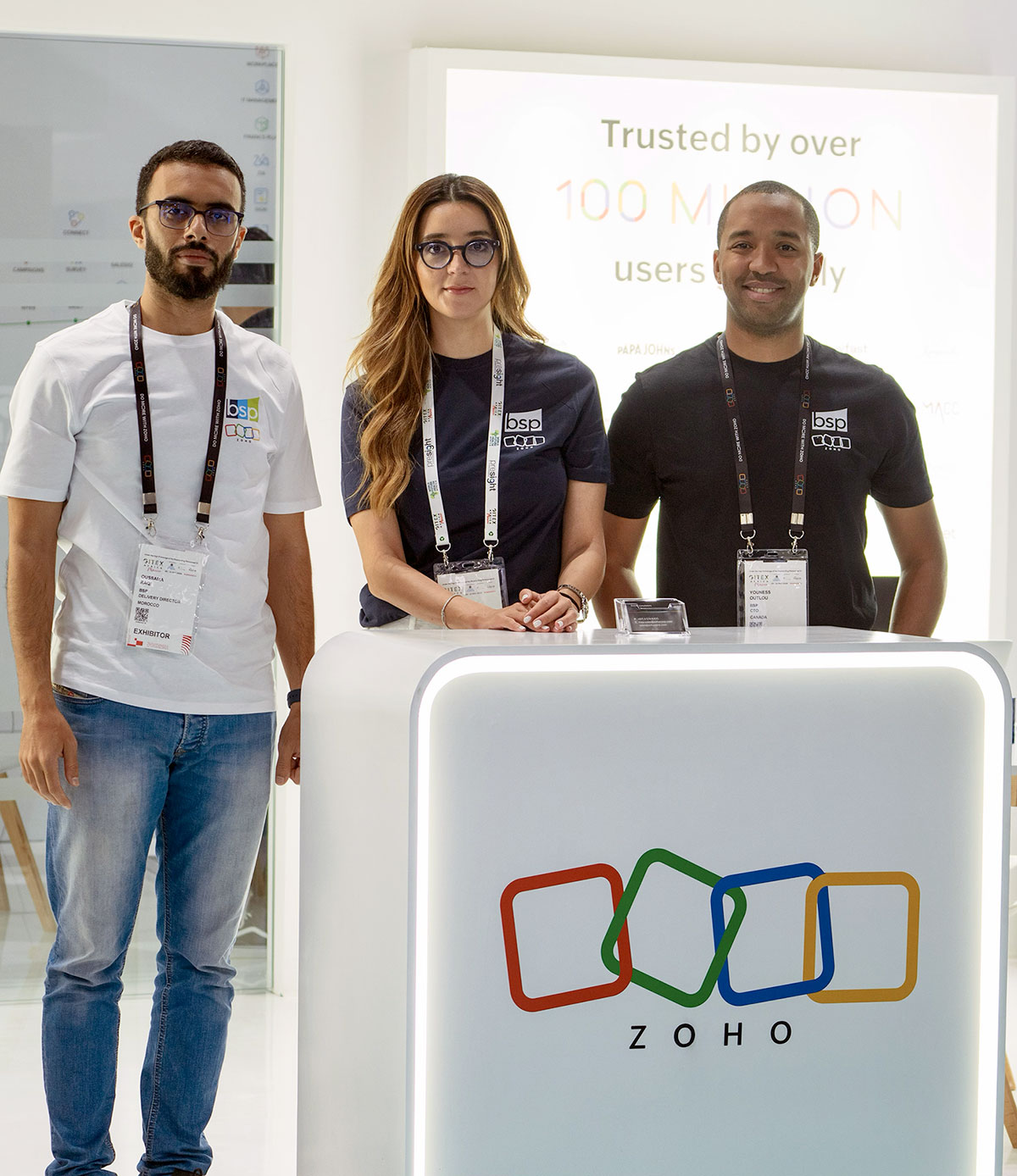
The company’s low-code story started before the product strategy. Youness Outlou, now CEO, has written that his exposure to Zoho Creator began around 2015. After joining BSP in 2017, he confronted Canada’s developer shortage by recruiting in Morocco, his hometown market. The Creator team grew from two developers to ten between 2018 and 2020. BSP acquired C-Cube and established a Casablanca office, later expanding to Texas and India.
That distributed team provided delivery capacity. Repeated client work provided the product thesis. BSP says Averro began as a custom Zoho solution for a complex manufacturing process. The application proved adaptable enough to survive beyond its first customer, so the company refined the common foundation into industry configurations. This distinction is easy to miss: Averro is not an attempt to eliminate customization. It standardizes the boring backbone while preserving the ability to alter the last mile.
The market position sits between two uncomfortable alternatives. Generic SaaS is fast to install but may force the business to contort itself. Traditional custom software can fit beautifully but demands more time, money and maintenance. BSP’s offer is a third lane: build on a maintained low-code platform, reuse tested modules, and customize the workflow that creates actual advantage. Competitors include other Zoho partners, Odoo and NetSuite implementers, Microsoft and Salesforce consultancies, custom-development shops - and, most stubbornly, the spreadsheet that still “works.”
What it costOne public number - and a better way to judge it
BSP does not publish a rate card. A Quebec municipal record provides a rare data point: in September 2024, Rimouski approved a contract with Gestion B.S.P. for professional services to implement a Zoho CRM system at CAD 91,925 before tax. That is one scoped public-sector engagement, not a universal quote. The sensible buying question is therefore not “What does BSP cost?” but “Which manual work, errors and delays does this scope remove - and how often do they recur?”
A PUBLICLY RECORDED RIMOUSKI ZOHO CRM IMPLEMENTATION CONTRACT, BEFORE TAX. A REFERENCE POINT, NOT A PRICE LIST.
Piscine Hippocampe’s five-to-ten-hour weekly saving offers the counterweight. At the low end, five hours each week becomes 260 hours a year, before counting fewer payment errors, better stock visibility or faster customer service. The copyable discipline is to price the leak before pricing the plumbing. Count re-entry, reconciliation, stock corrections, delayed billing and management time. If the business cannot measure its mess, no implementation partner can manufacture a credible return.
Steal thisThe consultancy-to-product checklist
BSP’s playbook is useful beyond Zoho. A service company already has something most product startups lack: customers paying to reveal their problems in detail. The trick is separating a recurring market need from one client’s charmingly peculiar habit.
- Start at the seam. Map where information is copied, delayed, reconciled or lost between people and tools.
- Make the first build earn its keep. Solve a live customer problem before declaring a platform.
- Measure boring outcomes. Hours saved, errors removed, faster billing and adoption beat feature counts.
- Wait for recurrence. A second and third customer reveal which modules are a market and which are a quirk.
- Standardize the core, configure the edge. Productization should reduce repetition without erasing the customer’s advantage.
The model also has limits. It works when workflows repeat across an industry, when the underlying platform can handle the required integrations and scale, and when the client assigns an internal owner who can make decisions. It fails when management expects software to settle unresolved politics, when every exception is treated as sacred, or when regulatory, latency, offline or platform-independence requirements exceed Zoho Creator’s envelope. A company that only needs a commodity CRM may be better served by a standard setup. A company building its core proprietary engine may want full ownership of a custom stack.
BSP’s own risk is focus. Consulting rewards saying yes; products reward saying no repeatedly and with conviction. Averro’s 25-plus modules across eight-plus industries sound like leverage, but they also create a wide surface to support. Capto and ZeFranchise widen it again. The next chapter will test whether BSP can preserve the listening advantage of a consultancy while enforcing the discipline of a software company.
Still, the company has earned evidence of technical depth: Canadian Zoho Creator awards in 2021 and 2022, a 2023 partner hackathon win, 2024 Global Partner of the Year for Zoho Creator, and a 2025 hackathon podium for an Averro FMCG app. Awards do not prove customer value. They do suggest BSP knows the platform it has chosen to bet on.
The amusing truth is that a firm named for the paperless office has arrived at a more ambitious idea without changing its original job. The paper was never the enemy. Neither was Excel. The enemy was information stranded between steps. BSP’s evolution from implementer to builder is simply the same old mission, made reusable.