The radiology software had a rather awkward problem: it was getting in the way of radiology. At PACS Harmony, a system designed to distribute medical studies was slow, and its interface confused people. Medium and large hospitals were feeling the consequences. A queue that ought to have helped doctors get through their work had become another thing to work around.
Glorium Technologies’ account of the repair begins with performance tests, API calls and database requests. Engineers examined the queries, changed how information was retrieved, and cached data that was repeatedly requested but rarely changed. They also rebuilt the interface and improved study distribution. The glamour, such as it was, lay in making the right information arrive at the right moment.
- What it sells: custom software, engineering teams, ERP implementation and AI automation.
- Who buys: startups and established businesses, with named work in healthcare and property technology.
- Why look closer: its portfolio makes the cost of disconnected systems unusually tangible.
- What to copy: trace one task from request to result before choosing another tool.
The queue was the clue
A radiologist’s worklist is a useful place to understand this company. The challenge involves workload, doctor preferences, specialist expertise, image viewers, dictation systems and schedules. Software must coordinate those details while remaining usable. Glorium’s PACS Harmony project included integrations, audit controls and performance reporting. Its case study describes a four-year collaboration.
That suggests a particular place in the market. Glorium works where software has to fit an existing business, including the inconvenient parts. The buyer might need a product built, an inherited application repaired, or extra engineers inside an existing team. Each arrangement puts the company close to the machinery of daily operations.
The glamour lay in making the right information arrive at the right moment.
An observation from the project
Its two co-founders remain in the leadership team: Andrei Kasyanau as CEO and Dmitriy Stepanov as CTO. The company dates its beginnings to 2010. That continuity matters to the story because its present offering combines client engineering with a software product of its own. The service business provides a vantage point from which to notice problems that keep recurring.


Anatomy, fertility and the work in between
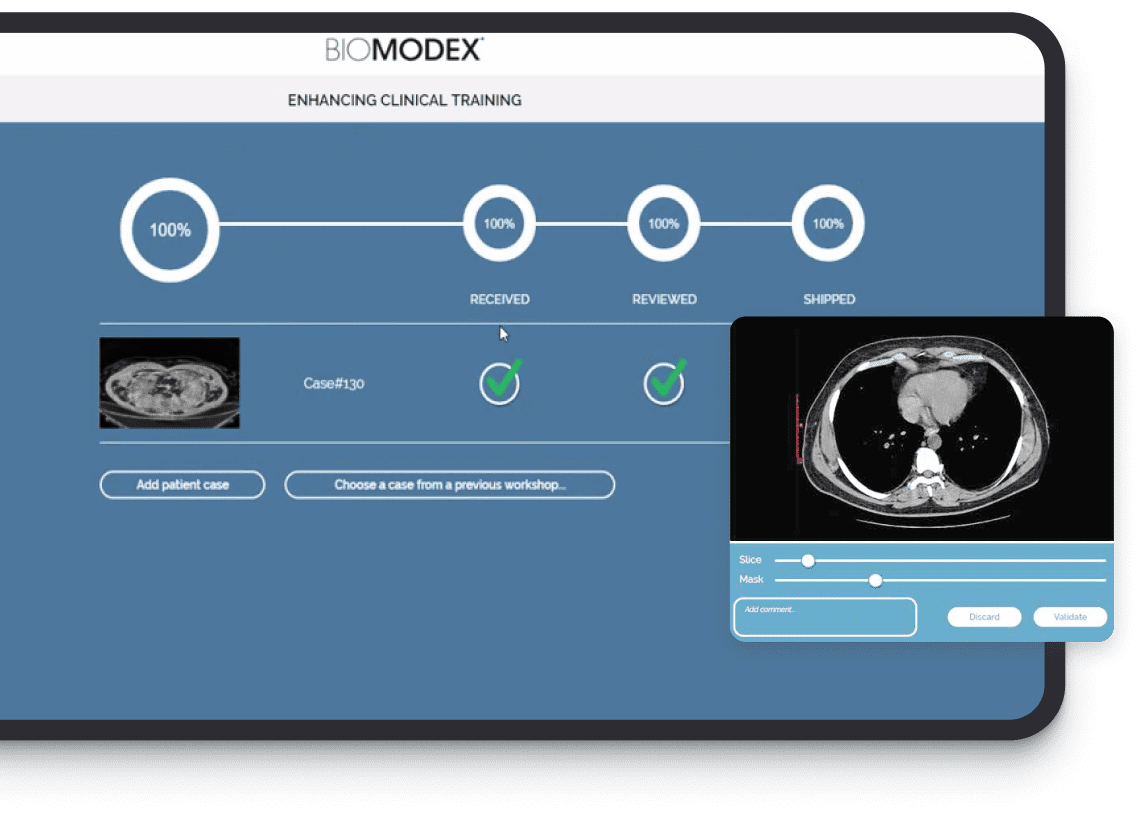
Consider BIOMODEX, which uses anatomical models for medical training and patient-specific rehearsal. Glorium developed software to process imaging data, select the relevant anatomy, segment DICOM images and create STL files for printing. An image becomes something a physician can practise with. That journey requires both specialist image processing and ordinary order management.
Glorium reports that the upgraded workflow converted medical imaging data into 3D models in 30 minutes. Treat that as the vendor’s reported result for this project, rather than a universal performance promise. The instructive detail is the chain of transformations: acquire, identify, reconstruct, prepare. The interface has to make those steps manageable for people doing consequential work.
Imaging data → 3D model
BIOMODEX project / Glorium-reported result
Turtle Health presents a different coordination challenge. Its at-home fertility-testing service needed patient, provider and administrative portals. Glorium’s case study says a previous supplier had struggled with code quality and deadlines. The replacement system joined intake information, ultrasound scans, blood-test results and a doctor’s review into a report workflow. A clinician validates the information.
The point is easy to miss when browsing a menu of development services. A patient portal is only one visible surface. Behind it sit orders, records, rules and responsibilities. The design problem includes deciding when the information is complete enough for the next person to act. That is a business question before it becomes a programming question.
The clipboard meets the croissant
The same problem can appear beside a tray of pastries. In an anonymous Portland bakery case, Glorium describes a cash register disconnected from inventory and accounting, custom orders held in Excel, stock tracked on clipboards, and managers reconciling shifts manually. Those arrangements had become difficult to manage as the bakery grew.
The company implemented Odoo 18 Enterprise, joining sales, inventory, production, accounting and staff planning. Its published results include 30% faster transactions and 20% less ingredient waste. These are company-reported outcomes from one unnamed client. The implementation lesson is more portable than the percentages: an order should carry its information through the kitchen and into the accounts without being repeatedly reconstructed.
- 01OrderPOS + online
- 02Recipe & stockIngredients + quantities
- 03ProductionWork + scheduling
- 04AccountsInvoice + reconciliation
Illustrative workflow, based on the bakery implementation. Each step needs the previous step’s information.
Glorium also worked on Liberkeys’ property platform, with mapping, search filters, a new interface and connections to an existing back end. Across these projects, the distinctive detail is the range of systems being connected. A medical image, a property listing and a cake recipe have very different meanings. Their software still has to carry those meanings intact.
A product born of repeated irritation
CogniAgent is Glorium’s attempt to package some of that coordination work. The product’s own history says recurring client problems became clear in 2022 and 2023: limited chatbots, voice tools losing context, and workflows that needed a developer whenever the business changed. It dates architecture work to 2024 and public launch to 2025.
The proposed solution combines conversations with actions. A business can configure an agent to collect details, qualify an enquiry, arrange a next step and update a record. The product places conversational agents, background agents and structured workflow logic on a visual canvas. That is its positioning; whether it suits a particular operation depends on what the operation actually requires.
The difference becomes concrete in the handoff. CogniAgent describes passing a conversation to a named person with its context attached, then continuing after that person responds. Its workflow material also describes explicit branches and execution logs. For a buyer, those details deserve more attention than a pleasing demo conversation: who approves an exception, and what record shows that it happened?
A September 2026 announcement says the team will demonstrate CogniAgent at the World Aviation Festival in Lisbon on October 13-15. As of this profile’s publication, that visit is still ahead. It is a useful indication of the product’s direction: taking a platform developed around business operations into another industry full of requests, approvals and transactions.
Three ways to buy the work
Glorium’s business model gives customers several entry points. A company can buy delivery of a software project, add specialists to its own team, or engage a dedicated development team. ERP implementation adds configuration, migration, training and support. CogniAgent introduces a separate software purchase, charged through usage credits and negotiated enterprise arrangements.
Published prices provide some scale. Glorium’s Odoo page lists a US and Australia Start Pack at $2,700 for 30 hours, and a Business Pack at $3,500-$14,000 for 50-200 hours. Clutch’s broader company profile lists a $25,000 minimum project size and $50-$99 hourly rates. These describe different scopes; the modest implementation package should not be mistaken for the budget of a bespoke clinical platform.
| Purchase | Price signal |
|---|---|
| Odoo Start Pack | $2,700 / 30 hours |
| Odoo Business Pack | $3,500-$14,000 |
| Custom services on Clutch | $25,000+ minimum |
| CogniAgent credit purchase | From $10 |
Published offers checked October 2, 2026. Odoo figures shown for US/Australia. Scope, licenses and third-party services affect the final budget.
CogniAgent currently starts free and sells credit packs from $10. Its pay-as-you-go model adds 12.5% to underlying language-model provider rates; connected communication providers bill their own channel costs. The pricing page says executions stop when the credit balance reaches zero. A pilot therefore needs an operating budget as well as a working flow.
Glorium’s alternative is not always another development firm. Sometimes it is an internal hire, a simpler off-the-shelf tool, or a different ERP partner. Its appeal lies in spanning those boundaries. Inc. independently records four consecutive Inc. 5000 appearances from 2020 through 2023, evidence of a growing service business during those years, rather than proof that every proposed project will work.
Start with the troublesome handoff
The practical move is to bring one troublesome process to the conversation. Show where information originates, where it is copied, who decides, and what counts as finished. Establish a baseline: turnaround time, re-entry work, or reconciliation effort. Then ask which parts need configuration, which need integration, and which truly need new code.
This approach needs someone inside the customer’s business who can settle those questions. If the process changes daily, the data is unreliable, or nobody owns exceptions, a more capable platform can inherit the confusion. A small team with a straightforward requirement may be better served by a standard application. Complexity should earn its place in the budget.
Glorium’s stated values include shared success, earned trust and long-term thinking. Buyers can turn those attractive nouns into specific commitments: access to progress, clear responsibilities, maintainable integrations and support after launch. The company’s own slogan puts it neatly: “Your Product. Your Idea. Our Innovation and Engineering.” The product still belongs to the customer, along with the responsibility to know what it must do.
The useful thought to take away is pleasantly unglamorous. Follow the work. Somewhere between the first request and the final record, a person may be doing the same small repair twenty times a day. That is a sensible place to start a software project.