An airport departure board can be perfectly illuminated and still be useless. The problem is the information arriving behind the glass. In a published Intagleo Systems case study, an airport’s flight updates took as long as eight minutes to reach its displays. Three separate systems had to be managed. A gate change could become a small administrative expedition.
Intagleo says it connected 340 screens through a common content platform and integrated the airport’s operational database. Reported update time fell to 23 seconds. These are the company’s figures, but the problem they describe is wonderfully concrete: passengers need to know where to go, and staff should not have to persuade three computers to agree.
That is a useful entrance to Intagleo, a custom software and outsourcing business whose catalogue stretches from phone applications to industrial devices. The connective work is the interesting part. It sells engineering for organisations with existing operations, existing customers and very little appetite for stopping everything while the software catches up.
The screen is the easy part
Digital signage gives Intagleo a more distinctive identity than a list of programming languages could. Its offering covers the software that schedules content, runs players, manages devices and checks what actually appeared. A display network has to keep behaving after someone has approved the attractive mock-up.
The company describes local caching and offline playback, remote updates and device monitoring in its signage practice. Those details matter because a disconnected screen still needs something sensible to show. An operator also needs to distinguish a missing advertisement from a dead device or a broken connection.
There is a physical-world extension to this work. Intagleo’s embedded engineering services encompass firmware, industrial communication protocols and device-management platforms. Information must travel from equipment to a usable application. The company offers work at several points along that route, including sensor processing and cloud connections.
For buyers, that breadth is a reason to examine relevant projects closely. A polished website portfolio alone says little about managing devices in the field. The useful question is whether the proposed team understands the equipment, the network and the person responsible when either misbehaves.
Repairing the aircraft while it flies
Intagleo’s legacy-software pitch addresses another uncomfortable setting: a business still depends on a system its engineers struggle to change. In its DataSync Pro account, a 500,000-line application had eight-week feature-release cycles and failures that could spread through the product. The company describes a 2023 outage costing the client $2 million in revenue.
The proposed full rewrite was estimated at more than $5 million and two to three years. That estimate explains the appeal of smaller steps. Intagleo describes an eight-month migration that first established infrastructure, then extracted notifications, followed by other services, before stabilisation and training.
Its reported feature-deployment interval fell to three days. The lesson to copy is the sequence: select a bounded first change, prove it works, then expand. Those rewrite figures describe an alternative under consideration, not Intagleo’s invoice. The sequence also assumes the business can support old and new components during the transition; a divided architecture brings its own operating work.
The customer is buying a working process
Named customer reviews bring the scale down to earth. Faith Journey’s founder, Kent Ezell, reviewed website and mobile development for student portfolios. Datahoist reviewed a Blazor application for industrial IoT data. These are specific working tools, serving different kinds of users.
“They’re good at figuring out what I want and then delivering it in a timely manner.”
Kent Ezell · Faith Journey · September 2023
Both published Clutch reviews award five stars. Two reviews give a narrow window into delivery, rather than a company-wide performance measure. The directory also lists a minimum project size of $100,000 and an hourly rate below $25. Treat these as listing parameters for a sales conversation; a project’s staffing, duration and support obligations determine the actual bill.
An Intagleo Salesforce case study makes the operational need particularly recognisable. A US client had complex products and a growing sales operation. Intagleo describes moving manual Excel work into Salesforce Sales Cloud, CPQ and billing processes, with approval workflows and more structured pricing.
The attraction is mundane in the best sense. A salesperson should be able to assemble a valid quote without becoming the company’s unofficial database. Rules about bundles, discounts and approvals belong in a process colleagues can inspect and repeat. Custom development earns its place when the peculiarities of that process justify the work.
Seven systems, one awkward audit
Another company-published case study describes Kellbridge’s employee learning systems: 18,000 people across 12 countries, with seven platforms and manual reporting. The immediate headache was proving who had completed which requirements. A reported £340,000 regulatory fine made that weakness expensive.
Intagleo says it built a shared platform with role-and-country training rules, localised content and automated reporting. It reports annual learning and development costs moving from £2.1 million to £1.2 million. That is an operating-cost comparison, not a disclosed implementation price.
The case illustrates a useful buying distinction. Delivering a course and maintaining reliable evidence that someone completed it are different jobs. The proposed solution also depends on people keeping the training requirements and localised content correct. Software can organise an approval process; it cannot supply the missing institutional judgement.
A hiring product of its own
Services companies often promise they understand product ownership. Intagleo has a tangible example to point to: IntVue, its browser-based interview platform. The company labels it a live product, established in 2020. Candidates can record responses, while hiring teams schedule interviews and review recordings together.
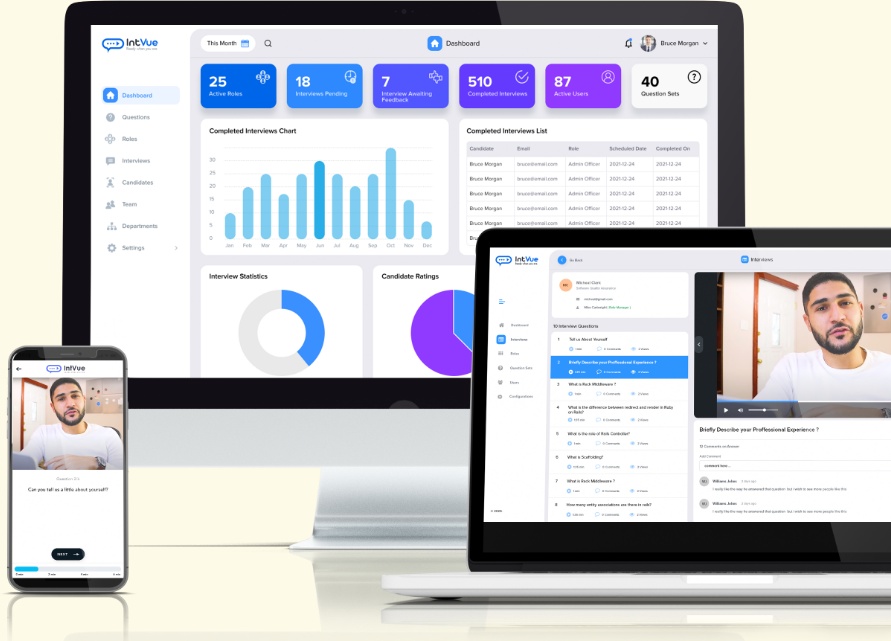
The current product page advertises AI-assisted recommendations, transcription and scoring. For an employer, the immediate practical benefit is asynchronous review: colleagues can inspect the same response without assembling another meeting. The scoring features require their own evaluation against the employer’s selection criteria.
IntVue also reveals where the catalogue ends and the roadmap begins. The same page lists an onboarding agent, a smart-signage product and an AI-powered HR system as in development. A proposed launch quarter should not be confused with a tool a customer can already use.
Rent the expertise, define the ownership
Intagleo’s commercial model gives buyers several entry points. Its cloud practice offers an infrastructure assessment and roadmap, a platform-build engagement, or an ongoing DevOps team. The recurring work includes release pipelines, monitoring and operational improvements. A deployment is the start of a maintenance obligation.
Its staffing service takes a different route: match specialists to an existing team and embed them in the client’s workflow. The company describes client interviews before selection and integration into tools such as Slack and Jira. That makes sense for an organisation that has direction and management capacity but needs additional engineering hands.
The market alternatives follow from those choices: hire internally, commission another consultancy, or adapt a packaged product. The comparison should start with responsibility. Who decides what gets built? Who handles incidents? Who can maintain the result after the original team leaves? An attractive hourly number answers none of those questions.
Intagleo also markets itself to US public-sector buyers and prime integrators, offering modernisation, cloud work and proposal support. Its stated work-for-hire approach places intellectual property with the customer. This is a specialist-supplier position: contribute engineering to a larger delivery arrangement while the prime retains the client relationship.
AI joins the maintenance rota
The company’s AI offering includes language-model applications, document processing, predictive analytics and computer vision. More revealing than the catalogue is the proposed progression: examine a workflow, test a prototype against real data, prepare it for production, then monitor it.
Intagleo explicitly includes model monitoring and retraining in that work. An AI feature becomes another system somebody owns. Access controls, integration with existing software and the quality of incoming information remain part of the assignment after the demonstration has ended.
For a buyer, a sensible first brief would identify one repeated task, a representative set of examples and a way to judge errors. That is an editorial inference from the service design, not a promise of savings. Where the task is poorly defined or the underlying information cannot be trusted, adding a model leaves those problems waiting downstream.
The people behind the handoff
Intagleo’s homepage dates its work to 2004, and the UK company register records incorporation in October 2007. Its public footprint spans the UK, US, UAE and Pakistan. This is an established services operation dealing with successive generations of enterprise technology.
Its stated delivery principles put weight on continuity: engineers who scope the work should remain involved, clients should receive weekly updates, and documentation should support handover. The careers page promotes direct ownership and flexible working. These are employer commitments worth testing in a project conversation.
There is a more personal glimpse in former employee Anum Jeelani’s public farewell after five years. She credited CEO Amar Ali and COO Muhammad Aamir Chaudhry with support and guidance. One employee’s account cannot describe every desk, but it gives the organisational promises a human reference point.
The strongest reason to consider Intagleo is a recognisable integration problem and a team that can demonstrate experience solving it. Start with the delayed update, the fragile release or the quote nobody trusts. Ask the engineers to follow it through the business. That is where this company’s broad menu becomes a specific piece of work.
Keep exploring
Company website · IntVue · Engineering blog · Project stories