There is a funny problem that arrives when a family business lives long enough. At first, the surname is a promise. It says somebody is watching the work, somebody will answer the phone, somebody's reputation is stapled to the invoice. Later, the name can become a piece of furniture: handsome, inherited, and too heavy to move. Brownstein Group reached that moment at sixty-one.
In October 2025, the Philadelphia company renamed its advertising practice Born and Raised. The parent remained Brownstein Group. The family remained in charge. But the creative shop joined three siblings whose names explained their jobs more readily: Red Thread PR, Nucleus Digital, and Poster Child. A surname that once described everything now sat one floor higher, connecting the parts.
CEO Marc Brownstein admitted that names like his father's once carried a competitive advantage in advertising. The market had changed. His reported hesitation was not about whether the old label confused people. It was about telling Berny Brownstein, who had opened the shop from his Mt. Airy home in 1964. That is the useful detail. Reinvention becomes real when the person who benefits most from tradition chooses clarity over sentiment.
“At that time, and for years afterwards, marketers' names provided a competitive edge. Times have changed.”Marc Brownstein, CEO
One roof, four front doors
Brownstein sells coordinated specialist judgment to other businesses. Media, enterprise work, and social campaigns are the broad territory; the sharper distinction is in how the labor is organized. Brands can buy the part they need, or assemble a team across the network.
Born and Raised
Brand strategy, advertising, production, content, and experiences.
Red Thread PR
Reputation and communications across paid, earned, shared, and owned media.
Nucleus Digital
Media buying, paid search, programmatic, CRM, automation, and analytics.
Poster Child
Creator relationships, brand partnerships, and influencer integration.
The arrangement answers a recurring complaint about “full service.” When one agency claims to be equally good at everything, the client has no easy way to tell where expertise ends and coordination begins. Brownstein turned capabilities into named shops. Each gets a sharper pitch and its own leadership; the group supplies the shared memory and the introductions.
The business makes money the conventional agency way: retainers and project fees for strategy, campaigns, media, public relations, and production. It publishes neither a rate card nor campaign budgets. Scale comes less from offices than from assembly. For work beyond its home market, Brownstein uses Worldwide Partners, a network of more than 90 independent agencies. This is global reach by federation, not by acquiring buildings full of matching letterhead.
The work starts with the thing people already feel
The best Brownstein cases share a small piece of mischief: they do not begin with the medium. Wawa wanted a ten-week push for specialty beverages. Brownstein invented “Siptopia,” a cheerful imaginary world deployed through television, radio, outdoor, in-store signs, shirts, and social media. The important number was not impressions. Sales beat Wawa's target by 58 percent.
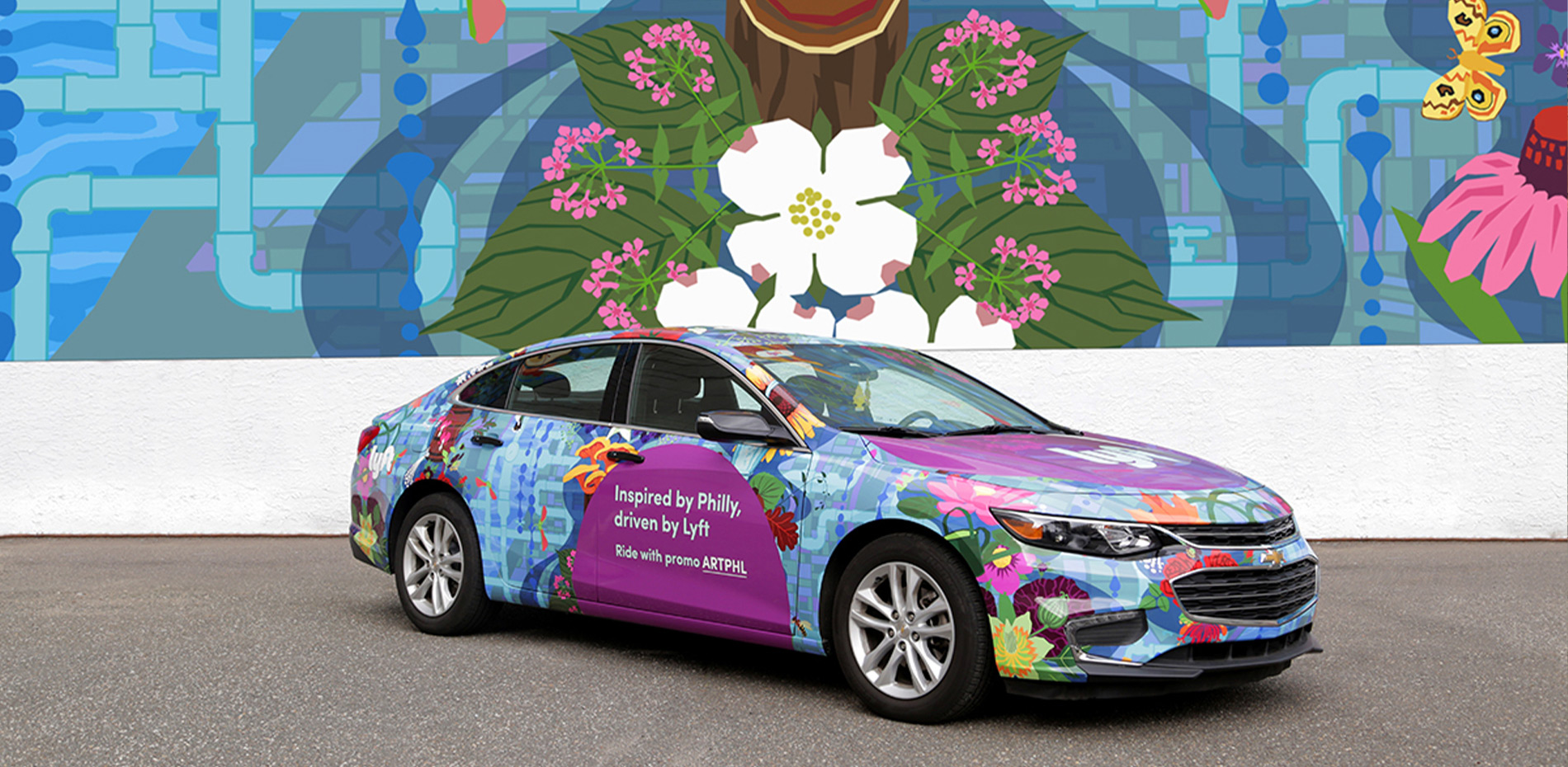
For Lyft, the problem was local legitimacy. Another launch ad would merely announce that a large technology company had noticed Philadelphia. Brownstein instead proposed Mural Arts Philadelphia. Four cars wore two murals. Flatbed trucks circulated eight others. A ride code discounted trips to art destinations. The stunt created one million impressions in four days; the wider two-year program produced 13.5 million.
For PREIT, the enemy was a phrase: “retail apocalypse.” Brownstein did not try to outshout it. The PR team attached the mall owner's transformation story to live news cycles, from fitness to teenage shoppers to holiday retail. Over four years, the work secured more than 860 placements. After the first year, earned-media impressions were up 50 percent. At the Fashion District Philadelphia opening, 132 placements landed within ten days of launch and 150,000 people visited over four days.
The pattern is portable. Find the belief already lodged in the audience's head - drinks are a summer treat, murals belong to Philadelphia, malls are dying - and change the relationship between brand and belief. The channel comes second. This sounds obvious. Many campaign decks reverse it.
The first thing to fail was the umbrella
Brownstein's history is a record of useful containers wearing out. Several mergers and spin-offs ran through the 1970s. Public relations became a formal practice in 1994. WebFingerprint arrived in 1999, became Fingerprint Interactive in 2005, and gave way to a more focused digital model when Nucleus launched in 2013. Red Thread separated PR in 2022. Poster Child made influence explicit in 2023. Born and Raised completed the set in 2025.
- Berny starts the agency at home; Stanley's Cadillac is client number one.
- AND1 becomes the first client of a new PR practice.
- Interactive work gets its own division, WebFingerprint.
- Nucleus Digital opens as a digital-first performance shop.
- Red Thread PR and Poster Child turn specialties into brands.
- The core advertising agency becomes Born and Raised.
What changed the company's mind was not one spectacular failure. It was accumulated ambiguity. A legacy name had become less informative just as clients were asking for more specialized skill. The answer was organizational editing: keep the parent, sharpen the children.
What another company can borrow
- Name specialist units for the problem they solve, not the org chart that owns them.
- Keep shared relationships and operations where they create leverage.
- Lead campaign planning with an audience belief, then choose channels.
- Publish outcome metrics that a client recognizes: sales, visits, qualified coverage.
There are limits. The model needs enough recurring demand to support genuine specialists; four logos wrapped around the same generalists would be theater. It also suits clients that value coordination and brand stewardship. A buyer seeking the cheapest self-serve media execution will find extra machinery. And Brownstein's international offer depends on partner agencies, which makes briefing and quality control part of the product.
History becomes a tool, not a shrine
Brownstein's market position sits between a local independent and a global network. It has Philadelphia texture, family ownership, national clients, and an international alliance when the assignment travels. Competitors can offer deeper single-channel specialization or vastly larger footprints. Brownstein's wager is that a brand would rather buy senior attention from connected specialists than navigate a holding company.
That wager is credible because the firm has been rewriting itself for decades. In 1981, it moved into 215 South Broad Street on April Fool's Day. It is still there. The address stayed. Almost everything inside the address changed.