Brock Fay earned a starting catching position as a walk-on at the University of New Hampshire. Then the university eliminated its baseball program. Two seasons into his college playing career, the team itself disappeared. The interruption belongs near the beginning of his story because it gives that familiar executive word, adaptability, something solid to stand on: a player who still wanted to play, suddenly without his college program.
The next opening came through another person. A teammate connected Fay with Scott Bleakley, the longtime coach of the Kingston Night Owls. Fay joined the North Shore Baseball League in 1997 and played 15 seasons with the club. In 2016, he entered the league’s Hall of Fame. There is a pleasing economy to that sequence. An institution closed a door; a teammate supplied a name; a new team supplied years of baseball.
Today, Fay is the chief executive of Onspire Health Marketing and is based in Greater Boston. The title places him at the front of a business assembled from several established agencies. His sporting history places him somewhere else: behind the plate, wearing the equipment, participating in a game that depends on people doing different jobs at the same time. Those are two separate chapters. Read together, they make an interesting portrait of an executive whose career involves putting working teams together.
An announcement is a date. Integration is a stretch of time.
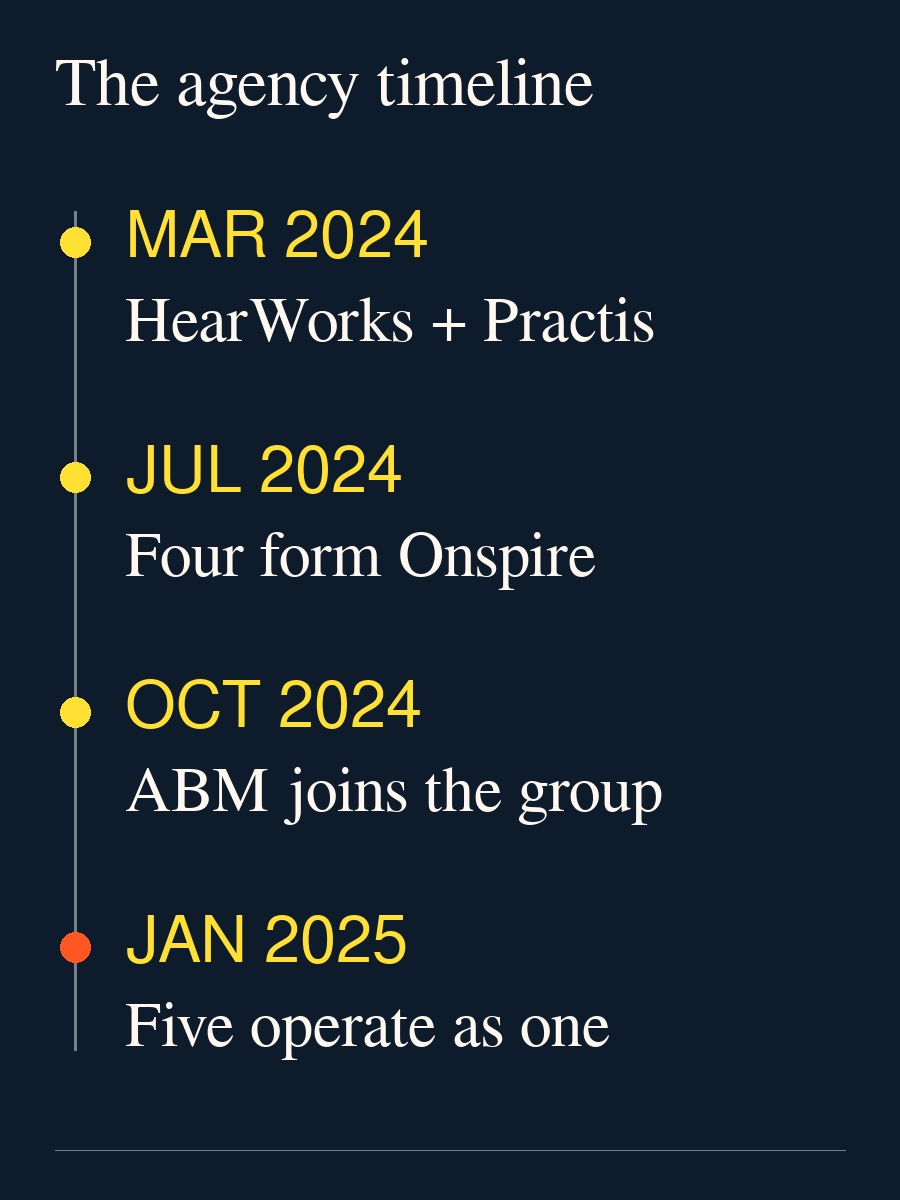
On July 11, 2024, Practis announced the formation of Onspire. The new organization brought together HearWorks, MedPB, Practis, and Dobies Health Marketing. Fay was named as its CEO in the announcement. Four businesses had acquired a common corporate identity, with additional companies expected to join. The proposition was practical: digital work, strategy, branding, and advertising could sit inside the same organization, rather than arrive as separate answers from separate firms.
A date is useful for a company announcement. It lets everyone put a pin in the calendar. It is less useful for describing the work on either side of that pin. There are relationships to carry forward, responsibilities to clarify, and a shared offer to explain. The interesting question in Fay’s chapter at Onspire is how those separate histories become a service that a client can understand and use. A new name gives the project a visible surface; the organization beneath it still has to function.
In January 2025, the business announced that five legacy agencies were officially operating together. ABM had joined the original four. The integration announcement also said the teams had been aligning operations since early 2023. These milestones tell a more useful story than a single launch date. There was preparatory work, a public formation, an expanded group, and then an announcement of completed integration. Corporate biographies often flatten all of that into one verb. Here, the calendar deserves to keep its distinctions.
The fifth name on the team sheet
Fay was already speaking as CEO of Practis in March 2024, when the company announced its acquisition of HearWorks. That transaction added marketing and database automation capabilities. In welcoming the company, he singled out its client-focused culture as well as its reputation and innovation. Culture is a broad word, but its appearance alongside capabilities is telling. An acquisition brings people and ways of working into the same room as technology and services.
By October 2024, Onspire had acquired Aesthetic Brand Marketing, or ABM, an interactive web design and marketing agency. Its staff were to remain in place. The point is small enough to disappear beneath a transaction headline, yet substantial enough to matter to the people involved. A business may change its corporate home while retaining the people who know its clients and its work. That continuity is part of the actual acquisition story, even when the new company name gets larger type.
The five-agency structure gives Fay’s job a particular shape. He is leading a combination of existing businesses, each entering with its own experience. The challenge can be described without borrowing the grand language of a merger announcement: make the range of services easier to access, make the teams easier to work with, and give the combined business a reason to exist beyond the arithmetic. Five names can fit comfortably on a slide. A functioning organization asks considerably more of everyone.
The name had to earn its place
Onspire’s brand was itself a project. Fay worked with Laura Dartnall and the team at JOHN LUKE on a naming and identity process for the combined business. In his account of the engagement, research, testing, and analysis helped bring the strengths of four companies into a shared brand story. Naming came with visual design, guidance, and execution. The sequence matters: a common identity was developed through a process, rather than simply selected as a decorative finishing touch.
An agency combining other agencies has a mildly comic burden. It sells clarity, so its own identity ought to survive a basic question: what do all these people do together? The answer must work for clients and for the people delivering the services. A fine logo can make a meeting deck look composed. It cannot conduct the meeting. Fay’s comments about the branding assignment keep returning to the work of identifying strengths and expressing them coherently.
He also described positive employee feedback about the branding team and said the executive team looked forward to their meetings. That is a specific detail in a story otherwise populated by corporate milestones. People sat with outside collaborators, offered input, and reacted to what came back. It gives the new identity a social history. Before a brand appears in public, it has to travel through conversations with people who will spend their working days representing it.
“The end result is a fresh, inspiring brand”Brock Fay, on the Onspire branding project
What he notices when someone else does the work
Fay’s earlier role at ProHealth Partners included the title Chief Business Development Officer. In a testimonial for Stratabeat, he praised the agency for taking time to understand the business, its culture, and its market. He also highlighted communication and execution that kept the project on schedule and within budget. These are ordinary measures, which is precisely why they are revealing. They describe what a client can observe while a project is happening, rather than what a firm can promise before it starts.
“Throughout the process, communication was excellent,” he said. The appeal of that sentence is its modest scope. It points to a working relationship. Anyone who has waited for an answer while a deadline approaches will recognize why the detail matters. Creative work can be judged by the finished product, but the route to delivery has its own consequences. A clear update can save a decision. A missed update can turn a manageable question into an afternoon of guessing.
Read beside his later branding comments, the testimonial offers a consistent set of things he chose to praise: understanding the assignment, listening to the people involved, communicating, and completing the work. That is an observation about his public feedback, rather than a claim to know his private temperament. It also makes the agency CEO’s position more concrete. Before speaking for a combined marketing business, he had been on the client side describing what useful agency work felt like.
A second scoreboard
Fay earned an MBA at Suffolk University; his LinkedIn profile lists the Sawyer School of Management from 2002 to 2004. His undergraduate institution was the University of New Hampshire. Education adds another strand to a career that includes sales, account management, and operations at CareScout. Those functions place different demands on an executive: winning business, maintaining a relationship, and helping the organization deliver. A customer’s experience passes through all three, whether the internal organization chart makes the handoffs visible or not.
His public professional record also includes a board seat at ProHealth Partners. Onspire’s investor, 424 Capital, lists Fay as the company’s CEO. These connections show an executive working across company leadership and governance. They do not require a mythology of the solitary builder. Boards, investors, operating colleagues, and specialist teams are part of the structure around him. The CEO title is one visible position within that structure, much as a named player occupies one place in a lineup.
The sports chapter has its own scorecard. Fay completed the 2013 and 2014 Boston Marathons and raised more than $17,000 for the Newton Boys and Girls Club. That is a result with a recipient attached. It sits comfortably beside his baseball history because it records another kind of participation: a personal event connected to a local organization. The number belongs to those two marathon efforts, rather than to an estimate of his lifetime giving.
The people between the milestones
Onspire’s leadership roster includes chief operating officer Jeff Provost, chief financial officer Paul Travers, and chief strategy officer Julie Amor. Tucker Worster leads sales and marketing as a senior vice president, while Candy Olesen directs people and culture. The list makes the combined organization easier to picture. Finance, strategy, operations, commercial work, and people each have a named leader. Fay’s role sits among these responsibilities, and the integration effort depends on work distributed across them.
The corporate record moves quickly through acquisition and formation. The baseball record moves through seasons. Keeping both tempos in view is useful. A transaction can be announced in a day; a place on a team is inhabited over time. Neither record proves that sport caused a business philosophy. Together, they show the scale of Fay’s commitments in two settings, with the emphasis falling on organizations that continue after an individual announcement or appearance.
The walk-on catcher, the Night Owls player, the marathon fundraiser, and the agency chief all belong in this portrait. There is no need to turn the mask into a management textbook. The connection is more human than that. A teammate once helped Fay find his next place to play. Years later, his work involves giving several groups a common place to operate. Between the highlight dates lies the less theatrical business of showing up, working with other people, and giving the next chapter enough time to happen.
Follow the next chapter
Explore Fay’s professional profile, the agency, and its public milestones.