The most revealing number in Brock Blake’s career is not $17 billion, the volume Lendio was reported to have helped facilitate by the summer of 2026. It is zero. Zero was the revenue Blake chose in February 2011, after deciding that a business with roughly $10 million in annual sales, 75 employees and a functioning product was solving the wrong problem.
The company was FundingUniverse. Its pitch was buoyant and very much of its era: bring entrepreneurs together with angel investors and venture capitalists. Online profiles did some of the work. “Speed pitching” events did the rest, moving hopeful founders from investor to investor like a business-school version of speed dating. There was energy in the room, and there was revenue on the books. There was also a stubborn fact.
About 98 percent of the business owners passing through were never going to raise equity. They ran restaurants, landscaping outfits and dry cleaners. Their companies could be sound, useful and loved without being built for a venture return. They did not need a dramatic pitch deck. They needed credit.
A prize with no idea attached
Blake’s route into entrepreneurship started with a peculiar vote of confidence. After studying at Brigham Young University and playing soccer there, he joined an eight-week competition run by Utah entrepreneurs Greg Warnock and Alan Hall. One hundred people applied. Twenty entered the boot camp. Five emerged with $50,000 apiece and permission to start a company, buy one, or otherwise prove the bet sensible.
The money backed the entrepreneur before the final idea. Blake used it to begin what became FundingUtah and then FundingUniverse. The progression was messy in the productive way: research, pitches, customer encounters and repeated models. By 2011, the company knew a great deal more about capital than it had at the start. Chief among the lessons was that its customers kept arriving with a need its core product could not satisfy.
The customer correction
Blake and co-founder Trent Miskin began sketching the alternative at night and on weekends. Then came the commitment. FundingUniverse closed in January 2011. Lendio launched the next month. The staff fell from 75 people to about eight. Blake later called it the most painful experience of his career. The phrase “pivot” has since acquired the weightlessness of office furniture on wheels. This was heavier. People lost jobs. Revenue disappeared. Conviction received a rather expensive audit.
One form, many doors
The new model was easier to explain. A business owner would complete one application. A network of lenders could consider it. Offers, when available, could be compared by rate, term and payment. Lendio was not trying to become the bank. It was building the connective tissue between a borrower with little time and institutions with very different credit appetites.
This distinction mattered after the 2008 financial crisis. Banks had pulled back from small-business lending while demand for capital remained. Online and non-bank lenders began to serve companies traditional institutions overlooked, but those lenders lacked the neighborhood footprint of a community bank. A marketplace could make the fragmented supply legible. Blake often described the concept through familiar consumer analogies: a Kayak or Expedia for business loans.
By July 2026, an episode of the Startup Ignition Podcast described Lendio as having facilitated more than $17 billion, with roughly $150 million then being originated each month across 6,000 to 7,000 loans and more than 75 lending partners. Scale did not simplify Blake’s advice about money. If anything, it made him more suspicious of founder folklore. He has urged entrepreneurs to establish credit when they are healthy, to understand the precedents set by an early financing round, and, when possible, to avoid raising outside capital at all.
Look for the customer the system repeatedly rejects. Ask that customer, not your cheering section, what is broken. Preserve optionality before you need it. And never confuse existing revenue with permanent product-market fit.
Customer truth, without the courtesy
Blake’s product-market-fit advice has the economy of a locker-room instruction: go directly to the customer. Friends and family are generous audiences, which is precisely the problem. They may praise an idea because they care about its author. Blake jokes that they do not want to tell you your baby is ugly. A stranger deciding whether to pay has fewer social obligations and considerably better data.
That principle explains why the FundingUniverse years were not wasted. The company had gathered a large and inconvenient sample of business owners whose behavior contradicted its premise. It took time to stop treating them as poor fits for the product and start treating the product as a poor fit for them. The distinction is tiny in grammar and enormous in payroll.
It also explains Blake’s interest in financing mechanics. On the Startup Ignition Podcast, he walked through the basic lenses lenders use - credit, cash flow and collateral - and argued that founders should arrange credit facilities while the business is healthy, not after the cash has become desperate. He discussed the lasting cost of careless cap-table decisions and why co-founder equity should be earned rather than casually gifted. The recurring theme was optionality. Clean terms leave room to move. Healthy cash flow buys time. Customer evidence prevents a team from polishing the wrong machine.
None of this is as photogenic as a fundraising announcement. It is more useful. Blake’s version of finance is not a trophy cabinet. It is a set of doors, and the operator’s job is to keep enough of them unlocked that one bad month does not choose the company’s future.
Prepared when the rules moved
In the spring of 2020, the marketplace met an event no strategy retreat had modeled. Ordinary business lending stalled while the Paycheck Protection Program materialized at speed. The federal program was new to borrowers, banks and platforms alike. Lendio redirected its operation, built a digital PPP application and formed lending partnerships within weeks.
By March 2021, the company said it had helped more than 130,000 small-business owners access over $9 billion in PPP loan approvals. The rush also exposed the confusion and strain of a program being assembled in public. Applications, guidance and documentation requirements shifted. For Lendio, the moment was both mission and machinery: years spent connecting lenders and borrowers suddenly had to carry emergency traffic.
Blake described the change in company purpose as moving from “fueling the American dream” to saving it. The line works because the infrastructure already existed. A mission without operations is a poster. Operations without a mission are merely a queue. Lendio had to run both at once.
The competitor learns to pace himself
Blake does not disguise his temperament. “I’m one of the most competitive people you’ll ever meet,” he once told Utah’s economic-development office. Soccer remains part of the explanation. BYU’s program operated without the usual Division I scholarship arrangement, and he has recalled the arithmetic of school, four-plus hours of practice and weight training, plus the need to cover tuition and living expenses. His word for the result is “scrappy.”
Yet his mature operating advice is less about endless exertion than sustainable performance. He has spoken about protecting date nights, attending his children’s activities, exercising and relying on a support system. He and his wife have four children. In another interview, he described the tension between being a serious chief executive and a present father, a contest with no quarterly victory lap.
His culture stories tend to combine competition with a deliberate soft edge. Lendio’s giving program connected employee contributions and company matching with microloans through Kiva. One Christmas, team members received two $100 bills: one to spend on an experience with people they loved, and another to give to someone who needed it more. Employees later shared what happened. The gesture converted an abstract value into a small assignment with faces attached.
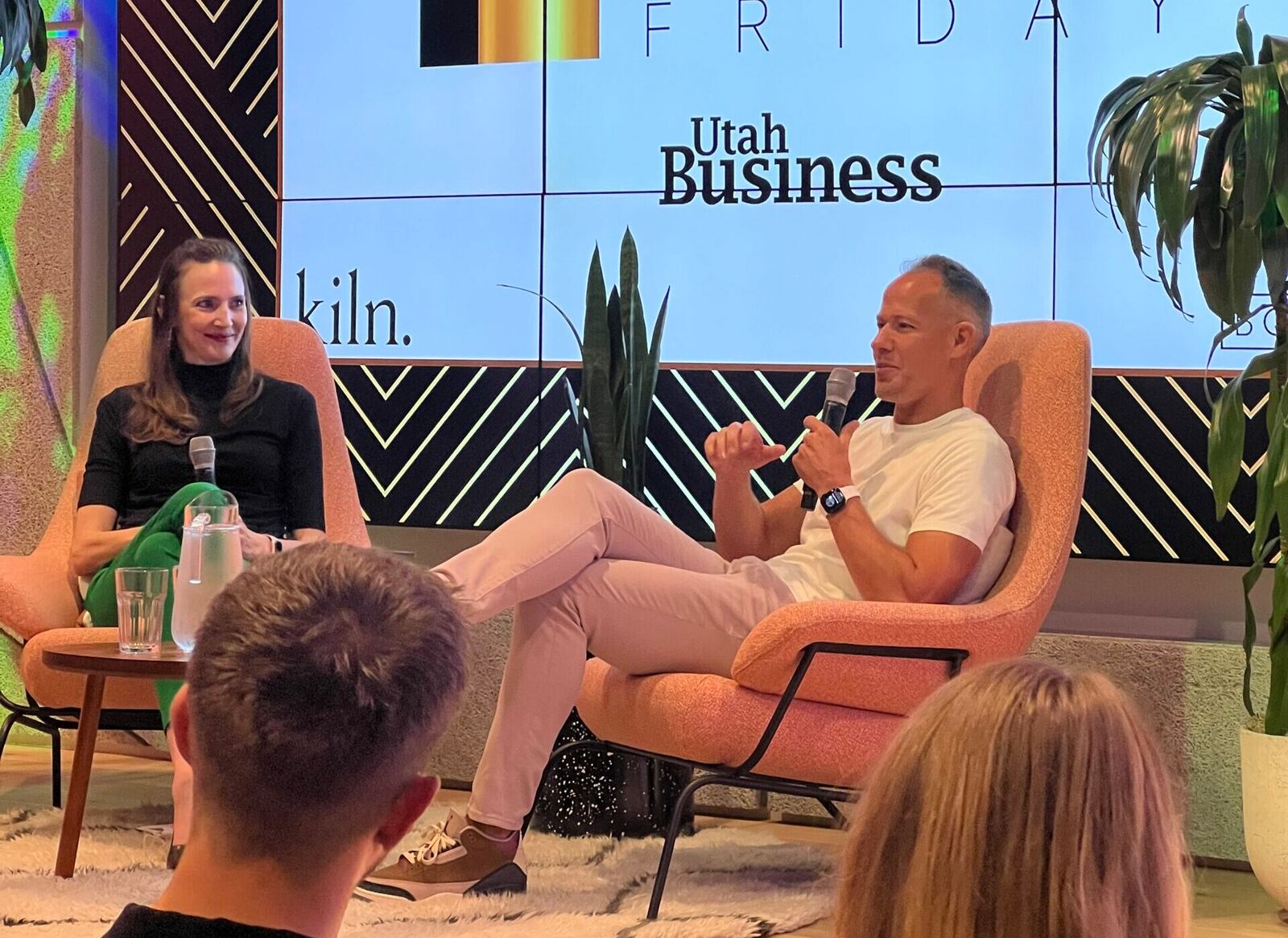
Blake’s awards arrived after the difficult chapters: an EY Entrepreneur Of The Year 2020 Utah Region honor shared with Miskin, then a Utah Business CEO of the Year recognition in 2021. Useful decorations, certainly. But the more instructive artifact is still that 2011 drop to zero. It shows a founder willing to let evidence humiliate momentum.
The next application
Lendio’s current chapter is about adding software and artificial intelligence to a lending marketplace old enough to have memories. Blake has framed the opportunity around more frictionless, transparent access to credit, with data and AI improving judgment and consistency without erasing the human connection. The wording is careful. A borrower does not experience “fintech” as a category. The borrower experiences a form, a wait, an offer, a rejection, a cost and the consequences.
That brings the story back to its original customer correction. Technology mattered because the restaurant owner could not spend a week visiting ten institutions. The marketplace mattered because one lender’s no might coexist with another lender’s yes. AI will matter only if it makes that passage clearer, quicker or fairer for the person at the other end.
Blake once advised would-be entrepreneurs to enter the work with their eyes open and to “Enjoy the Ride.” It is cheerful counsel from someone who knows the ride includes layoffs, dilution, moving rules and a chief executive’s private inventory of company problems. Enjoyment, in this telling, is not ease. It is the privilege of staying alert enough to recognize the wrong destination - and competitive enough to turn the vehicle around.